Summer practice 2014 Detection of charge particles generated in - - PowerPoint PPT Presentation

summer practice 2014
SMART_READER_LITE
LIVE PREVIEW

Summer practice 2014 Detection of charge particles generated in - - PowerPoint PPT Presentation

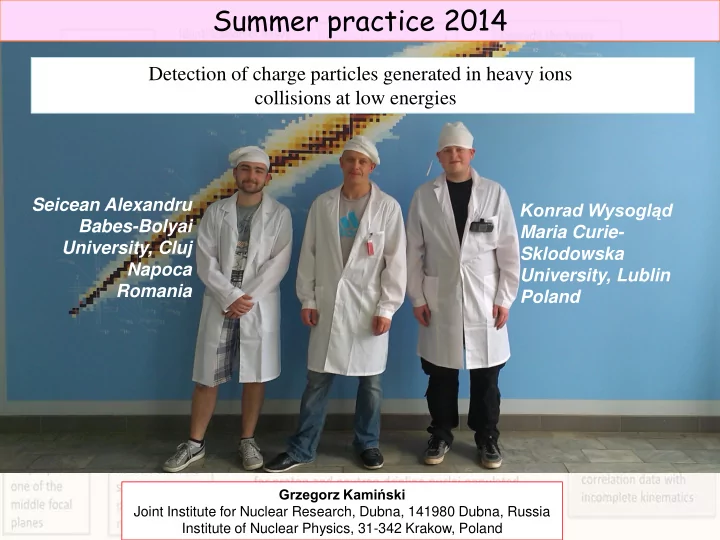
Summer practice 2014 Detection of charge particles generated in heavy ions collisions at low energies Seicean Alexandru Konrad Wysogld Babes-Bolyai Maria Curie- University, Cluj Sklodowska Napoca University, Lublin Romania Poland


slide-1
SLIDE 1

Grzegorz Kamiński Joint Institute for Nuclear Research, Dubna, 141980 Dubna, Russia Institute of Nuclear Physics, 31-342 Krakow, Poland

Summer practice 2014

Seicean Alexandru Babes-Bolyai University, Cluj Napoca Romania Konrad Wysogląd Maria Curie- Sklodowska University, Lublin Poland

Detection of charge particles generated in heavy ions collisions at low energies

slide-2
SLIDE 2

Area of study at ACCULINNA

light exotic nuclei, especially ‘super heavy’ hydrogen (5,7H) and helium (8,10He) isotopes proton emitting nuclei

slide-3
SLIDE 3

ACCULINNA separator

typical beams delivered from the U−400M cyclotron:

6,7Li,11B,18O @ 33 AMeV, 20Ne, 32S @ 50 AMeV

main parameters Max magnetic rigidity 3.6 Tm Solid angle 0.9 msr H/V acceptance 20/14 mrad Momentum acceptance 4.2-8.4 %

3H(8He,p)10He

Primary reaction

11B(33AMeV)+9Be -> 8Be+frag

slide-4
SLIDE 4

Key equipment of the ACCULINNA separator

Cryogenic tritium target system & correlation measurements Stilbene detectors & developement of 64-modules neutron array Optical Time Projection Chamber (OTPC) at ACCULINNA (collaboration with University of Warsaw) OTPC Cryogenic tritium target cell stilbene detectors crystal size 80( ) x 50 mm3

DEMON modules

6,8He

p

6,8He 6,8He

n

Veto detector Si telescope

3H target

10 cm

3 8 10

H( He, ) He p

8,10He

3 6 8

H( He, ) He p

proton telescope

n

8,10He

beam

3.1 m

slide-5
SLIDE 5

AMP S.C.A HV 600V= PMT CsI(Tl) γ PK

CsI(Tl) detector – how it works?

M.C.A PC Software

1.17 1.33 MeV 60Co

TTL

slide-6
SLIDE 6
slide-7
SLIDE 7

CsI(Tl) detector

slide-8
SLIDE 8

CsI(Tl) example spectra

slide-9
SLIDE 9

Optical Time Projection Chamber (OTPC)

Digital photography of single decay events A new type of ionization chamber with optical readout (OTPC) dedicated to studies of exotic and rare nuclear decays.

What is OTPC ?

OTPC – developed at the Warsaw University. The idea has come from M. Pfϋtzner and W. Dominik .The goal was to build the detector for direct observation of 2p emission from 45Fe .

slide-10
SLIDE 10

OTPC – How does it work?

slide-11
SLIDE 11

OTPC – How does it work?

slide-12
SLIDE 12

OTPC – How does it work?

Gas Electron Multiplier (GEM) foils

slide-13
SLIDE 13

OTPC – How does it work?

slide-14
SLIDE 14

OTPC – How does it work?

slide-15
SLIDE 15

OTPC – event reconstruction

slide-16
SLIDE 16

OTPC – main view

  • M. Ćwiok et al., IEEE TNS, 52 (2005) 2895
  • K. Miernik et al., NIM A581 (2007) 194

CCD 2/3’’

  • 512 512 pix
  • 14-bits
  • image ampl.

( 1200) PMT 5’’

HI

gas pressure (1atm) :

slide-17
SLIDE 17

OTPC – example picture

48Ni

p p

48Ni 48Ni 2p

2p p p picture from CCD time profile of pmt signals

OTPC is very effective for investigations of rear decay branches of exotic nuclei in a wide halflife time (1 1000 ms)

slide-18
SLIDE 18

LISE++

slide-19
SLIDE 19

LISE++

slide-20
SLIDE 20

Thank you for your attention! 