- N. C. Department of Environment and Natural Resources
Summary of Federal Response and State Response at CTS Site Buncombe - - PowerPoint PPT Presentation
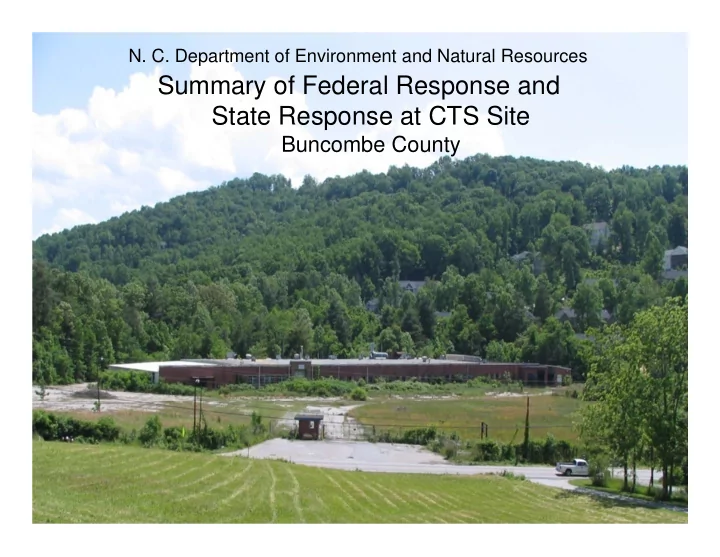
N. C. Department of Environment and Natural Resources Summary of Federal Response and State Response at CTS Site Buncombe County DENR Division of Waste Management (DWM) DWM consists of four sections and one program: Hazardous Waste
DENR Division of Waste Management (DWM)
- DWM consists of four sections and one
program:
– Hazardous Waste Section – Solid Waste Section – Underground Storage Tank Section – Superfund Section – Brownfields Program
2
Superfund Section
- Site Evaluation and Removal Branch (SERB)
- Federal Remediation Branch
- Inactive Hazardous Sites Branch (IHSB)
- Special Remediation Branch
3
Federal EPA Criteria
- National Priority List (NPL) Site
– Must score above 28.5 using Federal Hazard Ranking System (HRS) – 37 NPL Sites being cleaned up in North Carolina
- Removal Action
– Remove imminent threat to human health and the environment at sites that require emergency action or that have contaminant releases that exceed Removal Action Levels – Average of 8 EPA Removal Actions per year in North Carolina
4
Inactive Hazardous Sites Branch (State DWM)
- The state Inactive Hazardous Sites Branch
(IHSB) addresses sites that do not meet Federal Criteria for NPL Listing or EPA Removal Action
- 1,916 open sites in DWM IHSB Inventory
– (not including preregulatory landfills)
- 319 Ongoing Assessments/Cleanups including
Priority Sites and Registered Environmental Consultant Program sites
5
CTS Site Overview
- Operated from 1953 to
- 1985. Electroplating of
electrical components
- Originally a 66 acre
property, 37 acres redeveloped to residential (Southside Village, built with municipal drinking water lines)
- Trichloroethylene (TCE) in
groundwater has impacted seven residential water supplies
6
The CTS Site has been addressed primarily by the Federal EPA, with concurrent work by DWM since 2007
- Federal EPA has been involved in identifying threat to off site
drinking water sources and providing alternative water to impacted
- residents. This work also supports NPL listing requirements
- EPA has also operated a soil vapor extraction system to reduce
levels of contaminants in an adjacent spring
- State DWM IHSB has been reviewing work by CTS on defining
nature and extent of contaminants in groundwater at the site, primarily Trichloroethylene (TCE)
7
CTS Site History
- 1952-1959 International Resistance Company (IRC)
- 1959-1985 CTS operations on site
– Both IRC and CTS used chlorinated solvents in their plating
- peration
- Oct. 30, 1985 – EPA Preliminary Assessment conducted.
Report finds no threat to human health or the environment, but recommends follow-up site survey
- Aug. 31, 1987 – Site Assessment by Law Environmental
requested by CTS (pending sale)
8
- Dec 23, 1987 - CTS sells a 54 acre parcel to Mills Gap Road Associates
(MGRA)
- 1988 – DWM IHSB hires first staff; 1 to 3 project managers for first 10
years of the program
- June 18, 1990 - DWM SERB receives resident’s concerns of
contamination at CTS and potential drinking water well impacts
- June 18, 1990 – DWM SERB sends letter documenting those concerns
to EPA Contractor (NUS) and to EPA
CTS Site History
9
CTS Site History
- Feb. 22, 1991 – EPA contractor NUS completes Site
Screening Investigation (SSI) Report. Nearest well identified as 4,000 feet away
- March 6, 1991 - EPA forwards SSI Report to DWM with
cover letter stating that no further remedial action under Superfund is planned for the CTS site
- Nov. 30, 1993 – DWM IHSB ranks site based on existing
data
10
CTS Site History
- Aug. 19, 1997 – Mill Gap Roads Associates (MGRA) subdivides the 54
acre former CTS property. There is no requirement to notify the State of subdivision
- Aug. 22, 1997 - MGRA sells 45 acres to The Biltmore Group, retaining 9-
acre fenced plant site. Southside Village was ultimately developed on the 45 acres.
- Dec. 15, 1997 – DWM IHSB issues Order to Record a Notice of
Hazardous Substance or Waste Disposal Site
- Sept. 9, 1998 – MGRA records a Notice of Hazardous Substance or
Waste Disposal Site on deed for the 9-acre fenced plant site retained after the subdivision and sale
11
- Jul. 12, 1999 – In response to resident’s request, State
Division of Water Quality (DWQ) sampled springs on property adjoining CTS plant. First evidence of drinking water contamination
- Jul. 28, 1999 – Nine nearby potable wells sampled by
- DWQ. One well found contaminated.
- Aug. 16, 1999 – DWQ contacts DWM SERB about
contaminated springs and well. DWM SERB contacts EPA on same day for assistance with alternative water
- Aug. 23, 1999 – Bottled water supplied by EPA
CTS Site History
12
- April 2000 – EPA completed municipal water
connections to impacted residents.
- Repeated sampling of nearby drinking water
sources (1999, 2000, 2003, 2006) – No additional contaminated wells identified
- 2000 and 2010 – EPA surveyed CTS site for
buried drums
EPA Removal Actions
13
- 2006-2011 – Under EPA oversight, CTS
- perated a Soil Vapor Extraction system to
remove TCE from soils beneath the plant
- Dec. 2007 – Mar. 2009: EPA Vapor Intrusion
Study at nearby homes show results below EPA Removal Action Levels
- 2009-2011 - CTS ozone injection trial attempted
to reduce vapor emissions from springs
EPA Removal Actions
14
EPA Remedial (NPL) Program
- Five attempts to list the CTS site on the NPL:
(1985, 1991, 2001, 2006, and 2007-11)
- One-mile radius drinking water sampling (quarterly,
events since 2007) has two purposes:
- Protect residents: 5 additional contaminated
wells identified during this effort
- Support HRS Score that allows March 2011
Proposal to NPL
15
EPA 1-Mile Radius Quarterly Drinking Water Sampling
16
- DWM takes steps to solicit CTS assessment and cleanup
- f the site
- DWM IHSB oversees CTS groundwater assessment
through two phases of soil and bedrock drilling at the plant
- NC Division of Land Resources Geological Survey
conducts fracture study to support EPA’s NPL listing effort
- NC Division of Public Health (DPH) conducts a Public
Health Assessment in response to public request
NC Actions 2007 - 2011
17
- Earliest possible cleanup, either under state
authority, or under EPA authority if NPL listing successful
- Augment EPA Removal and Remedial resources
- Unified community involvement program with EPA,
Buncombe County Public Health, DWM and DPH
- Dovetail DWM IHSB site groundwater assessment
with EPA activities
- Improve information on attribution and drinking water
risk
NC Goals 2007 - 2011
18
Mills Gap Road
DWM IHSB – Phase IA Drilling
19
pandemonium DWM IHSB – Phase IB Drilling
20
Fracture Set 260-280/80 Fracture Set 260-280/80
NC DLR Geological Survey Rock Outcrop Fracture Study
21
US Geological Survey Borehole Fracture Study
22
EPA Pump Tests
23
NC DHHS Public Health Assessment
The N.C. Division of Public Health (NC DPH) was asked to conduct a comprehensive evaluation of the potential public health hazards related to contact with the contamination identified at the CTS site.
- Concentrations of trichloroethylene (TCE) observed in private wells in
1999 may have been high enough to cause adverse health effects.
- Private well data collected from 1999 through January 2008 does not
indicate the potential for adverse health effects…
- The chemical concentrations found in the outdoor air, soil, and crawl
space air were too low to cause harm.
- The evaluation of cancer rates in a 1-mile radius from the site showed
that the rates are not higher than what would normally be expected.
24
- October 2008 - Waterline
extension to The Oaks Subdivision
- 2011 - Demolition of CTS
plant building
- Active support of EPA,
DWM, and DPH efforts
Buncombe County Actions 2007 - 2011
25
- 28 Public meetings since October 2007
- NPL process includes statutory community involvement
steps
- Beginning March 2010 - Community Advisory Group
comprised of local citizens now reviews and comments on EPA/CTS investigation work plans
- As a result of 2010 EPA Inspector General office
investigation into CTS site, EPA instituted a nationwide Standard Operating Procedure for better risk communication with communities at Superfund sites
EPA Community Involvement
26
- Site proposed to NPL March 2011; Final Rule
anticipated as early as March 2012
- EPA negotiating with CTS on Administrative
Agreement for NPL Remedial Investigation and Cleanup
- EPA will continue quarterly monitoring of drinking
water in 1-Mile Radius
EPA Actions Going Forward
27
- Support listing of the site on the NPL and cleanup of site
using CTS funds
- Transition from DWM IHSB assessment to EPA NPL
Remedial Investigation/Feasibility Study
- DWM Superfund Section engineers fill Support Agency
- versight role under Cooperative Agreement with EPA at
all NPL sites
- Additional DPH Public Health Assessment required after
NPL listing
State Role Going Forward
28