Summary from last time Let f : X Y be a map of Our goal was to - - PowerPoint PPT Presentation

summary from last time
SMART_READER_LITE
LIVE PREVIEW

Summary from last time Let f : X Y be a map of Our goal was to - - PowerPoint PPT Presentation

Summary from last time Let f : X Y be a map of Our goal was to construct a functor f ! : D + (Sh( Y )) D + (Sh( X )) so that there are natural isomorphisms Hom D + (Sh( Y )) ( Rf ! F , G ) = Hom D + (Sh( X )) ( F , f ! G ) for all F


slide-1
SLIDE 1

Summary from last time

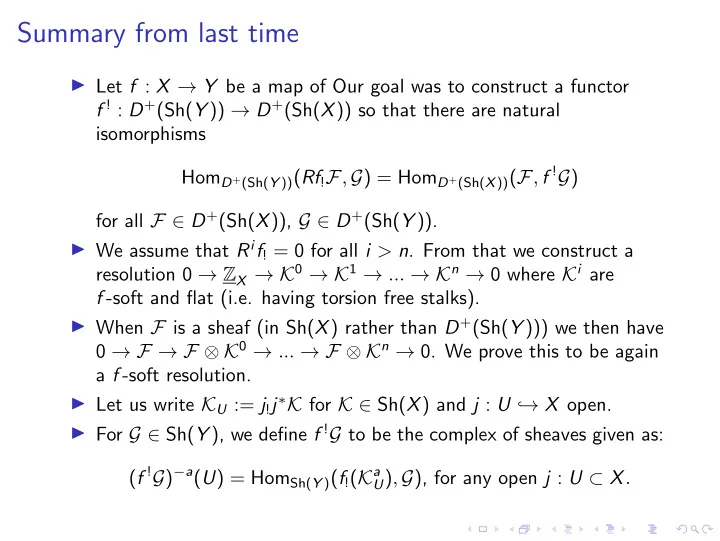
◮ Let f : X → Y be a map of Our goal was to construct a functor f ! : D+(Sh(Y )) → D+(Sh(X)) so that there are natural isomorphisms HomD+(Sh(Y ))(Rf!F, G) = HomD+(Sh(X))(F, f !G) for all F ∈ D+(Sh(X)), G ∈ D+(Sh(Y )). ◮ We assume that Rif! = 0 for all i > n. From that we construct a resolution 0 → ZX → K0 → K1 → ... → Kn → 0 where Ki are f -soft and flat (i.e. having torsion free stalks). ◮ When F is a sheaf (in Sh(X) rather than D+(Sh(Y ))) we then have 0 → F → F ⊗ K0 → ... → F ⊗ Kn → 0. We prove this to be again a f -soft resolution. ◮ Let us write KU := j!j∗K for K ∈ Sh(X) and j : U ֒ → X open. ◮ For G ∈ Sh(Y ), we define f !G to be the complex of sheaves given as: (f !G)−a(U) = HomSh(Y )(f!(Ka

U), G), for any open j : U ⊂ X.

slide-2
SLIDE 2

Proof of Verdier duality, V

(f !G)−a(U) = HomSh(Y )(f!(Ka

U), G)

◮ Why is this even a sheaf? ◮ Well, Cheng-Chiang made a mistake, and it isn’t. The reason is that Hom (−, G) rarely give a sheaf unless G is injective. ◮ So I mean, let us suppose G is injective. Now let’s prove this. ◮ Lemma The functor F → f!(F ⊗ Ka) from Sh(X) to Sh(Y ) is exact. ◮ Proof. We have seen last time that F ⊗ Ka are f -soft. Then f! is exact on f -soft sheaves. ◮ So for an open covering Ui of V and Uij = Ui ∩ Uj, we begin with

  • Zij →
  • Zi → ZV → 0.

then we have

  • f!(ZUij ⊗ Ka) →
  • f!(ZUi ⊗ Ka) → f!(ZV ⊗ Ka) → 0.

then we have 0 → HomSh(Y )(f!(Ka

V ), G) → HomSh(Y )(⊕f!(Ka Ui), G) → HomSh(Y )(f!(⊕Ka Uij), G).

This proves (f !G)−a to be a sheaf when G is injective.

slide-3
SLIDE 3

Proof of Verdier duality, VI

(f !G)−a(U) = HomSh(Y )(f!(Ka

U), G)

◮ Lastly, we have to prove that when G is injective, there is a natural isomorphism HomSh(Y )(f!(F ⊗ Ka), G)

α

− → HomSh(X)(F, f !G−a) ◮ That is to say given any φ ∈ HomSh(Y )(f!(F ⊗ Ka), G), for any open U ⊂ X we want to have a natural (i.e. functorial) and unique αφ ∈ Hom(F(U), HomSh(Y )(f!(Ka

U), G)) =

Hom(F(U), HomSh(Y )(f!(Ka

U), G)).

◮ That is, for any s ∈ F(U) and s′

V ∈ f!(Ka U)(V ) for any V ⊂ Y open,

we have to construct (αφ(s))(s′

V ) ∈ G(V ).

◮ This is evident; we just tensor s with s′

V and feed it to φ(V ).

◮ It’s easy to check all these are functorial (w.r.t. both F and G), i.e. α indeed induces natural transformations. ◮ Now we have to go back to prove that α is an isomorphism. ◮ When F = ZU for some U ⊂ X open, one checks this readily. ◮ In general, we can resolve F via such. That F → f!(F ⊗ Ka) and HomSh(Y )(−, G) are exact then gives us what we want.

slide-4
SLIDE 4

Proof of Verdier duality, VII

HomSh(Y )(f!(F ⊗ Ka), G) α − → HomSh(X)(F, f !G−a)

◮ For G ∈ D+(Sh(Y )) in general, we assume it is a complex of injective sheaves and define f !G′ to be the single complex associated to the double complex (f !Gb)a. ◮ We check that f ! so defined sends homotopic objects to homotopic

  • bjects, so that this is well-defined on D+(Sh(Y )).

◮ We claim that each (f !Gb)a ∈ Sh(X) is injective. Indeed, for F ∈ Sh(X) we have proved HomSh(X)(F, (f !Gb)a)

α

← −

∼ HomSh(Y )(f!(F ⊗ Ka), Gb)

is exact in F. ◮ We have to prove for F ∈ D+(Sh(X)): HomD+(Sh(Y ))(Rf!F, G) = HomD+(Sh(X))(F, f !G) Again, we may assume F is a complex of injective sheaves. ◮ In this case, the Rf!F in the left hand side can be computed via the f -soft resolution F ⊗ Ka, or rather the single complex associated to the double complex Fb ⊗ Ka. Things are then reduced to the pre-derived level, namely the isomorphism α we proved above.

slide-5
SLIDE 5

Sheaf Hom

HomD+(Sh(Y ))(Rf!F, G) = HomD+(Sh(X))(F, f !G)

◮ Since the Verdier duality (a.k.a. adjointness) characterize f !. We have (g ◦ f )! = f ! ◦ g !. ◮ It is desirable to have Verdier duality in fully derived and/or sheaf

  • version. Let’s prepare the notation.

◮ To begin with, for F, F′ ∈ Sh(X) we may construct Hom X(F, F′) to be Hom X(F, F′)(U) = HomSh(U)(F|U, F|U′). ◮ This is a sheaf. But warning: for the stalks Hom X(F, F′)x → Hom(Fx, F′

x) can be neither injective nor

surjective! ◮ It seems a good time to compare with F ⊗ F′, which is defined to be the sheafification of F(U) ⊗ F(U′). ◮ One readily checks that (F ⊗ F′)x = Fx ⊗ F′

x.

◮ Another remark: the usual adjoint property for Hom X reads: Hom Y (F, f∗G) = f∗Hom X(f ∗F, G) ◮ And maybe likewise (?) f ∗(F ⊗ G) = f ∗F ⊗ f ∗G.

slide-6
SLIDE 6

Derived Hom

HomD+(Sh(Y ))(Rf!F, G) = HomD+(Sh(X))(F, f !G)

◮ Viewing Hom(F, −) : Sh(X) → Ab, one may right derive it to RHomSh(X)(F, −) : D+(Sh(X)) → D+(Ab). ◮ In fact, it fits into a more general scheme of derived bifunctors, so that we have RHomSh(X)(−, −) : D−(Sh(X)) × D+(Sh(X)) → D+(Ab). We refer interested readers to [KS,§1.10]. ◮ Likewise, we have R Hom (−, −) : D−(Sh(X)) × D+(Sh(X)) → D+(Sh) ◮ Now our preferred version of Verdier duality reads RHomSh(Y )(Rf!F, G) = RHomSh(X)(F, f !G) ∈ D+(Ab). R Hom Y (Rf!F, G) = f∗R Hom X(F, f !G) ∈ D+(Sh(Y )).