Submarine Design Test & Evaluation: Challenging Cyber-Provenance - - PowerPoint PPT Presentation

submarine design test evaluation challenging cyber
SMART_READER_LITE
LIVE PREVIEW

Submarine Design Test & Evaluation: Challenging Cyber-Provenance - - PowerPoint PPT Presentation

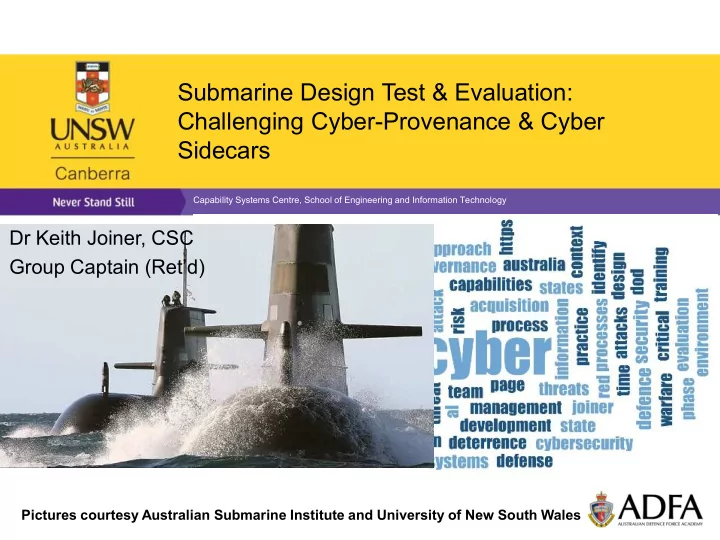
Submarine Design Test & Evaluation: Challenging Cyber-Provenance & Cyber Sidecars Capability Systems Centre, School of Engineering and Information Technology Dr Keith Joiner, CSC Group Captain (Retd) Pictures courtesy Australian

slide-1
SLIDE 1

Submarine Design Test & Evaluation: Challenging Cyber-Provenance & Cyber Sidecars

Capability Systems Centre, School of Engineering and Information Technology

Dr Keith Joiner, CSC Group Captain (Ret’d)

Pictures courtesy Australian Submarine Institute and University of New South Wales

slide-2
SLIDE 2

The challenge

Step 1 Categorise Systems Step 2 Select Security Controls Step 3 Implement Security Controls Step 4 Assess Security Controls Step 5 Authorise Systems Step 6 Monitor Security Controls Pictures courtesy Naval Group & Australian Submarine Institute Thanks to A. De Petro

  • FSM1 build start 2022, delivered 2031
  • Subsequent FSMs every 2 years
  • Submarines built in flights/batches of 3-4
  • Difficult to maintain pace with leading edge:
  • Dimensions & interface = 3-4 years prior to build
  • Build = 5-7 years
  • Technology age risk 8-11 years old for FSM1

RMF from US DISA & Nejib et al. (2017)

slide-3
SLIDE 3

LBTS & In-Water Ranges:

  • Concept developed & adopted by USN

through 1975-1980

  • De-risk early design for AS CRE
  • Parts maturity & accelerated lifing before

build

  • Continuous Cyber-security T&E??
  • Sovereign changes

Command System LBTS Weapon System LBTS Sonar System LBTS IPMS & Crew Training LBTS EW & Comms LBTS UUV & SF LBTS Whole Submarine LVC Simulation Likely only early Aust’

  • ne

Risk these 3 in US Risk in France Risk late & after design influence Propulsion System LBTS Ultra Quiet Acoustic Range Contiguous DWTR & SWTR

  • In US DoD would connect with JMETC for LVC & JIOR for cyber-security, but no

federated SIL/HWIL T&E network yet in Aust DoD

Thanks to Joiner & Atkinson (2016) & Joiner, Atkinson & Sitnikova (2017)

slide-4
SLIDE 4

Establishing Cyber Provenance

From: The World is Flat by Thomas Friedman. Dell Inspiron Notebook Thanks to Laing (2018)

slide-5
SLIDE 5

Leveraging Cyber Sidecars

From IARIA CYBER 2018 – Dr Steve Chan & Dr Thomas Klemas Cyber-Monitoring AI - Hybridizing Human intuition/judgement with cognitive computing Segregate, Protect (ITAR), Cross-level through-life = SECURE SIDECAR

slide-6
SLIDE 6

Conclusion

Future T&E is complex especially to regain cybersecurity

  • vermatch?

Questions?

https://youtu.be/RVBY WHOarRE

slide-7
SLIDE 7

References

  • Autret, G. (2017) ‘Naval Group’s Approach to Designing the Future Submarine,’ 4th Submarine

Science, Technology & Engineering Conference 2017, Submarine Institute of Australia, Adelaide, 13 - 16 November.

  • Chan, S. (2018) ‘Prototype Orchestration Framework as a High Exposure Dimension Cyber

Defense Accelerant Amidst Ever-Increasing Cycles of Adaptation by Attackers: A Modified Deep Belief Network Accelerated by a Stacked Generative Adversarial Network for Enhanced Event Correlation,’ CYBER 2018 : The Third International Conference on Cyber-Technologies and Cyber-Systems, Athens, 18-22 November.

  • Chan, S. & Klemas, T. (2018) ‘Harnessing Machine Learning, Data Analytics, and Computer-Aided

Testing for Cyber Security Applications: Achieving Sustained Cyber Resilience for Typical Attack Surface Configurations and Environments,’ CYBER 2018 : The Third International Conference on Cyber-Technologies and Cyber-Systems, Athens, 18-22 November.

  • De Petro, A. (2017) ‘Submarine Rolling Research, Design & Engineering Program,’ 4th Submarine

Science, Technology & Engineering Conference 2017, Submarine Institute of Australia, Adelaide, 13 - 16 November 2017

  • Joiner, K. F.; Ghildyal, A.; Devine, N.; Laing, A.; Coull, A.; Sitnikova, E. (2018) 'Four testing types

core to informed ICT governance for cyber-resilient systems', International Journal of Advances in Security, vol. 11

slide-8
SLIDE 8

References (cont)

  • Joiner, K. F.; Atkinson, S. R.; Christensen, P. H.; Sitnikova, E. (2018) 'Cybersecurity for Allied

Future Submarines', World Journal of Engineering and Technology, vol. 6, pp. 696 - 712, http://dx.doi.org/10.4236/wjet.2018.64045

  • Joiner, K. F.; Atkinson, S. R.; Sitnikova, E. (2017) 'Cybersecurity Challenges and Processes for

Australia's Future Submarine', in Skinner C. J.; Morgan, G. A. (eds.), 4th Submarine Science, Technology & Engineering Conference 2017, Submarine Institute of Australia, Adelaide, pp. 165 - 174

  • Joiner, K. F.; Atkinson, S. R. (2016) 'Australia's future submarine: shaping early adaptive designs

through test and evaluation', Australian Journal of Multi-Disciplinary Engineering, pp. 1 - 24, http://dx.doi.org/10.1080/14488388.2016.1238025

  • Nejib, P.; Beyer, and Yakabovicz, "Systems Security Engineering: What Every System Engineer

Needs to Know," 27th Annual INCOSE Int. Symp., Adelaide, July, 2017

  • U.S. DoD Defense Science Board (DSB), (2016) ‘Summer Study on Autonomy’.