SLIDE 1 Subaru/XMM-Newton Deep Survey
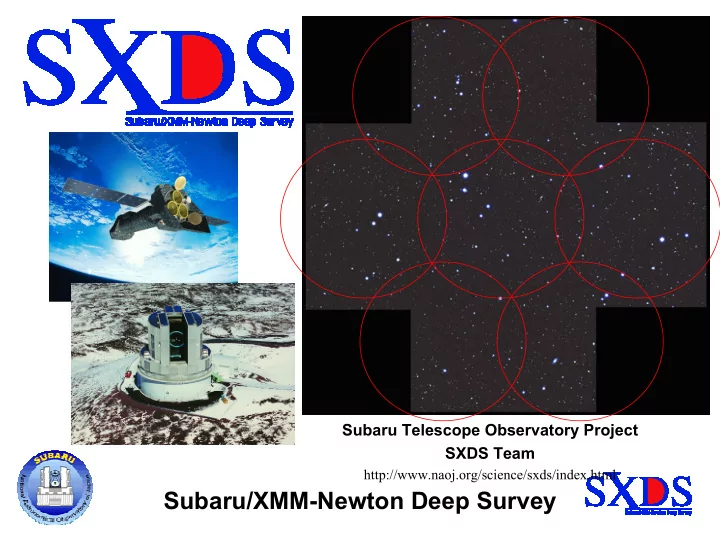
Subaru Telescope Observatory Project SXDS Team
http://www.naoj.org/science/sxds/index.html
SLIDE 2
Subaru/XMM-Newton Deep Survey
Today’s assignment 1) Background 2) Organization 3) Observations overview 4) Data products 5) Follow-up program 6) Companion program 7) Scientific results
SLIDE 3 Subaru/XMM-Newton Deep Survey
1) Background
A half of the optical observations were taken as a part of Subaru Telescope’s “Observatory Key Project”. In 2001, the then-Director of Subaru Telescope,
- Prof. H. Ando, made the decision to award large fractions
- f the thelescope time reserved for the people involved in
the construction and commissioning of Subaru to large survey projects which would otherwise be unable to receive the amount of telescope time they required.
SLIDE 4 Subaru/XMM-Newton Deep Survey
The Subaru/XMM-Newton Deep Survey (SXDS) is a deep optical / X-ray survey covering more than
The goal of the SXDS is to provide an accurate census of objects in the early Universe, by imaging to very faint magnitudes over a sufficiently large region to be relatively immune to cosmic variance. Also, we hoped the SXDS would be a “seed” for the Further follow-up and extended larger multiwavelength programs.
SLIDE 5 Subaru/XMM-Newton Deep Survey 2) Organization: SXDS Team members
Akiyama M.1, Aoki K. 1, Doi M.2, Furusawa H. 1, Furusawa J. 1 , Fuse T. 1, Imanishi M. 3, Ishida C. 1, Iye M. 3, Kajisawa K. 1,4, Karoji
- H. 1, Kobayashi N. 2, Kodama T. 3, Komiyama Y. 3, Kosugi G. 3,
Maeda Y. 5, Miyazaki S. 3, Mizumoto Y. 3 Morokuma T2. Nakata F. 1,6, Noumaru J. 1, Ogasawara R. 3, Ouchi M. 2,7, Saito T. 2, Sasaki T. 1, Sekiguchi K. 1,3, Shimasaku K. 1, Simpson C. 6,8, Takata T. 3, Tanaka I. 1, Ueda Y. 5,8, Watson M. 9, Yamada T. 1, Yasuda N. 2, & Yoshida M. 10
1 Subaru Telescope, 2 University of Tokyo, 3 National Astronomical Observatory of Japan, 4 Tohoku University, 5 Institute of Space and Astronautical Science 6 University of Durham 7 Space Telescope Science Institute 8 Liverpool John Moores University 9 University of Leicester (XMM/SSC) 10Okayama Astrophysical Observatory
SLIDE 6
Subaru/XMM-Newton Deep Survey 3) Observations overview The SXDS was initially awarded 15 nights (~90 hours) for four colour (B,Rc,i’&z’). In addition to the Observatory Key Project time, we used various amount of individual observatory staff time, SN Cosmology Project time (Doi et al.:14 hours) and Lyα emitting galaxies program (Ouchi et al.:3 hours) to complete five colour (B,V,Rc,i’&z’) imaging. Total allocation was ~177 hours Of which, 80 hours were lost due to bad weather. Total usable telescope time for this program was 97 hours. 2002 September – 2005 January
SLIDE 7 Subaru/XMM-Newton Deep Survey
Chandra DFS VIRMOS Deep SA68 LZLE Slone Slone
Various Survey fields on the Subaru sky SXDS Field
COSMOS
SLIDE 8
Subaru/XMM-Newton Deep Survey
SLIDE 9
Subaru/XMM-Newton Deep Survey
SLIDE 10 Subaru/XMM-Newton Deep Survey
02h18m
SXDS Field 1.3º
SLIDE 11
Subaru/XMM-Newton Deep Survey
SLIDE 12
Subaru/XMM-Newton Deep Survey
SLIDE 13 Subaru/XMM-Newton Deep Survey Major features: ・ Large area -- 1.3 deg2
=> cover large scale structures transverse dimention of ~ 75 Mpc (comoving) @ z~1 (~145 Mpc @ z~3) covers a volume of ~3.87Mpc3 to z~3
・ Deep imaging ( BAB = 28.2 mag, K’AB = 24.9 mag, 5σ)
=> L* galaxies at z < 3 => ~106 galaxies. A statistically sound, large volume and large number of high redshift sample of various different classes of objects. (Do not suffer from limited source statistics and cosmic variance, also by low detectability of rare
- bjects like the luminous high z AGNs.)
SLIDE 14
Subaru/XMM-Newton Deep Survey Major features (2): ・ Deep X-ray (by XMM/Newton) and VLA Imaging
=> cover the obscured AGNs Unbiased tracers of SMBH/Host Galaxy to study “Co-evolution”
・ Sub-mm Imaging by SCUBA (SHADES) and BLAST
=> Cosmic history of massive dust enshrouded star-formation activity. => Investigate the clustering properties of sub-mm galaxies to determine whether they could be progenitors of present-day massive ellipticals. => Investigate the fraction of sub-mm galaxies that harbour AGN
SLIDE 15 Subaru/XMM-Newton Deep Survey
B-V
0.9
- 22.0
- 21.5
- 21.0
- 20.5
- 20.0
- 19.5
- 19.0
MB – 5 log h
HDF
(From Benson et al. 2001)
141h-1 Mpc
z = 3.0 GOODS
SXDS
COSMOS
SLIDE 16
Subaru/XMM-Newton Deep Survey
Optical Imaging by Subaru Suprime-Cam
The SXDS covers 5 Suprime-Cam pointings (1.3 deg2) to the exposure time (estimated depth) : B=28.4 (AB, s/n=3σ, φ=2”) V=27.8 Rc=27.7 i’=27.7 z’=26.6
SLIDE 17
Subaru/XMM-Newton Deep Survey 4) Data products Data Release 2003/04/05 Beta-version released to Subaru project members (on http://www1.naoj.org/science/sxds/public or http://sbrprj.dc.nao.ac.jp/sxds/web/index.html) 2003/06 Beta-version released to Japanese astronomers 2003/10 Beta-version release to world wide (on access policy) 2005/03 Ver. 1.0 released to Japanese astronomer 2007/02 Ver. 1.0 released to world wide (no access restriction)
SLIDE 18
Subaru/XMM-Newton Deep Survey 5) Follow-up program ・Subaru FOCAS & AAT 2dF Spectroscopy 2,000 objects spanning 0.0< z <5.7 (Akiyama, Simpson, Sekiguchi, Saito, et al.,) ・Subaru narrow-band NB815 and NB921 imaging to isolate Lyman-emitters at z ' 5.7 and z ' 6.6 (Ouchi et al 2005) ・High-resolution VLA mosaic, reaching 1.4GHz = 6 µJy beam-1 at 1.4 GHz, (Simpson et al. 2006) ・Deep 610-MHz image from GMRT(Rawlings, et al.)
SLIDE 19
Subaru/XMM-Newton Deep Survey 6) Companion program
XMM-Newton X-ray Observatory
SLIDE 20 Subaru/XMM-Newton Deep Survey x-ray
100 50 50 50 50 50 1.3 deg 50
400 ksec of EPIC data from XMM/Newton: 100 ksec on central field 50 ksec on 6 flanking fields
SLIDE 21 Subaru/XMM-Newton Deep Survey
XMM Surveys
typical deep CDFS, Lockman SXDS LSS (now) typical ptg 1XMM cat
0.01 0.1 1 10 100 1 10 100 1000
exposure time (ksec) area (sq.deg.)
SLIDE 22
Subaru/XMM-Newton Deep Survey Multiwavelength Observations ・XMM-Newton (XMM/SSC) 1 x 10-18 W/m2 (0.5 – 2 keV) ・UKIRT/WFCAM (UKIDSS/UDS) 296 nights of UKIRT/WFCAM time DR1: 0.77 deg2 JHK (K=24, AB 5σ) This is already as deep as the GOODS CDFS VLT-ISAAC data-set, but cover an area 20 times larger. The final depth will be J=26.5, H=25.5 and K=25 (AB 5σ ) Matching the deepest near-IR surveys (Franx et al. 2003) but a 1,000 x in area by 2010. c.f. The Ultra-VISTA Survey of the COSMOS field cannot reach this depth until 2013.
SLIDE 23
Subaru/XMM-Newton Deep Survey
SLIDE 24
Subaru/XMM-Newton Deep Survey
SLIDE 25
Subaru/XMM-Newton Deep Survey Multiwavelength ・Spitzer (SWIRE) IRAC and MIPS data, but they are very shallow (120s & 80s) There is a plan to go deeper (see below). ・CSO : 350µ Obs. Just started ・JCMT/SCUBA (SHADES) 850 & 450 micron, 400 sq arcmin 60 sub-mm objects. SCUBA-2 Legacy Survey (see below) ・AzTEC 1.1µm, 0.2 sq deg-1, 1.3 mJy 25 objects ・VLA 1.4 GHz, σ=6µJy beam-1 ・GMRT 610-MHz, deepest mapping ever made
SLIDE 26
Subaru/XMM-Newton Deep Survey Multiwavelength: (Planned) ・JCMT/SCUBA2 (Cosmology Legacy Survey) 0.77 sq deg-1 to 5mJy (Aproved!) ・Subaru/FMOS: Galaxy Survey of 1.0 < z 100,000 galaxies ・HST+Spitzer Legacy program HST/ACS F850LP, z’ < 26 Spitzer/IRAC 3.6, 4.5 & 8 µm “ /MIPS 24 µm to 20 µJy ・ALMA : high spatial resolution mm imaging
SLIDE 27
Subaru/XMM-Newton Deep Survey 7) Scientific results
SLIDE 28
Subaru/XMM-Newton Deep Survey
SLIDE 29
Subaru/XMM-Newton Deep Survey
SLIDE 30
Subaru/XMM-Newton Deep Survey ・AGN in apparently normal galaxies
(Severgnini, et al., 2003 A & A, v.406, 483)
・Down-sizing in galaxy formation at z~ 1
(Kodama, et al., 2004, MNRAS, 350, 1005)
・Number Density of Old Passively Evolving Galaxies at z=1
(Yamada, et al, 2005, ApJ, 634, 861)
・Primeval Large-Scale Structures with Forming Clusters at Redshift 6
(Ouchi, et al., 2005, ApJ, 620, L1)
・Transition between Small- and Large-Scale Clustering for Lyman Break Galaxies
(Ouchi, et al., 2005, ApJ, 635, L117)
・Extended Lyα Sources over z~3-5
(Saito, et al., 2006, ApJ, 648, 54)
SLIDE 31
Subaru/XMM-Newton Deep Survey ・ SHADES (Mortier et al. 2005; Coppin et al. 2006) ・EROs (Simpson et al. 2006) ・Massive galaxies at redshifts 5 < z < 6 (McLure et al. 2006) ・Galaxy clusters (van Breukelen et al. 2006) ・Galaxy colour bimodality (Cirasuolo et al. 2007) ・AGN population (Martinez-Sansigre et al. 2007) So far a total of 30 refereed and 16 other papers on SXDF