
SLIDE 1
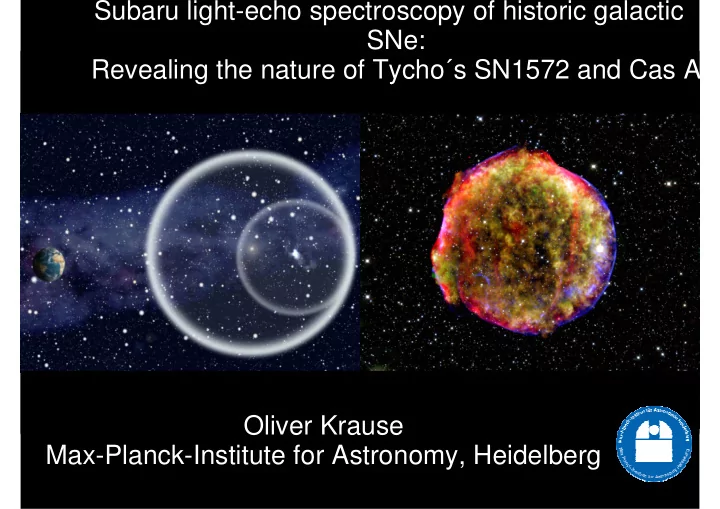
Subaru light-echo spectroscopy of historic galactic SNe: Revealing - - PowerPoint PPT Presentation
Subaru light-echo spectroscopy of historic galactic SNe: Revealing the nature of Tychos SN1572 and Cas A Oliver Krause Max-Planck-Institute for Astronomy, Heidelberg In collaboration with: Ken Nomoto, Masaomi Tanaka (IPMU, U. Tokyo)
Ken Nomoto, Masaomi Tanaka (IPMU, U. Tokyo) Tomonori Usuda, Takashi Hattori (Subaru) George Rieke, Karl Misselt (U. Arizona) Stephan Birkmann, Miwa Goto (MPIA)
„Astronomie Populaire“
Camille Flammarion, 1884
No parallax More distant than the moon Contradiction to Aristotle (Heavens not immutable and eternal) Milestone for a new view of the cosmos – together with Galileo and Kepler in 1609 Today, SNe are still key objects to our understanding of the universe
Hester et al. Blair et al.
Krause et al. 2005, Science 308, 1604
15 arcmin = 15 pc 24µm time series (2003-2008)
Echo surface brightness R = 23.4 mag / arcsec2
October 9, 2007
FOCAS
Krause et al. 2008, Science 320, 1195
Chandra X-ray Fe; 8keV Very hot gas Spitzer 24 µm; circumstellar/ synthesized dust
Hubble
Optical; Ejecta Line emission; Back-/ foreground stars
Prototypical shell-type core–collapse SNR Previously most quoted scenario: SN Ibc of WR Star Fesen ApJ 133, 161 (2001) Type IIb scenario consistent with a red supergiant progenitor in binary system
Balmer dominated optical spectra Historic light curve type Ia Ejecta morphology and composition Binary companion Ruiz-Lapuente et al. 2004 Nature 431, 1069 Subclass uncertain (subluminous – slightly overluminous)
Chandra X-ray Fe;Si;8keV Hot gas Spitzer 24 µm; circumstellar/ synthesized dust CaHa JHKs fore-/background stars
Field #4430 by Rest et al. 2008, ApJ 681, 81
Krause et al. 2008, Nature 456, 617
z-1)
Krause et al. 2008, Nature 456, 617
Strength similar to SN 2001el Spectropolarimetry suggests asphericity in the case of SN 2001el
Wang et al. 2003, ApJ 591, 1110; Kasen et al. 2003, ApJ 593, 788 Photospheric Si II 12,000 km/s HV Ca II 22,000 - 30,000 km/s
Light echoes at different lines of sight relative to the remnant provide a true 3-dimensional spectroscopic view
Nitrogen-rich (CSM?) material and morphology indicates different Ia scenario – Spectral classification urgently required