Subaqueous Soils and their Importance for Species and Marine - - PowerPoint PPT Presentation

subaqueous soils and their importance for species and
SMART_READER_LITE
LIVE PREVIEW

Subaqueous Soils and their Importance for Species and Marine - - PowerPoint PPT Presentation

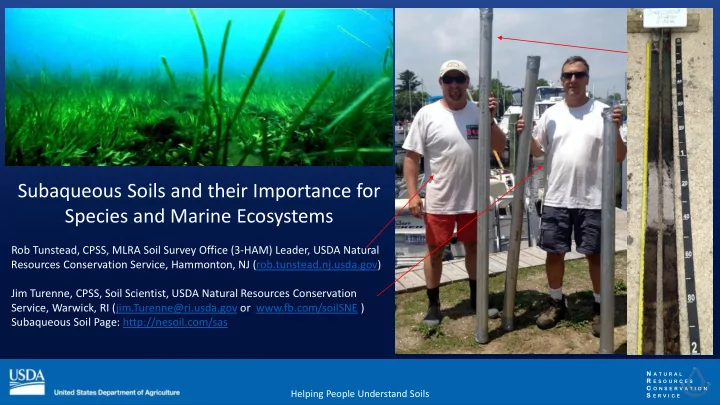
Subaqueous Soils and their Importance for Species and Marine Ecosystems Rob Tunstead, CPSS, MLRA Soil Survey Office (3-HAM) Leader, USDA Natural Resources Conservation Service, Hammonton, NJ (rob.tunstead.nj.usda.gov) Jim Turenne, CPSS, Soil


slide-1
SLIDE 1

N A T U R A L R E S O U R C E S C O N S E R V A T I O N S E R V I C E

Helping People Understand Soils

Subaqueous Soils and their Importance for Species and Marine Ecosystems

Rob Tunstead, CPSS, MLRA Soil Survey Office (3-HAM) Leader, USDA Natural Resources Conservation Service, Hammonton, NJ (rob.tunstead.nj.usda.gov) Jim Turenne, CPSS, Soil Scientist, USDA Natural Resources Conservation Service, Warwick, RI (jim.Turenne@ri.usda.gov or www.fb.com/soilSNE ) Subaqueous Soil Page: http://nesoil.com/sas

slide-2
SLIDE 2

N A T U R A L R E S O U R C E S C O N S E R V A T I O N S E R V I C E

Helping People Understand Soils

Outline

Brief history and introduction of subaqueous soils (SAS). How subaqueous soils are mapped. Q/A Why subaqueous soils are mapped / needed. Research, Interpretation, and Examples. Questions.

Billington - COARSE-SILTY, MIXED, ACTIVE, NONACID, MESIC THAPTO-HISTIC SULFIWASSENTS Indian River – Fluventic Psammowassent

slide-3
SLIDE 3

N A T U R A L R E S O U R C E S C O N S E R V A T I O N S E R V I C E

Helping People Understand Soils

Historical Background of SAS

von Post 1862

  • 1st nomenclature for SAS
  • Introduced terms “gyttja” and “dy” to describe limnic

sediments.

Kubiena 1952

  • Proposed a comprehensive soil classification system for

Europe that included the neglected SAS.

  • Included horizonation of SAS pedons.

Muckenhausen 1965

  • West Germany classification – subhydric soils.

Pomamperuma 1972

  • Used term “soil” for underwater sediments, undergo

pedogenesis.

http://nesoil.com/sas/Kubiena_sas.pdf

slide-4
SLIDE 4

N A T U R A L R E S O U R C E S C O N S E R V A T I O N S E R V I C E

Helping People Understand Soils

Yet Despite all this…

Soil Taxonomy (Soil Survey Staff) in 1975 stated: For the most part Subaqueous materials were excluded from the definition of soil by;

  • their permanent saturation beneath

deep water

  • need to support rooted vegetation

Most, but not all, were deterred…

slide-5
SLIDE 5

N A T U R A L R E S O U R C E S C O N S E R V A T I O N S E R V I C E

Helping People Understand Soils

History of Subaqueous Soils in the U.S.

  • Dr. George Demas 1958-1995

http://en.wikipedia.org/wiki/George_Demas

  • NRCS Soil Survey Project Leader
  • Pioneer of Subaqueous Soils
  • USDA Secretary’s honor for scientific research.
  • SSSA Emil Truog award for outstanding contribution to soil science
  • Traditional soil survey conducted on
  • land. Not a lot of work in Coastal Zone

and tidal marshes until the 70’s.

  • In 1993 – “Submerged Soils: A New

Frontier in Soil Survey” by Dr. George Demas published in Soil Survey Horizons.

  • Most early work in Chesapeake Bay

Region – Maryland/Delaware.

  • Dr. Demas pioneered the concept of

Subaqueous Soils differentiating them from sediment.

  • 1999 Definition of soil includes

shallow water.

slide-6
SLIDE 6

N A T U R A L R E S O U R C E S C O N S E R V A T I O N S E R V I C E

Helping People Understand Soils

Soil Definition Re-defined!

  • The upper limit of soil is the boundary between

soil and air [or] shallow water…[not] too deep (typically more than 2.5 m*) for the growth of rooted plants. * Arbitrary limit following Cowardin, RI limit is set at 5 m NAVD-88

slide-7
SLIDE 7

N A T U R A L R E S O U R C E S C O N S E R V A T I O N S E R V I C E

Helping People Understand Soils

Current Definition Subaqueous Soils in the U.S.

  • Soils with a field observable water table 2 cm
  • r more above positive water potential at the

soil surface for more than 21 hours of each day in all years. The water column is shallow (< 2.5 m/ 8.2 feet). Wassists and Wassents.

  • Soil must be capable of or presently

supporting rooted plants in the natural environment and/ or they must show evidence

  • f horizonation due to soil forming processes.
  • Four soil forming processes exist: additions,

losses, transfers, and transformations are active in subaqueous environments.

slide-8
SLIDE 8

N A T U R A L R E S O U R C E S C O N S E R V A T I O N S E R V I C E

Helping People Understand Soils

History of Subaqueous Soils in the U.S.

  • 1990’s Demas/Rabenhorst/Balduff.
  • 2001 – Bradley-Stolt thesis study in RI, others in ME, FL,

MD, MA.

  • 2003 – 1st National Workshop on SAS – Delaware

(Rehoboth Bay – Coppack/Rabenhorst).

  • 2004 – RI forms MapCoast, Dr. Mark Stolt (URI)

sabbatical.

  • 2005 Glossary of Landscape Terms, other areas begin

mapping.

  • 2006-2009 Proposal to amend Taxonomy & NASIS

proposals, Interpretation studies.

  • 2010 Eleventh Edition Soil Taxonomy released includes

Wassents and Wassists.

  • 2010 – 2nd National Workshop on SAS in Rhode Island.
  • 2011 RI completes 1st official Coastal Zone Soil Survey

(2012 first freshwater soil survey).

  • 2013 – Present CT, NJ SSURGO Mapping, research,
  • utreach, improvements…
  • 2016 – 70,00 acre Barnegat Bay NJ will be published,

1,000 acres of Thimble Islands Ct.

1st National Workshop on Subaqueous Soils, Delaware 2003 It’s Official!

slide-9
SLIDE 9

N A T U R A L R E S O U R C E S C O N S E R V A T I O N S E R V I C E

Helping People Understand Soils

Subaqueous Soils 101

The debate: Is it soil or sediment? Soil qualifying criteria: 1. Supplies nutrients to rooted plants. 2. Soil horizons formed by pedogenic processes.

Organic and mineral (O, A and C) horizons. Predominantly dealing with AC type soils (Entisols w/ few Histosols). Numerous buried A and O horizons. Some subaqueous and submerged soils have buried B horizons (spodic, argillic, etc.). Chemistry – sulfides, pH, salts, reduction/oxidation. Ss = f(C,R,O,B,F,P,T,W,Ce)

Bottom Line: Submerged lands can best be mapped and classified as soil!

slide-10
SLIDE 10

N A T U R A L R E S O U R C E S C O N S E R V A T I O N S E R V I C E

Helping People Understand Soils

slide-11
SLIDE 11

N A T U R A L R E S O U R C E S C O N S E R V A T I O N S E R V I C E

Helping People Understand Soils

?

slide-12
SLIDE 12

N A T U R A L R E S O U R C E S C O N S E R V A T I O N S E R V I C E

Helping People Understand Soils

How are Subaqueous Soils Mapped?

  • Need to use or develop a bathymetric map

which is used for subaqueous landform identification.

  • Can use existing NOAA charts or create detailed

bathymetry using fathometer and RTK GPS.

  • Detailed bathymetry was the number 1 data

need at our user conferences.

  • Bathymetric data collection and interpolation

method has been developed by MapCoast.

  • Traditional imagery is also helpful.
  • Develop soil-landscape model, delineate map

units, field map using standard tools.

  • Collect vibracore samples in representative

areas, describe, sample, classify.

  • Assemble map and NASIS entry.
slide-13
SLIDE 13

N A T U R A L R E S O U R C E S C O N S E R V A T I O N S E R V I C E

Helping People Understand Soils

How is subaqueous Bathymetry produced?

slide-14
SLIDE 14

N A T U R A L R E S O U R C E S C O N S E R V A T I O N S E R V I C E

Helping People Understand Soils

How are Subaqueous Soils Mapped?

slide-15
SLIDE 15

N A T U R A L R E S O U R C E S C O N S E R V A T I O N S E R V I C E

Helping People Understand Soils

Barnegat Bay - NJ Subaqueous Bathymetry

National Ocean Service (NOS) 1934 – 1936 estuarine bathymetry Pre-Sandy USGS EAARL-B LiDAR 2015 (ds885)

slide-16
SLIDE 16

N A T U R A L R E S O U R C E S C O N S E R V A T I O N S E R V I C E

Helping People Understand Soils

Remote Sensing

Wide array of remote sensing tool and techniques are available and can be employed to improve accuracy of the mapping:

  • Side-scan sonar (acoustic map) – bottom type, benthic

geologic habitat mapping.

  • Sub-Bottom profiling (low frequency acoustic) – map

deep structures.

  • High-resolution imagery/pictometry (NOAA protocol).
  • SPI Imagery, still and video images of the bottom.
  • AUV’s and other marine data.
  • GPR and EMI for freshwater subaqueous soils.
  • Resistivity.
  • Divers.
slide-17
SLIDE 17

N A T U R A L R E S O U R C E S C O N S E R V A T I O N S E R V I C E

Helping People Understand Soils

Subaqueous Landforms

slide-18
SLIDE 18

N A T U R A L R E S O U R C E S C O N S E R V A T I O N S E R V I C E

Helping People Understand Soils

Subaqueous Landforms

slide-19
SLIDE 19

N A T U R A L R E S O U R C E S C O N S E R V A T I O N S E R V I C E

Helping People Understand Soils

Subaqueous Landform Maps

slide-20
SLIDE 20

N A T U R A L R E S O U R C E S C O N S E R V A T I O N S E R V I C E

Helping People Understand Soils

Barnegat Bay - NJ Subaqueous Landforms

(Each L Landform b below h has i it’s o

  • wn Soil F

Facie ies) (Soil f facie ies a are distin inctiv ive s soils that f form u under c certain in s soil f formin ing factors r refle lectin ing t their ir p process o

  • r envir

ironment.)

  • Estuarine Tidal Creek
  • Lagoon Bottom
  • Lagoon Bottom Barrier Side
  • Storm Surge W ashover-Fan

Flat

  • Flood-tidal Delta Flat
  • Flood-tidal Delta Slope
  • Flood-tidal Delta Channel
  • Relict Flood-tidal Delta Flat
  • Relict Flood-tidal Delta

Slope

  • Subm erged W ave-cut

Platform

  • Subm erged Mainland Beach
  • Mainland Cove
  • Shoal
  • Dredge Channel
  • Dredge-Deposit Shoal
slide-21
SLIDE 21

N A T U R A L R E S O U R C E S C O N S E R V A T I O N S E R V I C E

Helping People Understand Soils

Subaqueous Soil Survey Field Data Collection Methods / Tools

slide-22
SLIDE 22

N A T U R A L R E S O U R C E S C O N S E R V A T I O N S E R V I C E

Helping People Understand Soils

Subaqueous Vibracoring

slide-23
SLIDE 23

N A T U R A L R E S O U R C E S C O N S E R V A T I O N S E R V I C E

Helping People Understand Soils

Subaqueous Soil Survey Vibracoring

slide-24
SLIDE 24

N A T U R A L R E S O U R C E S C O N S E R V A T I O N S E R V I C E

Helping People Understand Soils

Subaqueous Soil Survey Tools / Data Collection

slide-25
SLIDE 25

N A T U R A L R E S O U R C E S C O N S E R V A T I O N S E R V I C E

Helping People Understand Soils

Subaqueous Soil Survey Field Data Collection

Texture and Fluidity

slide-26
SLIDE 26

N A T U R A L R E S O U R C E S C O N S E R V A T I O N S E R V I C E

Helping People Understand Soils

Subaqueous Soil Survey Field Data Collection

Peroxide Reactions / Color change and Sulfide Odor (smell) / pH

slide-27
SLIDE 27

N A T U R A L R E S O U R C E S C O N S E R V A T I O N S E R V I C E

Helping People Understand Soils

Subaqueous Soil Survey Field Data Collection

slide-28
SLIDE 28

N A T U R A L R E S O U R C E S C O N S E R V A T I O N S E R V I C E

Helping People Understand Soils

Subaqueous Soil Survey Field Data Collection

slide-29
SLIDE 29

N A T U R A L R E S O U R C E S C O N S E R V A T I O N S E R V I C E

Helping People Understand Soils

Subaqueous Soil Survey Field Data Collection

slide-30
SLIDE 30

N A T U R A L R E S O U R C E S C O N S E R V A T I O N S E R V I C E

Helping People Understand Soils

Subaqueous Soil Survey Field Data Collection

slide-31
SLIDE 31

N A T U R A L R E S O U R C E S C O N S E R V A T I O N S E R V I C E

Helping People Understand Soils

Subaqueous Soil Survey Field Data Collection

slide-32
SLIDE 32

N A T U R A L R E S O U R C E S C O N S E R V A T I O N S E R V I C E

Helping People Understand Soils

Subaqueous Soil Survey Field Data Collection

slide-33
SLIDE 33

N A T U R A L R E S O U R C E S C O N S E R V A T I O N S E R V I C E

Helping People Understand Soils

Why Map Subaqueous Soils (Who Cares?)

“Talking Points”

  • The 2004 U.S. Commission on Ocean Policy identified the

need for “accurate and seamless living and nonliving marine resource data with bathymetry, and other natural features across the shoreline, coastal zone, near shore areas, and

  • pen ocean waters” (Recommendation 25-7)
  • In 2010 39% (124 million) of U.S. population live in counties

directly on shoreline.

  • None to little mapping currently available for shallow water

landscapes, coastal soil survey was not mapped to level of terrestrial areas.

  • Mantra “Coastal Soil and Sediment Mapping Helps us Better

Manage, Protect, and Restore our Underwater Marine Landscapes” (Ecological Site Description). The Task Force's recommendations and frameworks should be cost effective and improve coordination across Federal agencies. This memorandum covers matters involving the oceans, the Great Lakes, the coasts of the United States, and related seabed, subsoil, and living and non-living resources.

Marine Spatial Planning!

slide-34
SLIDE 34

N A T U R A L R E S O U R C E S C O N S E R V A T I O N S E R V I C E

Helping People Understand Soils

Subaqueous Soil Survey Uses (the Why?)

slide-35
SLIDE 35

N A T U R A L R E S O U R C E S C O N S E R V A T I O N S E R V I C E

Helping People Understand Soils

Beaches = 2,917 ac Total = 3,719 acres Total land = 775,676 Percent of RI that is beach = 0.4% half of the beach is exposed at high tide equates to 0.2% bigger at low tide. Technical Soil Services!

slide-36
SLIDE 36

N A T U R A L R E S O U R C E S C O N S E R V A T I O N S E R V I C E

Helping People Understand Soils

Subaqueous Soil Survey Uses (the Why?)

  • Identity and protect potential SAV habitat (shellfish, finfish, and shorebird nurseries)
  • Identify areas for creation of estuarine habitat i.e. coastal bird flyways, restocking of shellfish (aquaculture)
  • Assess site potential for managing eelgrass (SAV) remediation/ restoration
  • Evaluate soils and groundwater sources as potential contributors to eutrophication
  • Determine cause of habitat loss (physical, chemical and biological)
  • Provide consistent and comprehensive baseline soils data that was previously unavailable for lagoon’s / bays
  • Create a SA Vegetation prevalence map
  • Evaluate and identify soil (blue) carbon storage (sequestration) capabilities
  • Evaluate potential for eliminating noxious/ invasive species (stinging nettle and clinging jelly).
  • Characterize sediments/ soil (nutrients, pH, pollutants, metal contamination)
  • Evaluate barrier beach dynamics (Relict Inlets)
  • Assess site potential for pier/ piling, dock and mooring placement
  • Manage dredge activities & acid sulfate weathering potentials (evaluate areas needing removal /

replenishment and identify source materials)

slide-37
SLIDE 37

N A T U R A L R E S O U R C E S C O N S E R V A T I O N S E R V I C E

Helping People Understand Soils

Subaqueous Soil Survey Uses (the Why?)

  • Identify Tidal Marsh protection and restoration areas
  • Identify potential rare species habitat
  • Manage the shoreline resource by identifying high erosion and depositional areas
  • Benthic Site ID and preservation (* when we dig a site we can often determine if shellfish were

present or not)

  • ID stable and dynamic estuarine environments
slide-38
SLIDE 38

N A T U R A L R E S O U R C E S C O N S E R V A T I O N S E R V I C E

Helping People Understand Soils

Why Map Subaqueous Soils (Who Cares?)

Restoration – Seagrass, Tidal Marsh, Beaches, Shellfish

  • Eelgrass site selection model:
  • Wave Exposure (currents)
  • Soil Characteristics (texture, sulfides,
  • rganic matter).
  • Temperature.
  • Bathymetry (critical depth).

Missing!

slide-39
SLIDE 39

N A T U R A L R E S O U R C E S C O N S E R V A T I O N S E R V I C E

Helping People Understand Soils

Eelgrass Restoration (SAV maps / interps.)

Site Selection Model:

  • Wave exposure / tidal velocity
  • Soil Characteristics (sulfide,

texture, organic matter)

  • Bioturbator abundance
  • Temperature
  • Bathymetry depth (not too

deep or shallow)

slide-40
SLIDE 40

N A T U R A L R E S O U R C E S C O N S E R V A T I O N S E R V I C E

Helping People Understand Soils

NRCS Needs

In the coastal salt ponds the area occupied by aquaculture shall not exceed five percent (5%) of the total open water surface area of the coastal pond below

  • MLW. (CRMC Red Book 300.11(E)(6)
slide-41
SLIDE 41

N A T U R A L R E S O U R C E S C O N S E R V A T I O N S E R V I C E

Helping People Understand Soils

Research, Interpretations, Examples

  • Since 1990’s numerous (~20) thesis/doctorate studies
  • n shallow water mapping (UMD, URI, Penn State,

NRCS sponsored).

  • Long list of interpretations needed and being

developed (user conferences).

  • Baseline data is needed for chem/physical properties

and classification of soils.

  • Numerous areas for research.
  • Applications to Technical Soil Services (equipment,

coring, bathy).

  • Continued improvements to mapping and data

collection.

  • Work with partners to work collaboratively so data is

collected and made in usable platforms (not redundant).

  • SAV Restoration
  • Crab Habitat
  • Clam Stocking
  • Management for Sustainable Production - Shellfish
  • Nutrient Reduction
  • Benthic Preservation Site Identification
  • Wildlife Management
  • Critical Habitats for Wading Shore Birds
  • Nurseries and Spawning areas
  • Habitat Protection for Horseshoe Crabs
  • Dredging Island Creation
  • Tidal Marsh Protection and Creation
  • Bathymetric Map
  • Navigational Channel Creation/ Maintenance
  • Effects of Dredging on Benthic Ecology
  • Off Site Disposal of Dredge Spoil
  • Acid-Sulfate Weathering Hazards
  • Dune Maintenance/Replenishment
  • Halinity in marshes.
  • Thin layer Deposition
  • Living Shoreline restoration projects
  • Blue carbon sequestration volumes / landforms
slide-42
SLIDE 42

N A T U R A L R E S O U R C E S C O N S E R V A T I O N S E R V I C E

Helping People Understand Soils

slide-43
SLIDE 43

N A T U R A L R E S O U R C E S C O N S E R V A T I O N S E R V I C E

Helping People Understand Soils

slide-44
SLIDE 44

N A T U R A L R E S O U R C E S C O N S E R V A T I O N S E R V I C E

Helping People Understand Soils

Potential Eelgrass Restoration (SAV)

Barnegat Bay, NJ Subaqueous Soil Survey

“Blue” Carbon Sequestration Areas of Barnegat Bay

slide-45
SLIDE 45

N A T U R A L R E S O U R C E S C O N S E R V A T I O N S E R V I C E

Helping People Understand Soils

Comparison of 1996 and 2011 RI SSURGO

slide-46
SLIDE 46

N A T U R A L R E S O U R C E S C O N S E R V A T I O N S E R V I C E

Helping People Understand Soils

Comparison of 2015 and 2016 Barnegat Bay - NJ

slide-47
SLIDE 47

N A T U R A L R E S O U R C E S C O N S E R V A T I O N S E R V I C E

Helping People Understand Soils

Point Data Availability

slide-48
SLIDE 48

N A T U R A L R E S O U R C E S C O N S E R V A T I O N S E R V I C E

Helping People Understand Soils

CZSS (Coastal Zone Soil Survey) Initiative Focus

New NRCS Initiative working on CZSS issues / problems / deficiencies to be improved? 1 – Spatial deficiencies / shoreline loss 2 – Outdated mapunit design 3 – Field documentation data deficiency 4 – Soil interpretation issues 5 – New soil series concepts for subaqueous areas and

  • utdated subaerial series concepts
slide-49
SLIDE 49

N A T U R A L R E S O U R C E S C O N S E R V A T I O N S E R V I C E

Helping People Understand Soils

Rhode Island’s Coastal Zone Soil Survey

  • 2003 RI NRCS adopts a “Working Waters” strategic plan –

Farm Bill $$ directed to coastal zone ($1 million earmark for Eelgrass restoration).

  • Gap in soil survey data identified – No subaqueous soils

data for site selection model.

  • 2004 RI State Conservationist direct SSS to develop a plan

to have RI be Center of Excellence in coastal soils.

  • Internal = MLRA office plan (approved by BOD).
  • External = worked with URI to establish MapCoast and

begin the mapping protocol and map the coastal zone.

  • MapCoast protocol developed and south coastal lagoons

mapped, user conferences held, outreach, work with CEMCS, NASIS proposals, Glossary of landforms…

  • 2011 1st SSURGO CZSS is published, 2012 first freshwater

soil survey published on WSS.

slide-50
SLIDE 50

N A T U R A L R E S O U R C E S C O N S E R V A T I O N S E R V I C E

Helping People Understand Soils

Special Thanks

  • Dr. Marty Rabenhorst (UMD) and Dr.

Mark Stolt (URI) NCSS folks working on SAS (from 2nd National Workshop)

slide-51
SLIDE 51

N A T U R A L R E S O U R C E S C O N S E R V A T I O N S E R V I C E

Helping People Understand Soils

Questions? I think I’m stuck!