Study caf hours Weekday Time Place Tuesday 9.00-10.00 Kol G4 - - PowerPoint PPT Presentation

study caf hours
SMART_READER_LITE
LIVE PREVIEW

Study caf hours Weekday Time Place Tuesday 9.00-10.00 Kol G4 - - PowerPoint PPT Presentation

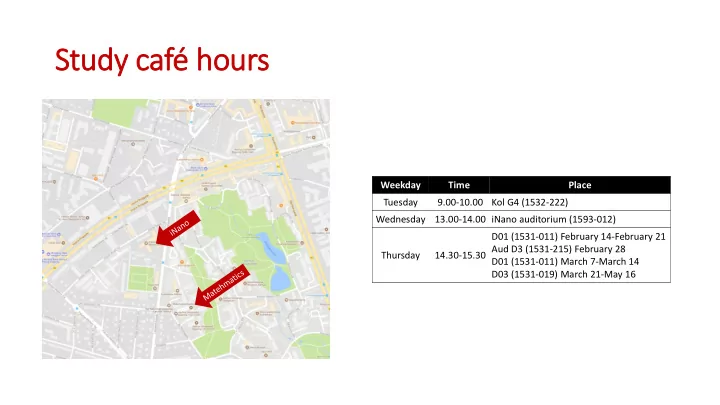
Study caf hours Weekday Time Place Tuesday 9.00-10.00 Kol G4 (1532-222) Wednesday 13.00-14.00 iNano auditorium (1593-012) D01 (1531-011) February 14-February 21 Aud D3 (1531-215) February 28 Thursday 14.30-15.30 D01 (1531-011) March


slide-1
SLIDE 1

Study café hours

Weekday Time Place Tuesday 9.00-10.00 Kol G4 (1532-222) Wednesday 13.00-14.00 iNano auditorium (1593-012) Thursday 14.30-15.30 D01 (1531-011) February 14-February 21 Aud D3 (1531-215) February 28 D01 (1531-011) March 7-March 14 D03 (1531-019) March 21-May 16

slide-2
SLIDE 2

Lis ists

  • List syntax
  • List operations
  • copy.deepcopy
  • range
  • while-else
  • for
  • for-break-continue-else
slide-3
SLIDE 3

Lis ist operatio ions

  • List syntax [value1, value2, ..., valuek]
  • List indexing L[index], L[-index]
  • List slices L[from:to], L[from:to:step] or L[slice(from,to,step)]
  • Creating a copy of a list L[:] or L.copy()
  • List concatenation (creates new list) X + Y
  • List repetition (repeated concatenation with itself) 42 * L
  • Length of list len(L)
  • Check if element is in list e in L
  • Index of first occurrence of element in list L.index(e)
  • Number of occurrences of element in list L.count(e)
  • Check if element is not in list e not in L
  • sum(L) min(L) max(L)

docs.python.org/3/library/stdtypes.html#sequence-types-list-tuple-range

slide-4
SLIDE 4

Lis ist modifiers (lists are mutable)

  • Extend list with elements (X is modified) X.extend(Y)
  • Append an element to a list (L is modified) L.append(42)
  • Replace sublist by another list (length can differ) X[i:j] = Y
  • Delete elements from list del L[i:j:k]
  • Remove & return element at position L.pop(i)
  • Remove first occurrence of element L.remove(e)
  • Reverse lists L.reverse()
  • L *= 42
  • L.insert(i,x) same as L[i:i]=x

docs.python.org/3/library/stdtypes.html#sequence-types-list-tuple-range Python shell > x = [1, 2, 3, 4, 5] > x[2:4] = [10, 11, 12] > x

| [1, 2, 10, 11, 12, 5]

> x = [1, 2, 11, 5, 8] > x[1:4:2] = ['a', 'b']

| [1, 'a', 11, 'b', 8]

slide-5
SLIDE 5

Questions – What is is x ?

a) [1,2,'a','b',5,6,7,8,9,10] b) [1,'a',3,4,5,6,7,'b',9,10] c) [1,2,3,4,5,6,7,'a','b'] d) [1,2,'a',4,5,'b',7,8,9,10] e) ValueError f) Don’t know x = [1,2,3,4,5,6,7,8,9,10] x[2:8:3] = ['a', 'b']

slide-6
SLIDE 6

Questions – What is is y ?

a) [3,6,9,12,15] b) [7,13] c) [1,9] d) [4,7,10,13,2,4] e) TypeError f) Don’t know

y = [1,2,3,4,5,6,7,8,9,10,11,12,13,14,15,16,17,18,19] y = y[3:15:3][1:4:2]

slide-7
SLIDE 7

Nested li lists (multi-dimensional li lists)

  • Lists can contain lists as elements,

that can contain lists as elements, that ...

  • Can e.g. be used to store multi-

dimensional data (list lengths can be non-uniform) Note: For dealing with matrices the numpy module is a better choice

multidimensional-lists.py list1d = [1, 3, 5, 2] list2d = [[1, 2, 3, 4], [5, 6, 7, 9], [0, 8, 2, 3]] list3d = [[[5,6], [4,2], [1,7], [2,4]], [[1,2], [6,3], [2,5], [7,5]], [[3,8], [1,5], [4,3], [2,4]]] print(list1d[2]) print(list2d[1][2]) print(list3d[2][0][1]) Python shell

| 5 | 7 | 8

slide-8
SLIDE 8

ali liasing

Memory a 13 a[0] 27 a[1] 7 a[2] 42 a[3]

a = [13, 27, 7, 42] b = a a[2] = 12

12- b

slide-9
SLIDE 9

y = x vs y = x[:]

Memory a 13 a[0] 27 a[1] 7 a[2] 42 a[3]

a = [13, 27, 7, 42] b = a a[2] = 12

12- b

a = [13, 27, 7, 42] b = a[:] a[2] = 12

Memory a 13 a[0] 27 a[1] 7 a[2] 42 a[3] 13 b[0] 27 b[1] 7 b[2] 42 b[3] b 12-

slide-10
SLIDE 10

x[:] vs nested structures

a = [[3,5],[7,11]] b = a c = a[:] a[0][1] = 4 c[1] = b[0]

Memory a a[0] a[1] 3 5 7 11 c c[0] c[1] b 4-

slide-11
SLIDE 11

Question – what is c ?

a = [[3,5],[7,11]] b = a c = a[:] a[0][1] = 4 c[1] = b[0]

Memory a a[0] a[1] 3 5 7 11 c c[0] c[1] b 4-

  • a) [[3,5],[7,11]]

b) [[3,5],[3,5]] c) [[3,4],[3,5]] d) [[3,4],[3,4]] e) Don’t know

slide-12
SLIDE 12

copy.deepcopy

  • To make a copy of all parts of a composite value

use the function deepcopy from module copy

Memory a a[0] 7 a[1] 3 5 b[0] 7 b[1] 3 5 b 4- Python shell > from copy import deepcopy > a = [[3, 5], 7] > b = deepcopy(a) > a[0][0] = 4 > a

| [[4,5],7]

> b

| [[3,5],7]

slide-13
SLIDE 13

In Initializing a 2-dimensional li list

Python shell > x = [1] * 3 > x

| [1, 1, 1]

> y = [[1] * 3] * 4 > y

| [[1, 1, 1], [1, 1, 1], [1, 1, 1], [1, 1, 1]]

> y[0][0] = 0 > y

| [[0, 1, 1], [0, 1, 1], [0, 1, 1], [0, 1, 1]]

Python shell > y = [] > for _ in range(4): y.append([1] * 3) > y[0][0] = 0 > y

| [[0, 1, 1], [1, 1, 1], [1, 1, 1], [1, 1, 1]]

slide-14
SLIDE 14

range(from, , to to, , step)

  • range(from, to, else) generates a sequence of numbers smaller than to

starting with from, and with increments of step:

range(5) : 0, 1, 2, 3, 4 range(3,8) : 3, 4, 5, 6, 7 range(2,11,3) : 2, 5, 8

  • Ranges are immutable, can be indexed

like a list, sliced, and compared (i.e. generate the same numbers)

  • list(range(...)) generates the

explicit list of numbers

Python shell > range(1, 10000000, 3)[2]

| 7

> range(1, 10000000, 3)[100:120:4]

| range(301, 361, 12)

> range(1, 10000000, 3)[100:120:4][2:3]

| range(325, 337, 12)

> list(range(5, 14, 3))

| [5, 8, 11]

In Python 2, range generates the explicity list, i.e. always use memory proportional to the length; Python 3 is more memory friendly

slide-15
SLIDE 15

Question – What is is range(3,20,4)[2:4][1] ?

a) 3 b) 7 c) 11 d) 15 e) 19 f) Don’t know

slide-16
SLIDE 16

for - lo loop

  • For every element in a sequence

execute a block of code: for var in sequence: block

  • Sequences can e.g. be lists, strings,

ranges

  • break and continue can be used

like in a while-loop to break out of the for-loop or continue with the next element in the sequence

Python shell > for x in [1, "abc", [2, 3], 5.0]: > print(x)

| 1 | abc | [2, 3] | 5.0

> for x in "abc": > print(x)

| a | b | c

> for x in range(5, 15, 3): > print(x)

| 5 | 8 | 11 | 14

slide-17
SLIDE 17

Question – What is is printed ?

Python shell > for i in range(1, 4): > for j in range(i, 4): > print(i, j, sep=':', end=' ')

a) 1:1 1:2 1:3 2:1 2:2 2:3 3:1 3:2 3:3 b) 1:1 1:2 1:3 2:2 2:3 3:3 c) 1:1 2:1 3:1 1:2 2:2 3:2 1:3 2:3 3:3 d) 1:1 2:1 3:1 2:2 3:2 3:3 e) Don’t know

slide-18
SLIDE 18
slide-19
SLIDE 19
slide-20
SLIDE 20

Pali lindromic substrings

  • Find all palindromic substrings of

length ≥ 2, that are spelled identically forward and backwards: abracadrabratrallalla i j i j

  • Algorithm: Test all possible substrings

(brute force/exhaustive search)

  • Note: the slice t[::-1] is t reversed

palindrom.py s = "abracadrabratrallalla" for i in range(len(s)): for j in range(i + 2, len(s) + 1): t = s[i:j] if t == t[::-1]: print(t) Python shell

| aca | alla | allalla | ll | llall | lal | alla | ll

slide-21
SLIDE 21

Sie ieve of Eratosthenes

  • Find all prime numbers ≤ n
  • Algorithm:

2 3 4 5 6 7 8 9 10 11 12 13 14 ... 2 3 4 5 6 7 8 9 10 11 12 13 14 ... 2 3 4 5 6 7 8 9 10 11 12 13 14 ... 2 3 4 5 6 7 8 9 10 11 12 13 14 ... 2 3 4 5 6 7 8 9 10 11 12 13 14 ... 2 3 4 5 6 7 8 9 10 11 12 13 14 ...

eratosthenes.py n = 100 prime = [True] * (n + 1) for i in range(2, n): for j in range(2 * i, n + 1, i): prime[j] = False for i in range(2, n+1): if prime[i]: print(i, end=' ') Python shell

| 2 3 5 7 11 13 17 19 23 29 31 37 41

43 47 53 59 61 67 71 73 79 83 89 97 en.wikipedia.org/wiki/Sieve_of_Eratosthenes

slide-22
SLIDE 22

while-else and for-else lo loops

  • Both for- and while-loops can have an optional “else”:

for var in sequence: block else: block while condition: block else: block

  • The “else” block is only executed if no break is performed in the loop
  • The “else” construction for loops is specific to Python,

and does not exist in e.g. C, C++ and Java

slide-23
SLIDE 23

Lin inear search

linear-search-while.py L = [7, 3, 6, 4, 12, 'a', 8, 13] x = 4 i = 0 while i < len(L): if L[i] == x: print(x, "at position", i, "in", L) break i = i + 1 if i >= len(L): print(x, "not in", L) linear-search-while-else.py i = 0 while i < len(L): if L[i] == x: print(x, "at position", i, "in", L) break i = i + 1 else: print(x, "not in", L) linear-search-for.py found = False for i in range(len(L)): if L[i] == x: print(x, "at position", i, "in", L) found = True break if not found: print(x, "not in", L) linear-search-for-else.py for i in range(len(L)): if L[i] == x: print(x, "at position", i, "in", L) break else: print(x, "not in", L) linear-search-builtin.py if x in L: print(x, "at position", L.index(x), "in", L) else: print(x, "not in", L)