Structuring Clinically Integrated Networks: Legal Considerations for - - PowerPoint PPT Presentation

structuring clinically integrated networks legal
SMART_READER_LITE
LIVE PREVIEW

Structuring Clinically Integrated Networks: Legal Considerations for - - PowerPoint PPT Presentation

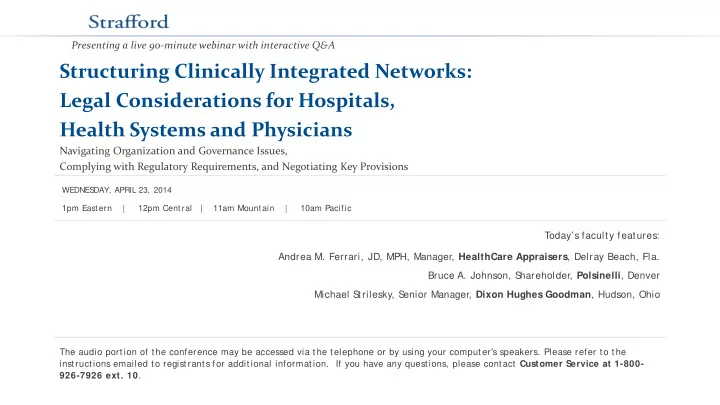
Presenting a live 90-minute webinar with interactive Q&A Structuring Clinically Integrated Networks: Legal Considerations for Hospitals, Health Systems and Physicians Navigating Organization and Governance Issues, Complying with Regulatory


slide-1
SLIDE 1

Structuring Clinically Integrated Networks: Legal Considerations for Hospitals, Health Systems and Physicians

Navigating Organization and Governance Issues, Complying with Regulatory Requirements, and Negotiating Key Provisions

Today’s faculty features:

1pm East ern | 12pm Cent ral | 11am Mount ain | 10am Pacific

The audio portion of the conference may be accessed via the telephone or by using your computer's speakers. Please refer to the instructions emailed to registrants for additional information. If you have any questions, please contact Customer Service at 1-800- 926-7926 ext. 10.

WEDNES DAY, APRIL 23, 2014

Presenting a live 90-minute webinar with interactive Q&A

Andrea M. Ferrari, JD, MPH, Manager, HealthCare Appraisers, Delray Beach, Fla. Bruce A. Johnson, S hareholder, Polsinelli, Denver Michael S trilesky, S enior Manager, Dixon Hughes Goodman, Hudson, Ohio

slide-2
SLIDE 2

Tips for Optimal Quality

S

  • und Qualit y

If you are listening via your computer speakers, please note that the quality

  • f your sound will vary depending on the speed and quality of your internet connection.

If the sound quality is not satisfactory, you may listen via the phone: dial 1-888-601-3873 and enter your PIN when prompted. Otherwise, please send us a chat or e-mail sound@ straffordpub.com immediately so we can address the problem. If you dialed in and have any difficulties during the call, press *0 for assistance. Viewing Qualit y To maximize your screen, press the F11 key on your keyboard. To exit full screen, press the F11 key again.

FOR LIVE EVENT ONLY

slide-3
SLIDE 3

Continuing Education Credits

For CLE purposes, please let us know how many people are listening at your location by completing each of the following steps:

  • In the chat box, type (1) your company name and (2) the number of attendees at your location
  • Click the word balloon button to send

FOR LIVE EVENT ONLY

slide-4
SLIDE 4

Structuring g Clinically I Integr grated N Networks: L Legal, Regulatory, F Fina nancial a and nd Practical C Consi sider erations for H Hos

  • spit

itals an and P Physic sicia ians

______________________________________________________ Andrea Ferrari, Esq., MPH, Healthcare Appraisers, Inc. Michael Strilesky, DHG Healthcare Bruce Johnson, Esq., Polsinelli PC

slide-5
SLIDE 5

Purposes of the Program:

__________________________________________________________

  • 1. De-Mystify the “buzzwords” of the year, including distinguishing

them from one another

  • Clinically Integrated Network (“CIN”)
  • Accountable Care Organization (“ACO”)/Accountable Care Entity (“ACE”)
  • Hospital Efficiency Program
  • Co-Management Arrangement
  • Gainsharing/Shared Savings Arrangement

5

slide-6
SLIDE 6

Purposes of the Program:

_________________________________________________________

  • 2. Provide an in depth discussion of the business, regulatory, financial

and practical considerations of CINs, focusing on physician contributions and payments and the necessity, methods and pitfalls of determining their fair market value

6

slide-7
SLIDE 7

Why Do We Think These Purposes Are Worth 90 Minutes of Your Time?

__________________________________________________________

  • 1. Increased attention on the quality, efficiency and value of health care is

fueling more vigorous interest in the legally-permissible ways for payors, hospitals and health systems to engage and/or work with physicians to manage care costs and improve the quality and efficiency of health care delivery.

  • options vary depending on variety of financial, cultural and infrastructure issues

7

slide-8
SLIDE 8

Why Do We Think These Purposes Are Worth 90 Minutes of Your Time?

__________________________________________________________

  • 2. “Clinical Integration” and “Clinically Integrated Networks” are becoming a

popular means to pursue the cost, quality and value objectives of post-ACA health care delivery. However:

  • Formation of a CIN is typically a large undertaking that requires consideration of myriad

legal, regulatory and financial factors.

  • Important for stakeholders to understand not only the theoretical goals of CINs, but also

the practical aspects of achieving those goals via a CIN, including how and why CINs are similar to and different from other strategies for achieving provider alignment toward common goals.

8

slide-9
SLIDE 9

Disclaimers:

__________________________________________________________

  • This slide deck:
  • Is the result of collaboration of your panelists.
  • May not be covered in its entirety in the course of the webinar. Some slides are

merely for general reference and to help provide context for the interactive discussion that we have planned.

  • May contain statements that are controversial and not espoused by colleagues or

employers.

  • Does not contain legal advice or legal opinions; it is just a collection of ideas.
  • Is the second in a planned series on the general topic of CINs, and will provide a

more in depth look at some of the issues raised in the first webinar presentation.

9

slide-10
SLIDE 10

The “Good Old Days”: Fragmented Delivery System and Relationships

Health Care Providers Financing and Insurance Consumers/ Patients

10

slide-11
SLIDE 11

The New Trend: CINs/ACOs

Accountable Care Organization Financing and Insurance Consumers/ Patients CIN/ACO Clinically Integrated Network

Key Attributes:

  • Patient Centered
  • Coordinated Care
  • Quality and Cost Focus
  • Information Sharing
  • Aligned Incentives

11

slide-12
SLIDE 12

De-Mystifying Alignment Strategies

12

slide-13
SLIDE 13

De-Mystifying Alignment Strategies

13

slide-14
SLIDE 14

De-Mystifying Alignment Strategies

14

slide-15
SLIDE 15

TACTICAL

LOW HIGH

Degree of Alignment

Pay for Call Physician Advisory Council Directorship Management Services Organization Joint Venture Professional Services Arrangement Physician Hospital Organization Gainsharing Institute Employment

STRATEGIC TRANSFORMATIONAL

IT Deployment Physician Enterprise Foundation Hospital Efficiency Program PCMH Clinically Integrated Network Accountable Care Organization

Resources Required

LOW HIGH Co-Marketing Co-Management

Alignment Strategies … Various Models

15

slide-16
SLIDE 16

Infrastructure & Funding Distribution

  • f Funds

Contracting Information Technology Physician Leadership Structure & Governance Participation Criteria Performance Objectives Clinically Integrated Network

Components of a Clinically Integrated Network

16

slide-17
SLIDE 17

Structure & Governance What is the optimal governance model? How do physician leaders participate in governance and decision-making? Infrastructure & Funding Is there a distinct entity that has the vision, leadership & infrastructure to truly succeed at creating value for physicians & payors? How will the costs of building the infrastructure be offset? What potential revenue sources exist and what is the plan to capture that revenue? Participation Criteria How will you decide which physicians to employ, align or integrate? Performance Objectives Do your physicians have experience in leading performance initiatives? How do you plan to proactively enact a cultural change towards value? Physician Leadership How do your physicians participate in leadership functions today? What kind of empowerment do they have within the organization? What plans do you have to develop physician leadership competencies? Information Technology What IT systems are in place to monitor and track utilization, quality, efficiency, and value? How mature is the technology platform and how effectively is it currently used? Distribution of Funds How are providers compensated across the organization? What methodology exists for distributing value-based funds to providers? How does the model mature with the market and

  • rganizational capabilities?

Contracting How urgent and ready is your market (payors and employers) to move toward value-based contracts? How prepared are providers to pursue value-based contracts and/or joint contracting?

Aligning Incentives; Moving Toward Integration; Preparing for Financial Risk

17

slide-18
SLIDE 18

MANAGING BOARD

Finance and Contracting Clinical Quality Membership and Operations Communication and Education Information Technology BOARD COMPOSITION PHYSICIAN CHAIR COMMITTEES CHAIRED BY PHYSICIANS

18

Board & Committee Structure

18

slide-19
SLIDE 19

IPA Health System Subsidiary PHO Joint Venture PHO

Health System Participating Physicians Payors / Employers

PHO

XX% XX% Health System Payors / Employers

IPA

Participating Agreement 100% Participating Physicians Health System Payors / Employers Participating Agreement

100%

Participating Physicians Subsidiary

Overview: Other than an employment-only model, a CIN usually is structured as a joint venture or subsidiary Physician Hospital Organization, or an Independent Practice Association (IPA).

Structure & Governance

19

slide-20
SLIDE 20

Organizational Structure: Joint-Venture LLC

Key Characteristics:

  • Physicians can elect Board Members
  • Participation Fees will be different for Owners than for Participants
  • All physicians will sign the same Membership Agreement
  • Active participation is required to achieve performance goals
  • Profit distribution to owners only, based on company’s profits
  • Performance rewards will be available to Owners and Participants based on

performance 50% Health System CIN Physician Owners Payers 50% Physician Participants

20

slide-21
SLIDE 21

Organizational Structure: Subsidiary LLC

Key Characteristics:

  • Physicians can nominate Board Members, that are approved by Health System
  • Participation Fees are typically the same for all Physician Participants,

assuming all physicians sign the same Participation Agreement

  • Active participation is required to achieve performance goals
  • Distribution pool developed at the discretion of Health System, factoring in
  • verhead costs for the network
  • Networks can create rewards to physicians

100% Health System CIN Payers Physician Participants

21

slide-22
SLIDE 22

ANNUAL CI INCENTIVES FOR ADVOCATE PHYSICIAN PARTNERS ADVANTAGES FOR PHYSICIANS

Low High Quality Improvement / P4P Incentives $300 $4,000 Shared Savings $1,500 $8,000 Leadership Participation Incentives $50 $1,500 Capitalize on Payer Relationships 2% 10% Narrow Network Participation Care Management Resources (IT, Staff, Case Management) Group Purchasing Benefit Range (Per Physician) Initiative Exclusive access to patients Shared network resources Reduction in expenses

$12.4 M $9.4 K $3.9 K $16.7 M $5.2 K $25.0 M $8.6 K $30.0 M 2005 2006 2007 2008

Per physician Total

Common Reasons to Join a CIN

Source: Advocate Physician Partners

22

slide-23
SLIDE 23

MATURITY OF CIN

Reporting Incentives and Membership Fees LOW HIGH Hospital Efficiency Program Self Funded Health Plan Payor Contracts Employer Contracts Pay-for-Performance

Overview: The CIN is a separate business entity with a distinct identity, mission, and vision, dedicated leadership and staff, sustainable sources of revenue, and participating provider agreements with physicians that create potential value for both physicians and payors. The CIN will need to offset costs of building the network (Infrastructure) and eventually provide returns through various revenue sources depending on the maturity of the network. Sources of Revenue

Infrastructure & Governance

23

slide-24
SLIDE 24

Element Description Examples Variance & Cost Reduction Minimize variable physician performance not related to patient characteristics

  • Minimize orthopedics supply chain cost
  • Staffing and productivity opportunities

Unnecessary Care Reduction Reduce avoidable, unproductive and duplicative services

  • Prostate cancer screenings for elderly

patients

  • Reduce Readmissions

Clinical Restructuring Ensure treatment in most optimal setting with most appropriate level of provider

  • Early step down from an IP to SNF bed
  • Partnerships with a local retail clinic to
  • ffer non-urgent care

System Optimization Shift focus to upstream, preventative care with emphasis on CI and population health

  • Disease-based medical homes
  • Patient engagement strategies using

telehealth

Source: Sg2 Analysis

Examples of Performance Improvement

Overview: CINs identify metrics and targets designed to meaningfully impact the clinical practice of all network physicians, and to align their conduct with hospital initiatives, so as to improve quality and demonstrate value across the entire continuum

  • f care.

Performance Objectives

24

slide-25
SLIDE 25

CIN

IT QUALITY COMMUNICATION MEMBERSHIP FINANCE

Clinical Leadership

  • Lead and participate on sub-

committees supported by CIN or Health System personnel

  • Provide clinical and operational input

to the Health System Medicine Primary Care Neurosciences Heart and Vascular Surgery Women & Children

Overview: Health systems must empower physicians to have an influence on the future direction of the network. This can represent a significant cultural transformation for many health systems, as physicians are integrated into the direction of the strategy for the network. If the network is successful, it will in turn have a significant impact on the future direction of the health system.

Share In Network Governance

Physician Leadership

25

slide-26
SLIDE 26

CIN

IT QUALITY COMMUNICATION MEMBERSHIP FINANCE

Membership:

  • Hold physicians accountable for performance and compliance with network

standards for quality

  • Assist with the recruitment of new members within the network
  • Assist physicians to improve, provide education and mentorship

Finance and Contracting:

  • Determine the appropriate pace of change from FFS to other payment models
  • Identify employers and payers that would be interested in contracting with the CIN
  • Create a distribution and performance rewards methodology for the upcoming year

Overview: Health systems must empower physicians to have an influence on the future direction of the network. This can represent a significant cultural transformation for many health systems, as physicians are integrated into the direction of the strategy for the network. If the network is successful, it will in turn have a significant impact on the future direction of the health system.

Share In Network Governance

Physician Leadership

26

slide-27
SLIDE 27

PHYSICIAN DASHBOARD

Category Description Potential Score Physician Score

Clinical Quality Sample Measures CAD Mgt: An LDL-C test performed for CAD patients during the measurement year. COPD Mgt: % of COPD patients that had an annual physician visit. Diabetes HbA1C testing: % diabetic members 18-75 who had at least one HbA1C testing within 12 months. Preventative Care: Breast Cancer Screening (40-69 years old). Preventative Care: Colorectal Cancer (50-75 years old) 40 IT Adoption Internet Access Email Address Install Patient Registry (MedVentive) 15 Credentialing Meets NCQA standards for credentialing 15 Patient Satisfaction CMS metrics 5 Education Completion of required educational programs 15 Leadership Committee involvement 10

Total Score 100

Sample Physician Performance Dashboard

27

slide-28
SLIDE 28

PAYORS & EMPLOYERS

  • Cost Savings
  • Efficiency Gains
  • P4P Contracts
  • Shared Savings
  • Increased Rates
  • Hospital
  • Specialty
  • Location
  • Equal distribution
  • Performance targets
  • Educational event attendance
  • Submission of Data
  • Adoption of IT platform

INDIVIDUAL ACTIVITY/ OUTCOMES % LOCAL NETWORK PERFORMANCE % CLINICALLY INTEGRATED NETWORK GLOBAL NETWORK PERFORMANCE %

$ $

Overview: The CIN establishes an organized plan to link performance on defined gradients to eligibility for incentive payments.

Distribution Funds

HOSPITAL / SYSTEM

28

slide-29
SLIDE 29

40% LOCAL NETWORK PERFORMANCE* 20% GLOBAL NETWORK PERFORMANCE 40% INDIVIDUAL ACTIVITY / OUTCOME

PHYSICIANS WILL RECEIVE BETWEEN:

*$2,444 - $3,503

*No Performance for Supply Costs and Pharmacy Costs Initiatives

Metric Distribution Per Physician Global Network Performance $537 Tier Distribution Per Physician $0 1 $916 2 $1,373 3 $1,831

Employee Health Costs Metric Distribution Per Physician Employee Health Cost $743

All numbers are rounded for illustrative purposes *This is an approximate amount and not a final range

SAMPLE RANGE

Patient Through Put Hospital Total Distribution per Physician Hospital A $393 Hospital B $249 Hospital C $249 Hospital D $393

Distribution Per Stakeholder – 2012 Distribution Results

29

slide-30
SLIDE 30

Contracting: Financial Risk & Investment Continuum

30

Maturity of Enterprise

Low High

Co- Management HEP Employee Health Plan Restrictive Network FFS HIX IP FFS + Shared Savings OP FFS + Shared Savings Managed PMPM Risk Episodic Bundled Payment Capitation

Level of Infrastructure Investment

IT Supporting Population Health Management

Level of Risk

Risk / Reward Upside Only Internal Contracting External Contracting Mix of Manual and Automated Reporting

slide-31
SLIDE 31

Internal Contracting through Hospital Efficiency Program

A Hospital Efficiency Program is an agreement between the hospital and a network of physicians to improve quality and efficiency within the hospital. Initiative and quality targets are defined in advance and if achieved, payments are made to the network for distribution to network physicians. Areas of focus are defined via a set

  • f initiatives and metrics, each with its own predefined baseline and performance targets.

Physicians

  • Increased quality and efficiency through

standardization

  • Receive payment for demonstrated efficiencies and

care coordination in various initiatives Markets and Hospitals

  • Reduce expenses in the “system” and gain efficiencies
  • Establish a sense of urgency to reduce waste

BENEFIT TO STAKEHOLDERS WHAT IT’S NOT

  • Traditional Gainsharing

Shared Savings Distribution

HEP Initiatives

CIN Health System

Shared Savings Pool

$

HEP Contract (1-3 Years)

Hospital Efficiency Program

$ $

31

slide-32
SLIDE 32

Sequential Maturation Phase for CIN Development

32

  • Clinical enterprise maturation can follow a systematic process paced to market opportunities, allowing the hospital and its

physicians to prepare for the future while remaining focused on short-term initiatives

  • While the phases of maturity are sequential, unique local dynamics will dictate how a market approaches the progression (if

appropriate) from each phase to another

  • Local committees formed to

begin service line and market-focused growth strategies

  • Committees foster shared

vision across market

  • Committees evaluate quality

and cost opportunities

  • Expectation is that stronger

engagement and loyalty leads to sustainability under a FFS model while building the infrastructure to become risk-capable

Physician Alignment and Engagement

  • Data collection allows

definition of quality baselines and targets

  • Physician-approved care

protocols and processes drive standardization, cost reduction and quality improvement

  • Typical models that

accommodate this phase include co-management, shared savings with hospital employee health plan & HEP contracts

Quality, Efficiency and Standardization

  • Demonstrated improvement in quality and performance creates

new value proposition for contract negotiations

  • Value proposition positions hospital and physicians for enhanced

reimbursement and narrow network opportunities

  • incentives from payers and/or employers shared with network

participants

  • Expectation is that new revenue through PMPM rates, P4P, VBP and

shared savings reimbursement will offset costs of network development

STRATEGIC OBJECTIVES

Value-Based Contracting

LEAD TIME: 6-12 MONTHS* LEAD TIME: 12-18 MONTHS* LEAD TIME: 18-24 MONTHS*

slide-33
SLIDE 33

33

Key Elements Definition Financial Components

Costs and Capital The hospital’s operating costs attributed to the implementation of the network. This assumes a joint-venture model.

  • Hospital and Employed Physician

Membership Dues

  • Health Plan Rate Increase and

Network Premium

  • Overhead Allocation to CIN

Hospital Health Plan Cost Saving An initiative that formally aligns quality improvement, cost containment and operational efficiency efforts across each hospital and the network.

  • Net Impact of Shared Savings within

the Employee Health Plan Market Share Impact Shifts in market share due to the introduction, performance and sustainment of Clinical Integration contracts with payers in the Hospital market.

  • Payer Contracts that include;

Employee Health Plan, major commercial payors Operating Cost Reduction Shifts in operating costs that can be attributed to specific performance initiatives led by CIN providers.

  • Variable Cost Assumptions

Service Line Impact Shifts in volume attributed to improved coordination of care, reduced outmigration and leakage to non-Hospital provider facilities.

  • IP Contribution Impact
  • OP Contribution Impact
  • Readmission Penalty Impact

Defining the ROI of a Network Strategy (Hospital Perspective)

33

slide-34
SLIDE 34

Legal Issues Affecting Alignment Structures and CINs

Issue Concerns Antitrust – Market Concentration and Integration Impact on competition by:

  • Too many providers/exclusivity in market
  • Competitor joint action without integration

Federal Fraud and Abuse – Stark, Antikickback and Civil Monetary Penalties

  • Physician financial and referral relationships
  • Hospital incentives/payments to reduce care
  • Beneficiary inducement

Tax Exempt Organization Concerns Use of charitable assets

  • Private inurement, private benefit
  • Excess benefit transactions

HIPAA, Privacy and Confidentiality

  • HIPAA privacy and security
  • State confidentiality and restricted records

State Law Issues

  • State/Medicaid fraud and abuse provisions
  • Medical practice and licensure
  • Peer review
  • Business of insurance and any willing provider
  • Form of entity and tax considerations

34

slide-35
SLIDE 35

Keeping the End Game in Mind

_____________________________________________________________

  • Future hospital and physician payment dependent upon new paradigm:
  • Quality control
  • Evidence-based care
  • Effective use of health IT
  • Patient-centered care
  • Patient engagement
  • Care coordination
  • Bundled services and payment systems
  • Managing total cost of care
  • Population health management

Clinical integration strategies directed at above Hospital utilization DECLINES over time

35

slide-36
SLIDE 36

Strategy and Structure Questions

__________________________________________________________________________________________________

  • Participants -- Health system only; employed and/or independent physicians; others (e.g., non-Hospital hospitals,

post-acute)

  • Form of Participation -- Ownership, service relationship, or both
  • Governance -- Formal (boards) and/or informal (advisory committees)
  • Activities (funding source)
  • Medicare ACA initiatives (e.g., Medicare ACO, Bundled Payments, CMMI)
  • Commercial initiatives (e.g., commercial/self-insured plan, Medicare Advantage)
  • Hospital quality/efficiency
  • Desire and timing for collective negotiation of fees
  • Infrastructure/Financial Systems
  • Capitalization, cash flow and use of existing resources
  • Flow of money/services, savings/proceeds from program
  • Participation strategy – Medicare-specific (specific rules and waivers) or commercial/specific

36

slide-37
SLIDE 37

CIN/ACO Legal, Relationship & Governance Structures

CIN/ACO Entity (New) Payers

CI and other contracts funds FFS

Dr./ Groups Group Hospital

MSO

CI Services HIE, Portals, Messaging, Care Management, Credentialing Governing Board

Participation Agreements (provider services)

IT Quality Finance Other Other Prov.

CIN Governance – Board and Committees

37

slide-38
SLIDE 38

Clinical Integration – Operational Definition

________________________________________________________________ “Clinical integration is defined as the extent to which patient care services are coordinated across people, function, activities, processes, and operating units so as to maximize the value of services delivered. Clinical integration includes both horizontal integration (the coordination of activities at the same stage of delivery of care as well as vertical integration the coordination of services at different stages).” −Stephen Shortell, 1996 Focus: How care is furnished. Tools, techniques and activities of care delivery for a patient population

38

slide-39
SLIDE 39

Clinical Integration – Legal/Antitrust Definition

_____________________________________________________________

  • Concern with collective negotiation of fees by independent providers

(hospitals, physicians, networks, etc.) who are not “integrated”

  • Acceptable “integration” may be via:
  • Financial risk sharing (e.g., financial withhold or capitation) or
  • Through “clinical integration”
  • Focus: Whether the network of providers is sufficiently “integrated” to

permit collective negotiation of fees

39

slide-40
SLIDE 40

Clinical Integration – Blended Operational and Legal Definitions

________________________________________________________________________

  • Clinically Integrated Networks involve arrangements in which:
  • Physicians participate in active and ongoing programs to evaluate and modify

practice patterns

  • Create a high degree interdependence and cooperation, in order to
  • Control costs and ensure the quality of services
  • Agreements concerning price and other terms are reasonably necessary to obtain

significant efficiencies

  • Joint contracting is necessary to the end goal; not end of itself

Sources www.ftc.gov -- FTC/DOJ Statements of Antitrust Enforcement Policy; Tri-State Health Affiliates FTC Advisory Opinion

40

slide-41
SLIDE 41

Progression to Accountable Care

“Clinically Integrated Network”

  • Provider network
  • The “team” for clinical integration

“Clinical Integration”

  • What the CIN does
  • Participants collaborate on care
  • Game plan and rules
  • Operational and legal concepts

“Accountable Care Organization”

  • Market and payor engagement
  • Clinical integration to achieve goals
  • Population health management
  • Shared savings and/or risk

41

slide-42
SLIDE 42

Clinical Integration Criteria

_______________________________________________________________________

  • Key Elements from FTC Advisory Opinions:
  • Structural goal is care coordination with rigorous medical management of clinical practice
  • Development and implementation of evidence based or other clinical protocols
  • Performance reporting, corrective action procedures
  • Focused management of high cost, high risk patients
  • Health Information Technology/EHR use promotes network objectives
  • Data collection, evaluation and performance/outcome benchmarking
  • Provider financial and time commitment to program (e.g., committee service and staff training)
  • Ultimate ability to terminate non-compliant providers if remediation efforts are unsuccessful i.e.,

provider selectivity is important

  • Valid plan to implement clinical integration can suffice . . . but the plan needs to be

implemented.

  • Norman PHO FTC Advisory Opinion

42

slide-43
SLIDE 43

Medicare Savings Program and Pioneer Accountable Care Organizations

__________________________________________________________________________

  • Affordable Care Act Section 3022 authorizes Medicare Shared Savings Program (MSSP) Accountable Care Organizations

(ACOs)

  • “Shared savings” and other payment possibilities
  • Improve quality, improve patient experience and decrease cost for Medicare fee for service populations
  • Defined process and protocol to become MSSP ACO
  • Concurrent guidance from other federal regulatory agencies
  • DOJ/FTC – Antitrust
  • MSSP ACOs effectively deemed clinically integrated
  • ACO market share protocol
  • CMS/OIG – Stark, AKS and CMP Waivers
  • Pre-participation Waiver
  • Participation Waiver
  • Shared Savings Waiver
  • Compliance with Physician Self-Referral Law waiver
  • Waiver of Patient Incentives
  • IRS – Exempt Organization “Notice and Fact Sheet”

43

slide-44
SLIDE 44

Federal Tax-Exempt Organization Issues

________________________________________________________________________

  • Tax-Exempt Organization Concerns –
  • IRS § 501(c)(3) tax exempt hospitals are prohibited from engaging in inurement and private benefit
  • Allowing exempt income to unduly benefit private actors, including physicians
  • Conferring excessive “private benefit” upon such individuals or other “insiders”
  • Tax-exempt organization implications for CIN establishment, operations and funds flow. Examples:
  • Use of charitable assets from tax-exempt hospital to fund initiative in manner that only benefits

participating physicians

  • Paying excessive compensation for physician services in connection with program

44

slide-45
SLIDE 45

Federal Fraud and Abuse Laws

_______________________________________________________________________

  • Stark Law -- Forbids physicians having a broadly-defined financial interest in entities providing “designated health services”

(including hospital services) from making patient referrals of Medicare or Medicaid-reimbursed patients to that entity, unless an exception applies

  • Common exceptions require compensation must be FMV and commercially reasonable
  • Antikickback Statute (AKS) -- Forbids the payment of remuneration in exchange for referring or arranging the referral of

governmentally-reimbursed health care services

  • Full or substantial compliance with safe harbor or AKS. No intent to influence referrals
  • Civil Monetary Penalties Law (CMP) -- Prohibits hospitals from making payments to induce a physician to reduce or limit services

provided to Medicare or Medicaid beneficiaries, and prohibits “beneficiary inducements”

  • Fraud and abuse law implications for Clinically Integrated Network establishment, funds flow and operations. Examples:
  • Financial relationships between and among CIN participants
  • Funding of strategic, development and operational costs
  • Return on investment and compensation arrangements from CIN activities
  • Use of CIN/ACO to reward referrals and flow of funds

45

slide-46
SLIDE 46

MSSP ACO Fraud and Abuse Waivers

__________________________________________

  • Pre-participation Waiver
  • Permits subsidy for “start-up arrangements” involving items, services, facilities, goods etc. used to create
  • r a develop an ACO that are provided by ACO, ACO participants or ACO providers
  • Governing body determination arrangement is “reasonably related to the purposes of the MSSP”
  • Participation Waiver
  • Start up and operational arrangements – “reasonably related to purposes of the MSSP”
  • Involving ACO, ACO participants, and outside providers and suppliers
  • Other Waivers
  • Stark self-referral exception compliance
  • Shared savings distribution waivers
  • Waiver for patient incentives

46

slide-47
SLIDE 47

Start-Up Arrangement Examples ___________________________________________

  • Infrastructure creation and

provision

  • Network development and

management

  • Care coordination mechanisms
  • Quality improvement mechanisms
  • Clinical management systems
  • Creation of governance and

management structures

  • Performance-based incentives
  • Staff (e.g., care coordinators,

management, quality leadership, IT support, financial management, health information exchanges, data reporting systems (including all payers), data analytics)

  • Consultant, legal and other

professional support

  • Organization and staff training

costs

  • Incentives to attract primary care

physicians

  • Capital investments

47

slide-48
SLIDE 48

Clinically Integrated Network Financial Issues

_____________________________________________________________________

  • CIN Development and Operations (e.g., infrastructure, IT etc.)
  • CIN Payer Initiatives – Funding Source and Purpose

– Hospital and Health System

  • CIN Development, Operations and Management
  • Hospital-oriented Initiatives (e.g., Co-Management and Hospital Efficiency Agreements)
  • Health System Self-Insured Plan Shared Savings Arrangements

– Commercial/Employer Self-Insured – Government – MSSP, Medicaid and other

  • CIN Distribution Methodology, Incentive Metrics and Amount (i.e., FMV, reasonableness and other

standards)

48

slide-49
SLIDE 49

Revenue Source and Funds Flow Illustration

Public / MSSP Commercial Health System Self Insured Clinically Integrated Network

  • Mgmt. Agmt.
  • Hosp. Eff. Agmt

CHI Shared Save Comm. Medicare Etc.

Hospital/Health System

  • Operating Capital
  • Budget and Business Plan

30% up to $1M 60% Drs./10% Hosp. Up to $2M Based on Performance 50% Shared Save Linked to Quality Performance 50% Shared Save Linked to Quality Performance 40% PCP Equal./ Perf. 60% Spec Equal./ Perf. 60% PCP Equal. 40% Spec Equal. 60% PCP Equal. 40% Spec Equal. 40% Spec Equal. 60% PCP Equal./ Perf.

Indiv. Participant

49

slide-50
SLIDE 50

OIG Advisory Opinion Guidance on Incentives

_______________________________________________________________________

  • Incentive Program Concerns:
  • Financial incentives to reduce or decrease patient care
  • Hospital payments for physician referrals’ or for “cherry picking” or steering of patients
  • Overutilization and elimination of patient choice
  • OIG Advisory Opinion 12-22, 08-16 and others involving hospital driven incentives
  • Program auditing, monitoring and transparency
  • No limitations on selection/available care
  • Limits on total compensation and program duration/term
  • No clinical and referral practice changes (e.g., stinting, cherry picking, etc.)
  • Fair market value compensation supported by valuation
  • Compensation not linked to volume/value of referrals
  • Recognized, evidence-based quality measures
  • Improvements from norms
  • Balancing of quality and cost (e.g., LOS and readmissions)

50

slide-51
SLIDE 51

State Law and Other Considerations

__________________________________________________________________________

  • State Fraud and Abuse Laws
  • Not waived by MSSP waivers; separate analysis
  • Corporate Practice of Medicine, State Licensure and Liability Concerns
  • Scope of practice limits and professional licensure requirements with service coordination across the continuum of care
  • Prohibitions Against Fee-Splitting
  • Business of Insurance -- Does arrangement involve acceptance of “insurance risk”?
  • Entity licensure by State Division of Insurance and/or availability of exemptions (e.g., contracting with a licensed

“upstream” carrier (indemnity insurer or HMO) from separate licensure requirements)

  • Any Willing Provider law application to CIN and activities
  • Peer review and protections
  • CINs focused on improvement of quality of care, data assessment etc. Application of federal and state peer review

protections

  • Alternative strategies (e.g., Patient Safety Organizations) to provide protections

51

slide-52
SLIDE 52

Fair Market Value Issues

__________________________________________________________

  • Is Fair Market Value Analysis Required, and If So, Why and How?
  • Sample Anatomy of Analysis
  • A. Does the Stark Law apply?

i. If yes, what are the applicable exceptions? ii. Do(es) the applicable exception(s) have a fair market value compensation requirement? iii. Is the fair market value compensation requirement modified by additional requirements– e.g. not determined in a manner that takes into account the volume or value of referrals, set in advance, etc.?

52

slide-53
SLIDE 53

Fair Market Value Issues

__________________________________________________________

  • Is Fair Market Value Analysis Required, and If So, Why and How?
  • Sample Anatomy of Analysis
  • B. Does the Federal Antikickback Statute apply?

i. If yes, will compensation that is set at fair market value reduce the risk that the arrangement will be viewed as prohibited remuneration for referrals? ii. Is the form of compensation ($ for service, percentage, annual stipend, etc.) equally or more important to the risk than the amount? iii. Is the risk that the arrangement will be viewed as prohibited remuneration for referrals: a. Based solely on whether the compensation is above fair market value? b. Based solely on whether the compensation is below fair market value? c. Equally troublesome if the compensation is above or below fair market value?

53

slide-54
SLIDE 54

Fair Market Value Issues

__________________________________________________________

  • Is Fair Market Value Analysis Required, and If So, Why and How?
  • Sample Anatomy of Analysis
  • C. Is one or more of the stakeholders tax exempt and subject to IRC §501(c)(3)?

i. If yes: i. Is there IRS guidance regarding this type of arrangement? ii. Does IRS guidance indicate that fair market value is: i. Required, to the extent that it establishes that compensation is reasonable compensation for services and not private inurement? ii. Trumped by other concerns, such as whether return is proportional to contributions?

54

slide-55
SLIDE 55

Fair Market Value Issues

__________________________________________________________

  • Is Fair Market Value Analysis Required, and If So, Why and How?
  • Sample Anatomy of Analysis
  • D. Are there state law issues that require consideration of the form or amount of

compensation, including its fair market value?

i. State physician self-referral laws? ii. State antikickback and/or anti-fee splitting laws? iii. State medical practice laws or regulations that restrict whom can be paid how much and/or in what form for specific types of services in healthcare settings?

55

slide-56
SLIDE 56

Fair Market Value Issues

__________________________________________________________

  • Defining what needs to be valued: what (exactly) are the services and/or

contributions for which fair market value analysis is needed?

  • Define the contributions of the various stakeholders to the arrangement
  • Use answers to the questions on previous slides (“Is Fair Market Value Analysis Required,

and if So, How and Why?”) to determine appropriate standards and focus for fair market value analysis

  • Common fair market value topics for CINs:
  • Services/contributions by individual physicians or specific physician groups
  • Services/contributions by hospital participants
  • Operating or management expenses for the CIN

56

slide-57
SLIDE 57

Fair Market Value Issues

__________________________________________________________

  • Selection of an Appropriate Valuation Approach
  • Potential Considerations and Pitfalls:
  • Why fair market value analysis is needed (legal and regulatory framework)
  • What is to be valued
  • Appropriate valuation approaches for what is to be valued
  • Cost
  • Market
  • Income
  • Challenges for implementing these valuation approaches under typical circumstances
  • Availability of appropriate data
  • Necessary assumptions

57

slide-58
SLIDE 58

Fair Market Value Issues

__________________________________________________________

  • Selection of an Appropriate Valuation Approach
  • Potential Considerations and pitfalls:
  • Necessary assumptions and limiting conditions
  • Will the fair market value opinion be worth anything with all its disclaimers?
  • The co-existence of alignment methods (e.g. service line co-management, hospital

gainsharing, and CIN)

  • Commercial reasonableness questions
  • Payments through different arrangements for the same services = payment in

excess of FMV?

58

slide-59
SLIDE 59

59

slide-60
SLIDE 60

Questions?

Andrea M. Ferrari, JD, MPH Healthcare Appraisers, Inc. aferrari@hcfmv.com Michael Strilesky DHG Healthcare michael.strilesky@dhgllp.com Bruce A. Johnson Polsinelli PC brucejohnson@polsinelli.com