Structuring and Negotiating Executive Compensation Packages: - - PowerPoint PPT Presentation

structuring and negotiating executive compensation
SMART_READER_LITE
LIVE PREVIEW

Structuring and Negotiating Executive Compensation Packages: - - PowerPoint PPT Presentation

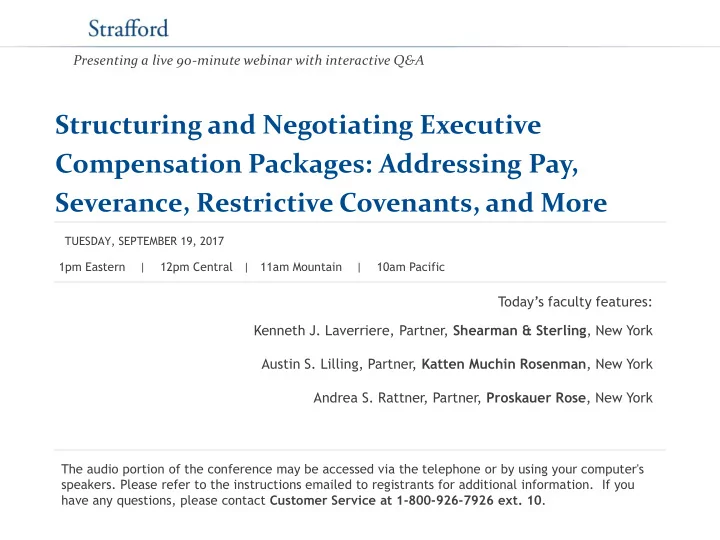
Presenting a live 90-minute webinar with interactive Q&A Structuring and Negotiating Executive Compensation Packages: Addressing Pay, Severance, Restrictive Covenants, and More TUESDAY, SEPTEMBER 19, 2017 1pm Eastern | 12pm Central |


slide-1
SLIDE 1

The audio portion of the conference may be accessed via the telephone or by using your computer's

  • speakers. Please refer to the instructions emailed to registrants for additional information. If you

have any questions, please contact Customer Service at 1-800-926-7926 ext. 10.

Presenting a live 90-minute webinar with interactive Q&A

Structuring and Negotiating Executive Compensation Packages: Addressing Pay, Severance, Restrictive Covenants, and More

Today’s faculty features:

1pm Eastern | 12pm Central | 11am Mountain | 10am Pacific TUESDAY, SEPTEMBER 19, 2017

Kenneth J. Laverriere, Partner, Shearman & Sterling, New York Austin S. Lilling, Partner, Katten Muchin Rosenman, New York Andrea S. Rattner, Partner, Proskauer Rose, New York

slide-2
SLIDE 2

Tips for Optimal Quality

Sound Quality If you are listening via your computer speakers, please note that the quality

  • f your sound will vary depending on the speed and quality of your internet

connection. If the sound quality is not satisfactory, you may listen via the phone: dial 1-866-258-2056 and enter your PIN when prompted. Otherwise, please send us a chat or e-mail sound@straffordpub.com immediately so we can address the problem. If you dialed in and have any difficulties during the call, press *0 for assistance. Viewing Quality To maximize your screen, press the F11 key on your keyboard. To exit full screen, press the F11 key again.

FOR LIVE EVENT ONLY

slide-3
SLIDE 3

Continuing Education Credits

In order for us to process your continuing education credit, you must confirm your participation in this webinar by completing and submitting the Attendance Affirmation/Evaluation after the webinar. A link to the Attendance Affirmation/Evaluation will be in the thank you email that you will receive immediately following the program. For additional information about continuing education, call us at 1-800-926-7926

  • ext. 35.

FOR LIVE EVENT ONLY

slide-4
SLIDE 4

Program Materials

If you have not printed the conference materials for this program, please complete the following steps:

  • Click on the ^ symbol next to “Conference Materials” in the middle of the left-

hand column on your screen.

  • Click on the tab labeled “Handouts” that appears, and there you will see a

PDF of the slides for today's program.

  • Double click on the PDF and a separate page will open.
  • Print the slides by clicking on the printer icon.

FOR LIVE EVENT ONLY

slide-5
SLIDE 5

5 5

Today’s Agenda

  • Threshold Considerations
  • Types of Compensation
  • Negotiating Severance
  • Change in Control (CIC) Considerations
  • Restrictive Covenants
  • Other Key Provisions and Considerations

5

slide-6
SLIDE 6

6 6

Threshold Considerations – Pros and Cons of Entering into Executive Employment Agreements

  • Employer’s Perspective ̶

Pros Cons

Helps attract key talent, particularly individuals leaving current employment May limit employer’s flexibility, including by locking in financial and other commitments, locking in title/role Typically contains restrictive covenants that are beneficial to employer and affiliates Limits ability to pivot (without executive’s consent) as the employer’s needs change over time May create a structure where expectations and conditions are generally established (e.g., execution of release as a condition to severance) May create expectations of other executives and create desire for similar agreements Fixed term contracts could delay “renegotiation” of the business deal May undercut ability to have uniform severance program for certain levels of employees and may encourage individual deals May provide clarity as to dispute resolution (e.g., arbitration, jury trial waiver, choice of law, injunctive relief) Increases scrutiny (and potential criticism) by institutional investors Adds economic consequences to “at-will” employment Enhanced legal compliance and considerations (e.g., SEC disclosure, tax considerations (e.g., 409A, 280G and 162(m)) and employment law considerations

6

slide-7
SLIDE 7

7 7

Threshold Considerations – Pros and Cons of Entering into Executive Employment Agreements (cont’d)

  • Executive’s Perspective ̶

Pros Cons

May provide significant protection to executive in event of certain termination event of certain termination events or possibly events or possibly in connection with a Change in Control Often contains restrictive covenants, which may negatively impact future prospects and employment Adds economic consequences to “at-will” employment Upfront compensation, such as a signing bonus, structured as a retention payment to require a clawback if employment termination precedes certain date Establishes employer’s financial and other commitments to executive (e.g., title, position, reporting, salary, benefits, severance) Certain protections may be asked to be waived (e.g., arbitration vs. court proceeding) Creates greater certainty in event of breach and/or termination (e.g., economic and non-economic consequences)

7

slide-8
SLIDE 8

8 8

Threshold Considerations – Term

  • Fixed term ̶ The term sets the parties’ expectations and provides for a

specified period of time during which the employer and the employee are bound to the agreement and its obligations.

  • Term Considerations:
  • Automatic renewals unless notice of “non-renewal” by either party

 What should be proper notice period (e.g., 90 days-6 months)?

  • Opportunity to renew upon notice of “renewal”
  • “Fixed term” without renewal opportunities
  • “No term” and open-ended
  • “Term” generally refers to period of agreed upon employment, not

duration of agreement, as agreement will typically contain obligations that continue after employment

8

slide-9
SLIDE 9

9 9

Threshold Considerations – Term (cont’d)

  • What is the relevance of the “term”?
  • Creates a time period during which the employee is expected to be

employed and during which the employer is expected to employ the executive under agreed upon terms

  • What are the consequences if employer/executive terminates employment

during the stated term?  Employer pays what it would otherwise pay?  Stipulated severance?  Can the employee quit during the term without breaching the agreement?

  • Sometimes used as a basis for calculating severance (e.g., severance is

salary that would have otherwise been paid until end of term; sometimes minimum severance is included, sometimes target bonus opportunities are included)

9

slide-10
SLIDE 10

10 10

Threshold Considerations – Term (cont’d)

  • What happens at end of term?
  • Is severance paid on the employer’s non-renewal?
  • Does employment terminate or just agreement?
  • If employment not terminated, will employment continue on an at-will basis?
  • How does continued employment on an at-will basis affect the restrictive

covenants, if they are solely embedded in the expired employment agreement?

10

slide-11
SLIDE 11

11 11

Threshold Considerations –Title/Duties/Reporting

  • Senior executive agreements (CEO, EVPs) tend to have precise titles,

duties and reporting lines.

  • Mid-level contracts, if offered, tend to be open-ended to preserve

employee flexibility.

  • Interplay of stated duties, reporting structure, and title with Good

Reason

11

slide-12
SLIDE 12

12 12

Threshold Considerations – Time Commitments

  • Time Commitment: Duty to act in best interest of employer and dedicate time to the

business (e.g., all time, substantially all time, business time).

  • Possible carve-outs for pre-approved and other permitted outside activities (e.g.,

serving on not-for-profit boards and other charitable endeavors, serving on for-profit boards (typically with pre-approval), speaking at industry events, managing personal investments).

  • Ability to shut down activity if “materially interferes” or interferes in any “material

respect” or general discretion to shut down or refuse.

  • Ability to shut down if “competitive” or conflict of interest
  • May be relevant in determining whether the executive has Good Reason to

terminate employment and collect severance

12

slide-13
SLIDE 13

13 13

Types of Compensation – Base Salary

  • Base salary ̶ Initial rate of base salary virtually always stated in executive employment

agreement and is a core feature of the agreement, because it factors into many other elements of compensation and benefits.

  • Other considerations:
  • Annual reviews
  • Discretionary increases
  • Automatic increases (e.g., COLA)
  • Across-the-board or “class” decreases
  • What happens if the employer decides to increase base salary?
  • Does the employer have ability to reduce the salary down to initial level?

 Once increased, can it be decreased?

  • Good reason considerations
  • Often base salary is used as the basis for or a component of severance formula
  • Code Section 162(m) tax deductibility concerns for base salary in excess of $1M paid to

certain named executive officers of a public company

13

slide-14
SLIDE 14

14 14

Types of Compensation – Bonus/Short-term Incentive Pay

  • Annual bonuses
  • Discretionary or Performance–based

 If performance-based, how and when are goals set and communicated  Should agreement provide for clawback of amounts paid (e.g., in error, misconduct, restating financials)

  • General or specific

 Consider whether to specify percentage of base salary to be paid as a bonus at threshold, target, maximum performance  Is there a plan?

  • Consider impact of termination

 Must be employed at payment date or year-end to receive bonus?  What about certain termination events such as death, disability, by the employer without Cause or by executive for Good Reason

14

slide-15
SLIDE 15

15 15

Types of Compensation – Bonus/Short-term Incentive Pay (cont’d)

  • Annual bonuses (cont’d)
  • Special bonuses, sign-on bonuses (with pay-back provisions), make-whole

bonuses

  • Guaranteed or multi-year bonus
  • Code Section 409A considerations: Short term deferral or 409A compliant (e.g.,

paid when otherwise paid in the event of a termination)

  • Code Section 162(m) considerations for performance-based bonuses

15

slide-16
SLIDE 16

16 16

Types of Compensation – Long-term Incentive Pay

  • Threshold Question: Public or Private Company?
  • Different approaches
  • Cash or Equity
  • Initial grant
  • Annual grants (universal), or grants in alternate years
  • Length of performance period, 3 years, 5 years, longer?
  • Setting performance goals – “all or nothing” or tiered approach?
  • Equity
  • Options (ISO, NSO), SARs, Restricted Stock, RSUs, Deferred Stock
  • Private v. Public Company considerations
  • LLCs – Profits Interests – valuation and 83(b)
  • Phantom Stock
  • Code Section 162(m) and 409A considerations
  • What does employment agreement provide? “No legally binding right” until award

16

slide-17
SLIDE 17

17 17

Types of Compensation – Equity

  • Amount (percentage)—dilution/anti-dilution considerations
  • Vesting – time or performance
  • Methods of Option Exercise – cashless exercise
  • Restricted Stock taxable on vesting (unlike options) – 83(b) election not later than 30

days after grant of restricted stock

  • Consideration for making/not making an 83(b) election
  • High/Low value of equity, risk of decline in value and substantial risk of forfeiture
  • Private Company: 409A Valuation – reasonable valuation
  • Private Company: Liquidity/Shareholder Rights
  • Voting/Management Rights
  • Preemptive Rights
  • Drag-along/Tag-along

17

slide-18
SLIDE 18

18 18

Types of Compensation – Benefits and Perquisites

  • Supplemental Executive Retirement Plans – defined benefit or defined contribution
  • Vacation and other Paid Time Off – company policy or special provisions?
  • Expense reimbursement – Code Section 409A considerations
  • Relocation expenses
  • Tax Gross–Up Payments
  • Tax Equalization Payments (foreign tax liability)
  • Outplacement
  • Financial planning, club dues, car allowance, office/support staff, technology budget,

general fringe benefits

  • Welfare Benefits:
  • Health Benefits – PPACA considerations, non-discrimination rules applicable to

fully insured plans

  • Life Insurance – split-dollar insurance – Code Section 409A considerations

18

slide-19
SLIDE 19

19 19

Negotiating Severance – Primary Termination Considerations

  • Types of Termination ̶ An employment agreement generally sets forth the types of

events that terminate the agreement and/or the employment relationship and the specific consequences resulting from such event of termination:

  • Death, disability, without Cause, for Cause, resignation without Good Reason,

resignation for Good Reason, expiration of term

  • Definitions of Cause, Good Reason, Disability
  • Cure rights, notice, prongs
  • Accrued Amounts
  • Vacation, expenses, prior years’ bonuses (if last day of year requirement)
  • Severance Benefits and Timing
  • Termination Procedure
  • Notice and Date of Termination

19

slide-20
SLIDE 20

20 20

Negotiating Severance – Primary Termination Considerations (cont’d)

  • Release Requirements
  • Internal Revenue Code Sections 409A, 457A, 162(m) and PPACA
  • Treatment of Equity Rights
  • Change in Control Considerations
  • Puts and calls
  • Option expiration and ISO treatment

20

slide-21
SLIDE 21

21 21

Negotiating Severance – Termination Events

  • Death: Easy to determine! Death benefits under an employment agreement may be a

point of contention.

  • Disability: There is often some discussion about what “disability” should mean and

what benefits should be payable therefrom. The definition is relevant if the benefits provided on disability differ from those payable upon without cause termination.

  • Stringent definition: e.g., 409A definition - unable to engage in any substantial

gainful activity because of a medically determinable physical or mental impairment that can be expected to result in death or to last for a continuous period of at least 12 months; or (b) he or she has been receiving income replacement benefits for at least three months under an accident and health plan of the service recipient as the result of a medically determinable physical or mental impairment that can be expected to result in death or to last for a continuous period of at least 12 months.

  • Less stringent definition: inability to perform material duties for certain specified

periods (e.g., any [90]-day consecutive period or [180] days in any 365-day period)

21

slide-22
SLIDE 22

22 22

Negotiating Severance – Termination Events (cont’d)

  • Many employers will take the position that death and disability benefits should

be obtained by the employee other than from the employer on the open market with after-tax compensation, or limit benefits to those provided by employer-provided group programs (via life and disability insurance)

22

slide-23
SLIDE 23

23 23

Negotiating Severance – With and Without “Cause”

  • Negotiation of the agreement’s “Cause” provisions are often the most heavily

negotiated provision of the agreement (along with ”Good Reason”).

  • Employer does not want to have to pay severance to a bad actor
  • Executive wants to protect himself/herself from terminations for arbitrary reasons or

events not within control

  • Executive generally wants:
  • ”good faith poor performance” excluded from Cause
  • to avoid overly subjective triggers.
  • Where employment agreements lack a Cause definition, the employer will generally

have broader discretion to determine what Cause means, and this could include poor performance.

  • Cause often includes prongs relating to: (i) failure to perform duties, (ii) negligence and

misconduct, (iii) criminal activity, (iv) dishonesty, fraud, embezzlement, (v) violation of company policy (including substance abuse policy where abuse hinders ability to perform), (vi) breach of contract (including covenants), (vii) loss of license required to perform duties, (viii) breach of employee reps in agreement.

23

slide-24
SLIDE 24

24 24

Negotiating Severance – Drafting Cause

  • Cure rights and notice: Should executive have a limited cure right for acts that are not

intentional or clear on their face?

  • For example, a cure right would not often be afforded to a material breach of a

covenant or willful misconduct.

  • Cure rights generally from 5-30 days.
  • Employers are asked to agree to provide notice somewhat timely of the event

constituting Cause so as not to prejudice the employee’s right to cure.

  • Agreement on notice is important since failure to provide notice in required time

could constitute a “waiver of the grounds constituting Cause. Should the notice have to be given from actual knowledge” by employer or “when employer should have known”?

  • “Procedural equivalents”: When discussing “conviction” or “felony” consider adding “or

their procedural equivalent” so as not to cause a technical issue under state law differentiations

  • Due Process: Should the executive have an opportunity to present his/her case to the

Board and/or should the Board have to act unanimously, by super-majority or should simple majority suffice? Definition of “willful” (bad faith)

24

slide-25
SLIDE 25

25 25

Negotiating Severance – Drafting Cause (cont’d)

  • Qualifiers: “Gross,” “material,” “that results in/could reasonably be expected to result in

material harm to the company and its affiliates,” “substantial failure to perform”

  • Crimes: Conviction vs. Commission
  • Suspension Rights: Should employer have right to suspend executive with pay

(without tripping Good Reason) so as to investigate Cause?

25

slide-26
SLIDE 26

26 26

Negotiating Severance – The other side of the coin: Good Reason

  • The corollary to Cause is “Good Reason,” which provides protections to the executive

from “bad acts” of the employer. This provision is intended to prevent a “constructive discharge” whereby the executive is forced to quit and give up severance. This definition is also highly negotiated.

  • Saying to CEO: “Go clean toilets...”
  • Good Reason may include prongs relating to: (i) diminution in duties, title, authority,

responsibilities, etc., (ii) relocation of principal place of business, (iii) breach of employer’s obligations under agreement, (iv) failure to pay compensation, (v) reduction in compensation and benefits, (vi) change in direct report, (vii) adverse changes following a change in control.

  • The employer is most concerned about running its business and the executive is most

concerned about an adverse change in the business deal.

  • Earlier parts of the agreement, such as base salary, title, reporting, could be in play

here.

26

slide-27
SLIDE 27

27 27

Negotiating Severance – Drafting Good Reason

  • Cure rights and notice: Should employer have a cure right? It is customary to provide

a cure right since a cure right is a material element of the “safe harbor” under 409A’s good reason definition. A second material element of the safe harbor is prompt notice by the executive to the employer of the grounds constituting good reason. Agreement

  • n notice is important since failure to provide notice in required time could constitute a

waiver of the grounds constituting good reason. Should the notice have to be given from “actual knowledge” by executive or “when executive should have known.”

  • Qualifiers: “material reduction in base salary,” “duties materially inconsistent with

executive’s title,” “material and adverse,” “material provision,” distance for relocation prong (how measured), etc.

  • Broad Operational Carve-outs: Changes in compensation of management team,

carve-outs for transactions (e.g., resulting in changes to direct report), superficial or inconsequential changes to title, or title and position relative to other executives.

27

slide-28
SLIDE 28

28 28

Negotiating Severance – Termination Benefits

  • Accrued but unpaid Base Salary: Generally paid on all types of terminations

(including Cause) as a matter of state law

  • Accrued Amounts:
  • For Cause: Generally limited to base salary and unreimbursed expenses
  • Other terminations: Could include accrued but unused vacation pay, expenses,

prior year’s unpaid but earned bonus, other amounts

  • Severance:
  • Never paid on Cause termination
  • Rarely paid on voluntary termination without Good Reason (instances might include

retirement or expiration of agreement)

  • Generally paid on Good Reason and without Cause terminations

28

slide-29
SLIDE 29

29 29

Negotiating Severance - Termination Benefits (cont’d)

  • Add in re: “no other benefits” - Agreement should provide that “except as provided

herein, no other benefits are payable (including under any severance policy) as a result

  • f termination”

Severance Attributes to Consider

Release timing for 409A Installments or lump sum Cash or property Clawbacks/forfeiture Vesting of equity Extension of option exercise period Put/call rights on equity Benefits continuation/COBRA subsidy Prorated termination year bonus Pension/SERP credit Deferred compensation vesting CIC benefit (multiplier) Mitigation Offset (consider 409A issues) 29

slide-30
SLIDE 30

30 30

Negotiating Severance – Notice and Date of Termination

  • Generally some notice of voluntary resignation without good reason is afforded to the

employer so as to accommodate a transition.

  • However, seeking notice of termination by an employer of a termination without cause

is generally looked at like an ask for additional severance.

  • No notice for Cause termination (other than required notice triggering a cure period).
  • Employer should have ability to shut off notice given by employee and effect the

termination immediately. Agreement should be clear on this right and whether compensation for the notice period must be paid.

  • Employer should also have ability to shut off notice to employee and require the

employee not come into office or perform services. 409A considerations here given that a “separation from service” would apply from the point when no further substantial services will be performed.

30

slide-31
SLIDE 31

31 31

Negotiating Severance – Release

  • It is customary that severance payments (but generally not accrued amounts required

to be paid by law) are contingent upon the execution and non-revocation of a general release of claims against the employer and its affiliates.

  • Depending on the business deal, the release is often very broadly drafted with only

specific carve-outs for employee claims to:

  • vested welfare and pension plan benefits,
  • vested indemnification and D&O rights,
  • rights to contribution/exculpation, if any,
  • rights other than as an employee (for example, if there are rights held as investor,

noteholder, or stockholder of employer),

  • rights to receive severance serving as the consideration for the release (i.e., to

enforce the agreement),

  • rights that cannot be released as a matter of law.

31

slide-32
SLIDE 32

32 32

Negotiating Severance – Release (cont’d)

  • IRS Notice 2010-80 provides that release return and effectiveness cannot affect

payment timing of deferred compensation under 409A.

  • Agreement should provide that release must be executed and not revoked within [60]

days from termination date. This should not affect payment timing and thus not violate

  • 409A. Since ADEA’s maximum consideration period is 45 days, and the revocation

period is 7 days, then depending upon the time period in which the employer has to provide an execution copy (which should be stated in the agreement), the period could be as short as 52 days. [45+7+ [5] day period in which to deliver is 57 days (generally rounded up to 60)]

  • Employer needs to build in 45 (rather than the 21 day ADEA period) since employer will

not know at outset whether a group termination could be triggered under ADEA.

  • Alternatively, use the “deemed later of two years” provision, where release period spans

two calendar years.

32

slide-33
SLIDE 33

33 33

Negotiating Severance – Release (cont’d)

  • If severance is in the form of installments, the parties should determine in the

agreement whether:

  • Installments commence on the [60th] day, or
  • Installments commence as of separation date, but any installments that would have

been payable in such [60]-day period are accumulated and paid with the first scheduled installment payment following the 60-day period, or

  • If the [60]-day period begins in one year and ends in the following, provide that

payments will not commence before the beginning of the second year.

  • Sometimes the form of release is attached to employment agreement, with the

provision for changes to be made to affect applicable law changes and other reasonable changes. This minimizes potential controversy in the future and allows for the execution copy to be delivered within the agreed time without violating the timing provisions described above.

33

slide-34
SLIDE 34

34 34

Internal Revenue Code Section 409A

  • Internal Revenue Code Section 409A put limits on deferred compensation, which could

include amounts under employment agreements. Failure to be exempt from or satisfy requirements could result in significant additional taxes to service provider and add tension to the service relationship.

  • Section 409A applies only to cash method taxpayers and is a concern of most

employers.

  • Wreaks havoc on compensation practices that were traditionally permitted.
  • 409A requires that deferred compensation be deferred in accordance with a robust set
  • f rules governing initial deferral elections, payment timing, re-deferral elections,

accelerations, etc.

  • Important to determine at outset whether an exception applies: two main exceptions are

“short-term deferral” and “two times pay.”

34

slide-35
SLIDE 35

35 35

Internal Revenue Code Section 409A

  • Exceptions:
  • Short-term deferral: Compensation cannot be paid later than 2.5 months following

year of vesting. The applicable 2.5 month-period is the later of the employer’s or the employee’s first tax year after the year of vesting

  • Two times pay exception: 2x lesser of annualized compensation for most recently

completed taxable year or the 401(a)(17) limit ($270,000 annually or $540,000 for 2017) must be paid

  • Stacking permitted
  • Every employment agreement should address the following issues, as applicable:
  • Separate payments
  • 6-month delay: Must provide a firm date (i.e., first day of 7th month). Don’t use no

earlier than the 6-month anniversary.“ Not specific enough.

35

slide-36
SLIDE 36

36 36

409A Implications

  • Taxable expense reimbursement mechanics
  • Definitions (separation from service)
  • 409A catchall (savings clause). Customary to see a “no guarantee/no liability” clause

shielding employers as a contractual matter.

  • Good Reason mechanics (cure, prompt notice)
  • Release mechanics
  • Considerations should be made if amounts are payable in respect of a voluntary

termination without good reason. Could result in “vesting” and 409A issues. (Note: IRC Section 457A issues can also arise in this instance)

  • Toggle issues (Paying compensation different forms/times depending on type of

termination)

  • Change in Control definition (limits under 409A)

36

slide-37
SLIDE 37

37 37

Internal Revenue Code Section 162(m) and PPACA

  • 162(m) Performance-based Compensation considerations upon termination:
  • Rev. Rul. 2008-13 provides that if performance-based compensation could be paid

as a result of events other than performance, then the compensation does not qualify as performance-based compensation even if not paid as a result of such

  • events. Thus, considerations must be taken when affording vesting/payment on

terminations of employment in public companies’ employment agreements with applicable NEOs.

  • PPACA and COBRA continuation:
  • Health care reform expanded 105(h) to insured plans (although specific guidance is

pending). Notwithstanding, providing for subsidized COBRA under an insured plan to a highly compensated employee/class may result in discrimination under PPACA and other applicable laws, and as such, adverse tax and other consequences could result (such as having to provide the subsidy to the class discriminated against and injunctive relief ceasing behavior).

37

slide-38
SLIDE 38

38 38

Internal Revenue Code Section 162(m) and PPACA (cont’d)

  • Consider qualifier when dealing with post-termination health benefits:
  • “to the extent the benefits hereunder would result in adverse tax or other

consequences to the Company under Section 4980D of the Code, such other Code Section, or other applicable law, including, without limitation, the Employee Retirement Income Security Act of 1974, as amended (“ERISA”), then the Parties agree to negotiate in good faith an alternative arrangement for providing such benefits in an economically neutral manner which does not cause the imposition of such tax and adverse consequences, provided that if in the reasonable determination of the Company’s accountants, such alternative arrangement cannot be achieved, then such benefit shall be forfeited without consideration therefor.”

38

slide-39
SLIDE 39

39 39

Equity Considerations

  • Puts and Calls and Valuation—Private Companies:
  • Consider whether an employment agreement should provide for post-termination

put and call rights following certain terminations

  • Put/Call Valuation: Book/Purchase Price, FMV, Formula
  • Generally there is punitive pricing for such rights in respect of a termination for

Cause.

  • Mechanics are generally in a shareholders agreement, LLC agreement, plan

document or applicable employment arrangement

  • Options expiration (409A) and vesting
  • Providing for extended period within which to exercise options following termination

should be limited to the original stated term of the option so as not to result in a 409A modification.

  • Accelerated vesting of option on termination should not result in a modification under
  • 409A. ISO treatment
  • Note that character as an ISO expires (treated as nonqualified option) after 90-day

period following employee/employer relationship ceases. Both parties should be aware

  • f this when negotiating termination benefits.

39

slide-40
SLIDE 40

40 40

Change in Control Considerations

  • Enhanced severance
  • Severance eligible terminations following a change in control may result in

enhanced severance

  • Often the severance multiplier is increased; Trend is toward a shrinking of the

multiple

  • Acceleration of Equity – definition of Change in Control important
  • Triggers
  • Single trigger (CIC only)
  • Modified single trigger (CIC + walkaway window)
  • Double trigger (CIC + without Cause/Good Reason)
  • Change in control benefits are a focal point for institutional shareholder advisors (e.g.,

ISS) and disclosure and say on pay issues must be considered.

40

slide-41
SLIDE 41

41 41

Public Company Concerns

  • Timing and Announcement and Form 8-K
  • Board and Compensation Committee approvals, particularly of equity grants
  • Reporting and Disclosure
  • Filing of Agreement
  • Disclosure of pay and proxy statement
  • Compliance with institutional investor compensation and governance guidelines

41

slide-42
SLIDE 42

42 42

Institutional Investors

  • Key ISS Indicators:
  • Multi-year guarantees for salary increases or bonuses
  • Non-performance based bonuses
  • Excessive make-whole provisions or “one-off” awards
  • Egregious pension/SERP payouts (i.e., additional years of service)
  • Excessive perks (most significantly, tax gross-ups)
  • Single-trigger CIC payments and CIC payments that exceed 3x base and bonus
  • Lack of minimum vesting for equity
  • Use of single performance metric for bonuses, equity and other awards
  • Evergreen term
  • Key Glass-Lewis Indicators
  • Less specific than ISS
  • “Problematic contractual payments” (such as excessive and/or guaranteed

bonuses)

  • Other Institutions

42

slide-43
SLIDE 43

43 43

Internal Revenue Code Sections 280G/4999

  • Code Section 280G/Code Section 4999: Parachute payments can result in loss of

deduction to paying employer and potential excise taxes to employee.

  • Generally, parachute payments equal to or exceeding 3x the “base amount” result in

adverse tax consequences on any payment above 1x the base amount

  • Parties often consider in agreements ways to handle potential “parachute” payments,

such as:

  • Gross-ups

 Employers pay for the excise tax and the additional income tax on the gross-up payment  Employers still lose deduction under 280G

  • Modified Gross-up (i.e., will gross-up unless close to the safe harbor level by [$x])
  • Best net after-tax payment

 Employer loses deduction if not cutback to safe harbor levels

  • Cutback

 No loss of deduction or excise tax.

  • Important planning opportunity to ensure compensation is not back-loaded or

excessively deferred. Also, 280G provisions might set forth the manner and order of cutback (i.e., cash first, then equity, etc.)

43

slide-44
SLIDE 44

44 44

Restrictive Covenants – Scope and Breadth

  • Restrictive covenants protect employers from a former employee’s competition and
  • ther detrimental activity
  • What interests do employers typically wish to protect?
  • Trade secrets

 Confidentiality

  • Goodwill

 Non-solicitation of customers/clients

  • Reputation

 Nondisparagement

  • Employees

 Non-solicitation of employees

44

slide-45
SLIDE 45

45 45

Restrictive Covenants – Scope and Breadth (cont’d)

  • Key issues to consider
  • Scope of restrictions: What restraints to impose?
  • Duration of restrictions: For how long should they be imposed?
  • Geographic location of restrictions: Where should they be imposed?
  • Remedies if employee breaches restrictions?
  • Key challenge is enforceability, which largely depends on the scope and breadth of the

restrictive covenant

  • State law governs
  • Facts and circumstances / case-by-case analysis
  • Whistleblower and IP carve-outs

45

slide-46
SLIDE 46

46 46

Restrictive Covenants – Key Strategies for Restricting a Former Employee’s Activity (cont’d)

  • Traditional Covenant not to Compete – Contractual provision restricting employee’s

activity for a set time and in a geographic area. Issues affecting enforceability:

  • Are the time and geographic restrictions reasonable?
  • Are the restrictions necessary to protect the employer’s legitimate interests?
  • Are the restrictions harmful to the general public?
  • Are the restrictions unreasonably burdensome to the employee?
  • No black and white test as to what constitutes reasonable restrictions
  • Employee Choice Doctrine (includes clawbacks) – Employer provides employee with

compensation subject to forfeiture upon employee’s breach of a restrictive covenant (employee who leaves his employer makes an informed choice between forfeiting his benefit or retaining the benefit by avoiding competitive employment)

46

slide-47
SLIDE 47

47 47

  • “Springing Consideration” – Provides employer with choice at the time of termination as

to whether it wishes to pay additional consideration for the restrictive covenant

  • Garden Leave – Employer requires the employee to give advance notice of termination;

Employee is sent home but restricted during the notice period, while employer continues to pay employee during the period

  • Liquidated Damages – Employer and employee agree on employee’s liability in the

event of a breach; cannot constitute a “penalty”

47

Restrictive Covenants – Key Strategies for Restricting a Former Employee’s Activity (cont’d)

slide-48
SLIDE 48

48 48

Restrictive Covenants – Enforcement Problems

  • Enforcement of restrictive covenants is a function of state law
  • Some states have passed statutes governing enforceability of restrictive covenants
  • New York does not have such a statute
  • States differ on definitions of key concepts
  • Significant challenges in certain states (e.g., California)

48

slide-49
SLIDE 49

49 49

Restrictive Covenants – Drafting Pitfalls

To avoid drafting issues:

  • Avoid taking a “one size fits all” approach: Highly subjective area of law based on all

facts and circumstances.

  • Account for (i) State law considerations, (ii) business considerations and the

marketplace, (iii) enforceability, if overbroad, and (iv) employer’s needs and protectable interests

  • Coordinate documentation and make sure documents “speak to one another“
  • Avoid different versions of restrictive covenants in different documents for an

executive

  • Include key provisions:

 Identify restrictions  Damages/Remedies/Injunction  Tolling (extension of restriction period in the event of breach)  Jurisdiction / blue pencil and severability  Choice of law

  • Consider alternatives to “traditional covenants not to compete”

49

slide-50
SLIDE 50

50 50

Restrictive Covenants – Drafting Pitfalls (cont’d)

  • Be mindful of Code Section 409A consequences
  • Switching from lump sum specified in agreement to installments to enable

employer to cease payments when employee breaches restrictive covenants

  • Using noncompete with consulting raises issues concerning the timing of

“separation from service” for triggering severance and other nonqualified deferred compensation payments under Code Section 409A

  • Issues with garden leave and Code Section 409A

50

slide-51
SLIDE 51

51 51

Other Key Provisions and Considerations

  • Clawbacks
  • Indemnification
  • D&O Insurance
  • Duty or no duty to mitigate
  • Governing law
  • Dispute Resolution
  • Headings
  • Counterparts
  • Electronic documents/execution

51

slide-52
SLIDE 52

52 52

Thank You

Kenneth J. Laverriere Shearman & Sterling klaverriere@shearman.com Austin S. Lilling Katten Muchin Rosenman austin.lilling@kattenlaw.com Andrea S. Rattner Proskauer Rose arattner@proskauer.com

52