structure. Each carbon atom is bonded to three other carbon atoms - - PowerPoint PPT Presentation

structure
SMART_READER_LITE
LIVE PREVIEW

structure. Each carbon atom is bonded to three other carbon atoms - - PowerPoint PPT Presentation

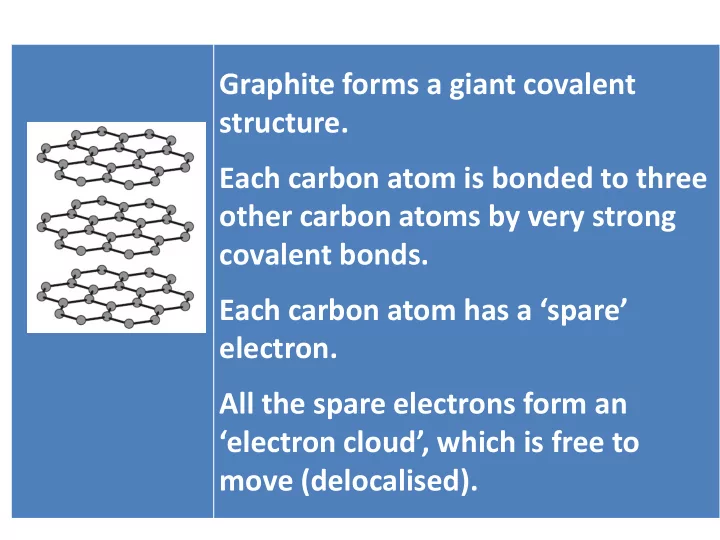
Graphite forms a giant covalent structure. Each carbon atom is bonded to three other carbon atoms by very strong covalent bonds. Each carbon atom has a spare electron. All the spare electrons form an electron cloud, which is free


slide-1
SLIDE 1

Graphite forms a giant covalent structure. Each carbon atom is bonded to three

  • ther carbon atoms by very strong

covalent bonds. Each carbon atom has a ‘spare’ electron. All the spare electrons form an ‘electron cloud’, which is free to move (delocalised).

slide-2
SLIDE 2

Substance Description Picture Diamond A hard, clear non-metal Graphite A soft, slippery, grey, solid non- metal

slide-3
SLIDE 3

Property Diamond Graphite Melting point 3550oC 3652-3697oC (sublimes) Hardness Very hard Very soft Electrical conductivity Poor Good

slide-4
SLIDE 4

Diamond forms a giant covalent structure. Each carbon atom is bonded to four other carbon atoms by very strong covalent bonds. There are no ‘free’ electrons.

slide-5
SLIDE 5

Graphite is used for pencils and as a lubricant to reduce friction on moving surfaces.

slide-6
SLIDE 6

An electric current is the movement of free electrons.

slide-7
SLIDE 7

Diamonds are used for jewellery and in drills for cutting through rock.

slide-8
SLIDE 8

The layers in graphite are held together by weak forces. These forces are easily broken.