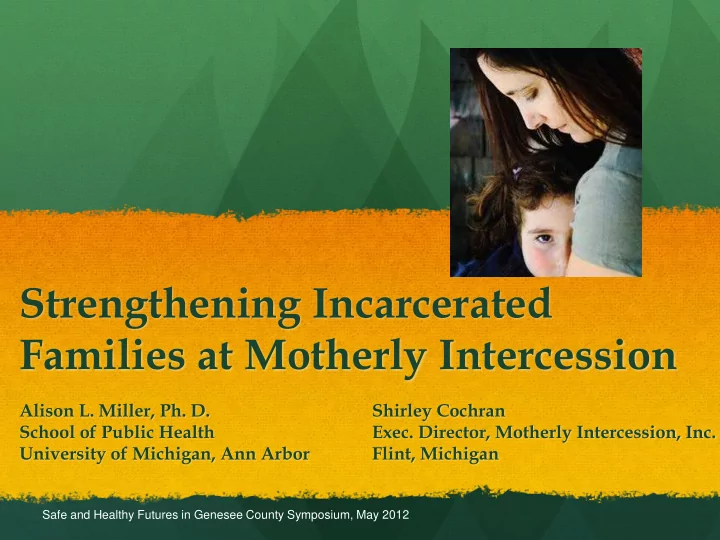
Strengthening Incarcerated Families at Motherly Intercession Alison - - PowerPoint PPT Presentation

strengthening incarcerated families at motherly
SMART_READER_LITE
LIVE PREVIEW

Strengthening Incarcerated Families at Motherly Intercession Alison - - PowerPoint PPT Presentation

Strengthening Incarcerated Families at Motherly Intercession Alison L. Miller, Ph. D. Shirley Cochran School of Public Health Exec. Director, Motherly Intercession, Inc. University of Michigan, Ann Arbor Flint, Michigan Safe and Healthy


slide-1
SLIDE 1

Strengthening Incarcerated Families at Motherly Intercession

Safe and Healthy Futures in Genesee County Symposium, May 2012

Alison L. Miller, Ph. D. School of Public Health University of Michigan, Ann Arbor Shirley Cochran

  • Exec. Director, Motherly Intercession, Inc.

Flint, Michigan

slide-2
SLIDE 2

Incarceration: Acute Stress for Chronically Stressed Families

Financial Insecurity Housing Instability Change in caretaking roles, responsibilities Parent Incarceration May fracture family structure, harm relationships, place children at risk Child Outcomes Altered Parent-Child Relationship

slide-3
SLIDE 3

Facts and Figures

 1.5-2 million children have parents currently incarcerated  203% increase in women incarcerated from 1995-2008

 High rates of drug abuse; mental illness; homelessness  Tougher drug laws = longer sentences

 75%-80% are mothers; many w/multiple children <18 yrs

Children living in poverty more likely to be affected by parental incarceration, increasing their risk of “falling through the cracks”

slide-4
SLIDE 4

Inmates have Young Children

Less than 1 year old, 2% 1-4 years old, 20% 5-9 years old, 35% 10-14 years old, 28% 15-17 years old, 15%

Mumola, C. (2000). Incarcerated parents and their children (NCJ 182335). Washington, DC: US Department of Justice, Bureau of Justice Statistics.

slide-5
SLIDE 5

Disparities: Whose Parents Are Incarcerated?

Approximately 7%

  • f African-American

children, compared to 2% of all children, have at least one parent incarcerated

slide-6
SLIDE 6

Developmental Issues and “Hidden Victims”

Young children may not understand incarceration; attachment concerns Behavior problems may increase during adolescence, with serious consequences Children of all ages may experience stigma, shame, grief/loss, school problems, and unmet needs

slide-7
SLIDE 7

Children of Incarcerated Parents: A Bill of Rights

 I have the right to be kept safe and informed at the time of my parent’s arrest.  I have the right to be heard when decisions are made about me.  I have the right to be considered when decisions are made about my parent.  I have the right to be well cared for in my parent’s absence.  I have the right to speak with, see and touch my parent.  I have the right to support as I face my parent’s incarceration.  I have the right not to be judged, blamed, labeled because my parent is incarcerated.  I have the right to a lifelong relationship with my parent.

Created by the San Francisco Children of Incarcerated Parents Partnership (SFCIPP) http://www.sfcipp.org/index.html

slide-8
SLIDE 8

Children of Incarcerated Parents: A Bill of Rights

 I have the right to be kept safe and informed at the time of my parent’s arrest.  I have the right to be heard when decisions are made about me.  I have the right to be considered when decisions are made about my parent.  I have the right to be well cared for in my parent’s absence.  I have the right to speak with, see and touch my parent.  I have the right to support as I face my parent’s incarceration.  I have the right not to be judged, blamed, labeled because my parent is incarcerated.  I have the right to a lifelong relationship with my parent.

Created by the San Francisco Children of Incarcerated Parents Partnership (SFCIPP) http://www.sfcipp.org/index.html

slide-9
SLIDE 9

Hungerford, G. (1996). Caregivers of children whose mothers are incarcerated: A study of the kinship placement system. Children Today, 24 (1), 23-28.

50% 18% 15% 3% 4% 10% Grandmother/father Father Sibling/Cousin Ex- in laws Friends Foster care

Who Cares for these Children?

slide-10
SLIDE 10

Challenges Reported by Caregivers

Financial concerns , 36% Children's behavior problems , 32% Feeling

  • verburdened ,

28% Dealing with

  • ther family

members , 24% Mother's incarceration , 16% Living conditions , 8%

Mackintosh, V., Myers, B & Kennon, S. (2006). Children of incarcerated mothers and their caregivers: Factors affecting the quality of their

  • relationship. Journal of Child and Family Studies, 15(5), 581-596
slide-11
SLIDE 11

Programs and Resources

 Inmate job training, education, some parenting programs (rare; e.g., prison nurseries)  Visitation programs

 E.g., Girl Scouts Behind Bars  Geographic barriers (prison)

 Mentoring programs

 E.g., Big Brothers Big Sisters – Mentoring Children of Prisoners

 Few programs support families/caregivers on the

  • utside
slide-12
SLIDE 12

Mission: To break the cycle of intergenerational incarceration

Our Vision: That children of incarcerated parents will realize their parent’s destiny… Does not have to be their destiny!

slide-13
SLIDE 13

Shirley Cochran, Executive Director and Co-I

 Community-based organization serving children of incarcerated parents (mothers) in Flint  Started in 1999 as jail visitation program  Provides support for families  Partnership with UM-SPH http://www.motherly-intercession.org/

slide-14
SLIDE 14

Motherly Intercession : Strengthening Incarcerated Families

Children of Incarcerated Parents Incarcerated Mothers Caregivers

slide-15
SLIDE 15

2 Grants to Build Capacity and Meet Family Needs

 Locally Tailored Programs for Children of Incarcerated Parents and their Caregivers

National Institute of Mental Health (NIMH) PI Miller, grant #R21 MH081921  Parenting While Incarcerated Michigan Institute for Clinical Health Research (MICHR) PI Miller/Co-I Cochran, grant #U029861-186334

slide-16
SLIDE 16

Strengthening Families Program [SFP]

(Kumpfer, 1989)  Developed for families with a substance-abusing parent  Strength-based, family based, focused on young children  Evidence-based, manualized, support for training

slide-17
SLIDE 17

Two SFP-Based Programs

 Strengthening Families Program [SFP]

 16-weeks – evenings @Motherly Intercession  Caregiver/Parent, Child, Family Groups  Transportation, meals, child care are provided

 Parenting While Incarcerated [PWI]

 14-weeks – 1 hour in jail each week  For incarcerated mothers

 Process and Outcome Evaluations

slide-18
SLIDE 18

Who Participated in Programs?

31 Caregivers/Parents in SFP

 14 grandmothers; 14 mothers; 1 grandfather; 1 father; 1 aunt  64% African-American; 36% Caucasian  Ages: 22 to 70 years (M = 46 years)

29 Children (plus siblings/cousins) in SFP

 18 girls, 11 boys  62% African-American, 38% Caucasian  Ages: 4 to 14 years (M = 8.5 years)

38 Mothers in PWI (different families)

slide-19
SLIDE 19

Details on PWI Mothers

African American 36% Caucasian 57% Hispanic 7%

Mothers’ Age: 30.74 years (range: 21-42) Average number of children: 2.4 (range: 1-6) Average age of children: 7.7 years (range: 6 months – 18 years)

slide-20
SLIDE 20

What outcomes did we measure?

 SFP Caregivers

 Parenting strategies, family functioning, social support, depression, child behaviors

 PWI Mothers

 Beliefs about parenting and discipline

 Satisfaction was reported for SFP and PWI

slide-21
SLIDE 21

Strengthening Incarcerated Families Programming: Evaluation Results

slide-22
SLIDE 22

SFP and PWI had High Participation and Low Dropout

 81% of SFP families completed all assessments (pre-test, post-test, 4- month follow up)  95% of SFP families came to most sessions  58% of PWI mothers completed post-tests  These mothers attended

  • ver half (58%) of sessions

 Most PWI mothers were moved or released during PWI

slide-23
SLIDE 23

After SFP: Increased Family Organization, Family Strength, Positive Parenting, Social Support*

1 2 3 4 5

Caregiver Parenting Family Organization Family Strength Professional Helpful Support Pre Post Follow Up

* Families with the least social support at the start of SFP were less likely to complete the program, suggesting we may need to provide extra aid to these families so they can benefit from intervention.

slide-24
SLIDE 24

0.5 1 1.5 2 2.5 3

Family Conflict Child Criminal Behavior/Overt Aggression Pre Post Follow Up

After SFP: Decreased Family Conflict, Child Aggression/Criminal Behavior

slide-25
SLIDE 25

After SFP: Decreased Depression Symptoms for Caregivers

5 10 15 20 25 Caregiver Depression Pre Post Follow Up

68% of caregivers reported clinical levels of depression symptoms at pretest; 42% at post-test; and

  • nly 36% at follow-up
slide-26
SLIDE 26

Families Enjoyed the Programs

What did you like most?

 Talking with other caregivers; discussing different ways they do things; weekly meetings with good food  How to discipline without spanking

What did you learn from this class?

 To be patient with kids, ask more questions and listen.  Don't sweat the small stuff. Don't go hyper over every little thing  That no matter the distance, or why, love and involvement in your child's life is needed and all makes a healthy relationship  How much my child needs me

What did you like least?

 Conflict with work schedule; hard to commit; rushing to get here  That I had to do it in jail.

slide-27
SLIDE 27

Promising Results, but More Work To Do…

 Parental Incarceration creates stress for families left behind  Strengthening Families can help children  More can be done to reach the neediest families and caregivers

slide-28
SLIDE 28

THANK YOU!!!

 Motherly Intercession  Shirley Cochran  LaVonda Lee  Ja’Lessa Mayes  And many volunteers…  UM-SPH (*=students/interns)  Shavonnea Brown*  Susan Franzen  Talia Horwitz*  Allison Krusky*  Lara Markovitz*  Jamie Perryman*  Lauren Ramsey*  Lauren Weston*  PRC/MI (M. Zimmerman, PI)  Interns – UM Flint, SVSU, MSU  Tamara Brickey  Kaylah Foley  Danielle Lied  Alecia Nicol  Canisha Norris  Liz Van Hest  Clinical Supervisors Bridgette Cavette & Lucy Mercier  Genesee County Jail; Sheriff Pickell  Funders NIMH (grant # R21 MH081921) MICHR (grant # U029861-186334)  And last but not least… all the families!

slide-29
SLIDE 29

Resources

 fcnetwork.org/ National Resource Center on Children and Families of the Incarcerated  aecf.org/ Annie E. Casey Foundation; topic briefs  www.e-ccip.org/ Center for Children of Incarcerated Parents – offers training, program finder  ppmkids.org/ Volunteer pediatricians serve children of incarcerated parents in Michigan