Coverage and Timeliness of Maternal and Pediatric Vaccine Uptake in - - PowerPoint PPT Presentation

coverage and timeliness of maternal and pediatric vaccine
SMART_READER_LITE
LIVE PREVIEW

Coverage and Timeliness of Maternal and Pediatric Vaccine Uptake in - - PowerPoint PPT Presentation

Coverage and Timeliness of Maternal and Pediatric Vaccine Uptake in Durham Undergraduates: John Madden, Alexandra Putka, Lucy St. Charles ; Project Manager: Nick Bloom ; Project Leads: Lavanya Vasudevan, Geeta Swamy, Ashwin Machanavajjhala


slide-1
SLIDE 1

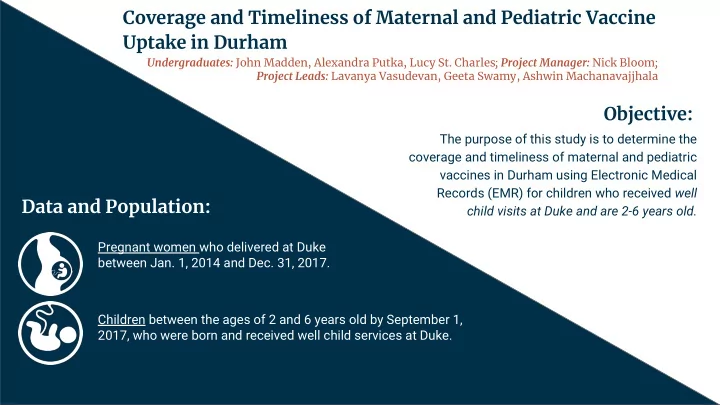
Coverage and Timeliness of Maternal and Pediatric Vaccine Uptake in Durham

Undergraduates: John Madden, Alexandra Putka, Lucy St. Charles; Project Manager: Nick Bloom; Project Leads: Lavanya Vasudevan, Geeta Swamy, Ashwin Machanavajjhala

Objective:

The purpose of this study is to determine the coverage and timeliness of maternal and pediatric vaccines in Durham using Electronic Medical Records (EMR) for children who received well child visits at Duke and are 2-6 years old.

Data and Population:

Pregnant women who delivered at Duke between Jan. 1, 2014 and Dec. 31, 2017. Children between the ages of 2 and 6 years old by September 1, 2017, who were born and received well child services at Duke.

slide-2
SLIDE 2

Descriptive Statistics: Data and Methods:

Mother Sociodemographics:

Average age of mother.

29.7 years

Child Age Distribution:

2-3 years of age. 3-4 years of age. 4 years of age.

58% 38% 4%

The combination of DEDUCE data from Duke Health with block-group level demographic information from the American Community Survey in 2016 created a macro understanding of the communities’ impact on decision making. The study then analyzed this subset of individuals for coverage and timeliness utilizing CDC recommended dosages and windows.

Methods: Data Subsetting Data:

This chart depicts the data subsetting process to create the cohort of individuals with one well child visit per year. This condition captures continued care at Duke while allowing for flexibility in visits.

slide-3
SLIDE 3

The study collected calculations for coverage and timeliness for each individual vaccination and overall. Coverage for a vaccine denotes an individual who receives all the necessary doses for a specific disease according to CDC standards. Timeliness defines an individual who receives vaccine doses during or less than a month after the dose period recommended by the CDC.

Mapping Coverage and Timeliness:

Marginal Effect of Age of Mother at Delivery on Probability of Complete Coverage Marginal Effect of Percent below Median Income on Probability of Complete Coverage

To create a logistic model, we correlated complete coverage with sociodemographic information. The logistic model includes the significant binary variables from all correlations, and the model excludes variables to ensure a statistically significant constant.

Predicted Probabilities from a Logit Regression of Complete Coverage on Individual and Neighborhood Attributes

Results

Visualizations:

slide-4
SLIDE 4

Executive summary for website

This summer, the Data+ Vaccine Hesitancy and Uptake Group analyzed Duke Health data to define and predict maternal and pediatric vaccine coverage. Standards from the Centers for Disease Control and Prevention (CDC) were used for the definitions of vaccine coverage and timeliness. The overall coverage and timeliness estimates were 63.5% and 4.99% respectively. The low level of timeliness and moderate level of coverage indicate real social barriers to vaccination such as limited time, transportation, and insurance. The probability

  • f complete coverage decreased among babies from mothers who identify as black, use tobacco, have had

previous children, are on Medicaid, or are below median income. Conversely, the probability of complete coverage increased as the age of mother increased. This work will continue through the corresponding 2018-2019 Bass Connections project Vaccine Misinformation and Its Link to Vaccine Hesitancy and Uptake in Durham.