
SLIDE 1
1
Streaming Canola across Western Canada
TSX.V: INP August 2018
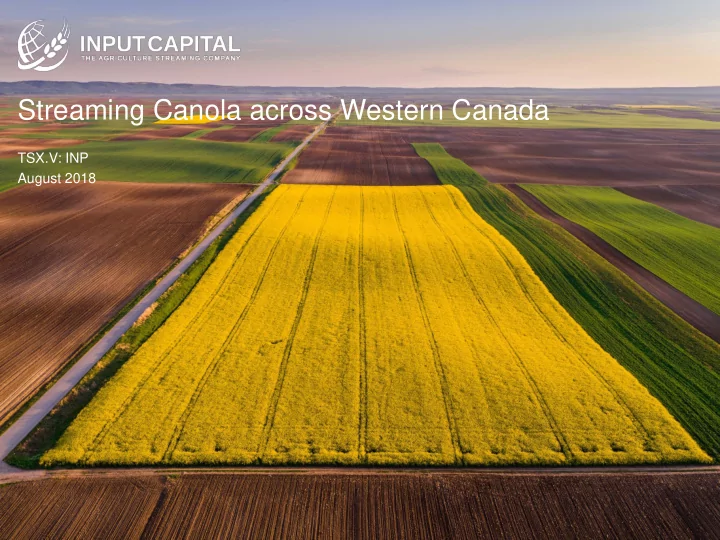
Streaming Canola across Western Canada TSX.V: INP August 2018 1 - - PowerPoint PPT Presentation
Streaming Canola across Western Canada TSX.V: INP August 2018 1 Important notice concerning this document including forward looking statements This Presentation discloses management policies, investment strategies and courses of conduct that may
1
TSX.V: INP August 2018
2
April 2017 TSX.V: INP
Important notice concerning this document including forward looking statements This Presentation discloses management policies, investment strategies and courses of conduct that may constitute “forward-looking information” within the meaning of applicable Canadian securities legislation. All statements, other than statements of historical fact, included herein may be forward-looking
“proposed”, “is expected”, “budgets”, “scheduled”, “estimates”, “forecasts”, “intends”, “anticipates” or “does not anticipate”, or “believes”, or variations of such words and phrases, or by the use of words or phrases which state that certain actions, events or results may, could, would, or might occur or be achieved. This forward-looking information reflects the Company’s current beliefs and is based on information currently available to the Company and on assumptions the Company believes are reasonable at the time of preparation. These assumptions include, but are not limited to, the actual results of investee’s being equivalent to or better than estimated results by the Company. Forward-looking information is subject to known and unknown risks, uncertainties and other factors that may cause the actual results, level of activity, performance or achievements of the Company to be materially different from those expressed or implied by such forward-looking information. Such risks and
the agricultural industry; weather; the early stage development of the farming operations or dishonesty of the streaming partners; reliance on management, uncertainty in identifying and structuring streaming agreements, liquidity of investments, potential conflicts of interest, failure of the Company to meet targeted returns, limited transferability of Shares, defaulting streaming partners, competition; changes in project parameters as plans continue to be refined; delay or failure to receive board or regulatory approvals; changes in legislation, including environmental legislation affecting the Company and its streaming partners; timing and availability of external financing on acceptable terms; conclusions of economic evaluations; and lack of qualified, skilled labour or loss of key
forward-looking information, there maybe other factors that cause results not to be as anticipated, estimated or intended. Accordingly, readers should not place undue reliance on forward-looking information. The Company does not undertake to update any forward-looking information, except in accordance with applicable securities laws. As a result of these risks and uncertainties, actual events or results and the actual performance of the Company or its business may be materially different from those reflected or contemplated in the forward looking statements or information. Likewise, in considering the prior performance information contained herein, prospective investors should bear in mind that past performance and experience is not necessarily indicative of future results, and there can be no assurance that the Company will achieve comparable results. The securities referred to herein have not been and will not be registered under the United States Securities Act of 1933, as amended (the “1933 Act”), or any state securities laws. Accordingly, these securities may not be offered or sold within the United States of America or to a U.S. Person (as such term is defined in Regulation S under the 1933 Act) unless registered under the 1933 Act and applicable state securities laws or an exemption from such registration is available.
3
Direct exposure to the growing global canola market
emerging middle classes in countries such as China, India and Brazil
to greater Canadian production = strong canola price dynamics
Investments into streaming contracts provide attractive returns
against farm assets (land, equipment, buildings)
signed up over 270 farmers in first nine months
significantly increase ROE; rock solid security; already accounts for ~50% of invested assets.
A dividend-paying growth story led by experienced owner-management team
earnings per share and distributable cash; any debt to be secured against mortgages – no operating debt
from 22.4% to 27.8% FD)
1. 88,147 MT of canola equivalent sold from streaming in the twelve month period ending June 30, 2018.
4
Previous periods restated for the twelve month periods ended June 30 to reflect trailing twelve month comparisons.
Operational Metrics Per Share Metrics
78 107 300 371 JUN 15 JUN 16 JUN 17 JUN 18
At end of quarter
Total Active Streams
25,418 56,415 62,402 88,147
JUN 15 JUN 16 JUN 17 JUN 18
TTM to date
Canola Equivalent Tonnes from Streaming
$11.6 $27.4 $29.7 $42.4 JUN 15 JUN 16 JUN 17 JUN 18
TTM to date
Adjusted Streaming Sales
(CAD Millions) $0.05 $0.24 $0.23 $0.19 JUN 15 JUN 16 JUN 17 JUN 18
TTM to date
Adj Operating CF/Share
$0.07 $0.24 $0.25 $0.23 JUN 15 JUN 16 JUN 17 JUN 18
TTM to date
Adj EBITDA/Share
$0.01 $0.04 $0.01 $0.03 JUN 15 JUN 16 JUN 17 JUN 18
TTM to date
Adj Net Income/Share
5
6
10,000 15,000 20,000 25,000 1986 1987 1988 1989 1990 1991 1992 1993 1994 1995 1996 1997 1998 1999 2000 2001 2002 2003 2004 2005 2006 2007 2008 2009 2010 2011 2012 2013 2014 2015 2016 2017
Production (Thousands MT)
Canadian Canola Production and Exports
Manitoba Saskatchewan Alberta Other Provinces Exports
global exports.
250,000 Canadian jobs and $11.2 billion in wages.
Sources: Canola Council of Canada, Statistics Canada
40 bpa yield = 21.0M MT production limit1
Canadian production has reached a production ceiling at ~40 bushels per acre; this can only be solved by higher yields, higher prices, or both.
30 bpa yield = 15.7M MT production limit1
7
2,000 4,000 6,000 8,000 10,000 12,000 14,000 16,000 18,000 $0 $100 $200 $300 $400 $500 $600 $700 $800 Jan 2010 Jul 2010 Jan 2011 Jul 2011 Jan 2012 Jul 2012 Jan 2013 Jul 2013 Jan 2014 Jul 2014 Jan 2015 Jul 2015 Jan 2016 Jul 2016 Jan 2017 Jul 2017 Jan 2018 Jul 2018
Exports (thousands MT)
Max: $669.80 Min: $359.00
agronomic limits using existing farming practices.
Source: Intercontinental Exchange and the Canola Council of Canada
8
9
Management has built and profitably exited deals in the Canadian ag space; NAV per unit growth from $18 in 2005 to ~$64
1 in 2013, ~19% IRR 2 from inception.
Entry Exit
Source: Assiniboia Farmland Limited Partnership MD&A
Launched first farmland private equity fund in Canada in 2005; raised $53M in equity through eight private and public offerings. In January 2014, closed the sale of its ~115,000 acre portfolio of Saskatchewan farmland to the Canada Pension Plan Investment Board (CPPIB) for $128M.
LP Gross NAV per Unit
10
Doug Emsley
Co-Founder, Chairman, President & CEO
and Assiniboia Capital Corp.
(2002) Inc., Chairman of Security Resource Group Inc. and Sabre West Oil & Gas Ltd.
Offsetters Inc., Information Services Corporation (TSX: ISV)
Saskatchewan Roughriders Football Club, Bank of Canada, Royal Utilities Income Fund (TSX), Public Policy Forum, IRPP
Brad Farquhar
Co-Founder, Director, Executive VP & CFO
and Assiniboia Capital Corp.
(TSXV: YAK), Greenfield Carbon Offsetters Inc., and SIM Canada
Chamber of Commerce Investment & Growth Committee
Gord Nystuen
Co-Founder, VP Market Development
and Chairman of Saskatchewan Crop Insurance Corporation
Saskatchewan
Affairs at SaskPower
David Laidley, FCPA, FCA
Independent Director
Lorne Hepworth
Independent Director
Research Fund Scientific Advisory Committee
Saskatchewan Minister of Agriculture, Finance, Education, and Energy & Mines
David A. Brown, C.M., Q.C.
Independent Director
Commission (OSC)
Employment Insurance Financing Board
Invesco Trimark Group of mutual funds
John Budreski
Independent Director
President & CEO of Orion Securities Inc., and Head of Investment Banking, Scotia Capital Inc.
11
12
Capital Stream
market canola on a multi-year basis.
Capital’s canola marketing program.
that will write you a cheque today for the right to market your canola tomorrow.”
Marketing Stream
producers to secure future production
working capital
for a cash injection for expansion, succession planning, on-farm projects or to save money by purchasing inputs with cash.
with unique features:
cash – cash-flow friendly
price
logistics & marketing
Mortgage Stream
13
How capital streams work.
One-time Upfront Payment / Deposit from Input to Farmer – Input pays farmer $100,000
Graph is based on $100,000 deployed and $475/MT canola price Highly seasonal: revenue comes in September to December period. No revenue recognized during the rest of the year. After 5 years, the contract ends, with no further obligation by either party.
Year 0 Year 1 Year 2 Year 3 Year 4 Year 5 Input picks up & sells crop for $78,850 Input pays Crop Payment to farmer: $46,480 $32,370 net to Input Input picks up & sells crop for $78,850 Input pays Crop Payment to farmer: $46,480 $32,370 net to Input Input picks up & sells crop for $78,850 Input pays Crop Payment to farmer: $46,480 $32,370 net to Input Input picks up & sells crop for $78,850 Input pays Crop Payment to farmer: $46,480 $32,370 net to Input Input picks up & sells crop for $78,850 Input pays Crop Payment to farmer: $46,480 $32,370 net to Input
Example based on standard 5 yr $100,000 30/70 capital stream and $475/MT realized canola price
$- $5,000 $10,000 $15,000 $20,000 $25,000 $30,000 $35,000 $40,000 $45,000 $50,000 Q3 Q4 Q1 Q2 Q3 Q4 Q1 Q2 Q3 Q4 Q1 Q2 Q3 Q4 Q1 Q2 Q3 Q4 Q1 Q2
Capital Stream Revenue Timing
14
$- $5,000 $10,000 $15,000 $20,000 $25,000 $30,000 $35,000 $40,000 $45,000 $50,000 Q3 Q4 Q1 Q2 Q3 Q4 Q1 Q2 Q3 Q4 Q1 Q2 Q3 Q4 Q1 Q2 Q3 Q4 Q1 Q2
Marketing Stream Revenue Timing Graph is based on $100,000 deployed and $475/MT canola price Highly seasonal: revenue comes in September to December period. No revenue recognized during the rest of the year. After 5 years, the contract ends, with no further obligation by either party.
How marketing streams work.
price.
Year 0 Year 1 Year 2 Year 3 Year 4 Year 5 Input picks up & sells crop: Keeps 5-10% Input pays Crop Payment to farmer: 90-95% of proceeds Input picks up & sells crop: Keeps 5-10% Input pays Crop Payment to farmer: 90-95% of proceeds Input picks up & sells crop: Keeps 5-10% Input pays Crop Payment to farmer: 90-95% of proceeds Input picks up & sells crop: Keeps 5-10% Input pays Crop Payment to farmer: 90-95% of proceeds Input picks up & sells crop: Keeps 5-10% Input pays Crop Payment to farmer: 90-95% of proceeds One-time Upfront Payment / Deposit from Input to Farmer – Input pays farmer $100,000
Example based on standard 5 yr $100,000 marketing stream and $475/MT realized canola price
15
$- $500 $1,000 $1,500 $2,000 $2,500 $3,000 $3,500 $4,000 Q3 Q4 Q1 Q2 Q3 Q4 Q1 Q2 Q3 Q4 Q1 Q2 Q3 Q4 Q1 Q2 Q3 Q4 Q1 Q2
Mortgage Stream Revenue Timing Graph is based on $100,000 mortgage principal, 9% interest rate and guaranteed $450/MT price to farmer Quarterly interest accruals smooth annual revenue. Small additional revenue bump on grain delivery in September to December period. After 5 years, the farmer pays back the original $100,000 principal or renews for another 5 year term.
$100K Mortgage loan Year 0 Year 1 Year 2 Year 3 Year 4 Year 5 Input picks up crop and sells it Farmer directs $450/MT Crop Payment to cover annual interest Interest accrues Interest accrues Interest accrues Interest accrues Interest accrues 5 annual grain delivery contracts guarantee $450/MT canola price to farmer Input picks up crop and sells it Farmer directs $450/MT Crop Payment to cover annual interest Input picks up crop and sells it Farmer directs $450/MT Crop Payment to cover annual interest Input picks up crop and sells it Farmer directs $450/MT Crop Payment to cover annual interest Input picks up crop and sells it Farmer directs $450/MT Crop Payment to cover annual interest
How mortgage streams work.
Example based on standard 5 yr $100,000 mortgage stream @ 9% interest and $450/MT realized canola price
16
Mortgages on farmland are the most important aspect of the security package. Analysis and valuation of the land and any existing liens on the land are performed to calculate equity. Farmland Mortgage Intent Credit behaviour analyzed to forecast if counterparty will meet
manner.
Independent verification of a producer’s intent, ability and capacity to execute
decreases risk. Larger crop payments give Input the right to offset cash against outstanding delivery obligations.
Ability Crop records provide insight into historic production ability and trends in farm size and crops grown. Capacity Balance sheet analysis provides insight into a producer’s capacity to sustainably sell future production to Input. GSA gives Input security on all present and after acquired assets. General Security Agreement (“GSA”) Crop Insurance provides a security blanket for farmers and Input in years of low yields. Assignment of Crop Insurance PMSI provides security over the current year crop. Purchase Money Security Interest (“PMSI”)
17
18
2014 Harvest 2015 Harvest 2018 Harvest
9%
19
1
2
per tonne
2
per tonne
1
per tonne
20
Streaming is becoming a common tool to finance farm operations and sell canola. Input’s portfolio of active producers is accelerating in size while mitigating counterparty and geographic risk.
21
5 9 10 10 15 20 21 42 68 78 79 77 94 107 112 122 181 300 301 325 353 371
MAR 13 JUN 13 SEP 13 DEC 13 MAR 14 JUN 14 SEP 14 DEC 14 MAR 15 JUN 15 SEP 15 DEC 15 MAR 16 JUN 16 SEP 16 DEC 16 MAR 17 JUN 17 SEP 17 DEC 17 MAR 18 JUN 18
concentrated in Saskatchewan, with continuing growth initiatives into Alberta and Manitoba.
each new contract in the portfolio, reducing concentration risk and enhancing diversification.
Active Streaming Contracts
Launch of Marketing Streams First full quarter selling Marketing Streams
1. Based on FY18 Q3 ended June 30, 2018.
22
cost, long-term base of canola production from which to grow. $25 million revolving credit facility provides non-dilutive dry powder to fund continued growth. Term debt facilities provide low cost mortgage financing to leverage mortgage streams and provide the liquidity necessary for growth.
earned to date provides significant capital for reinvestment.
Cumulative Upfront Payments Cumulative Streaming Revenue
$42.7M $90.1M $121.8M $154.3M $190.8M $5.3M $17.0M $44.3M $74.1M $116.5M JUN 14 JUN 15 JUN 16 JUN'17 JUN 18
23
TSX Venture Symbol INP Indices S&P/TSX Venture Select Index Shares Outstanding1 84.2M (basic), 90.5M (FD) 52 Week Range1 $1.00 - $2.06 Market Capitalization1 $97M Cash Position1 $9.0M Available Credit Facility1 $25M ($4.0M drawn)
Total Liabilities to Tangible Net Worth (not to exceed 0.50:1) 1 Current Ratio (no worse than 2.00:1) 1
Basic Fully Diluted Insider Ownership 22.3% 27.8% XL Value Offshore LLC2 9.5% Other Institutional2 ~15% Retail ~53% Total 100% Research Analyst Coverage: GMP Securities Anoop Prihar Stonegate Capital Laura Engel
$0.00 $0.50 $1.00 $1.50 $2.00 $2.50 $3.00 $3.50 Sep-13 Dec-13 Mar-14 Jun-14 Sep-14 Dec-14 Mar-15 Jun-15 Sep-15 Dec-15 Mar-16 Jun-16 Sep-16 Dec-16 Mar-17 Jun-17 Sep-17 Dec-17 Mar-18
24
Direct exposure to the growing global canola market
emerging middle classes in countries such as China, India and Brazil
to greater Canadian production = strong canola price dynamics
Investments into streaming contracts provide attractive returns
against farm assets (land, equipment, buildings)
signed up over 270 farmers in first nine months
significantly increase ROE; rock solid security; already accounts for ~50% of invested assets.
A dividend-paying growth story led by experienced owner-management team
earnings per share and distributable cash; any debt to be secured against mortgages – no operating debt
from 22.4% to 27.8% FD)
1. 88,147 MT of canola equivalent sold from streaming in the twelve month period ending June 30, 2018.
25
Doug Emsley
President, CEO & Chairman (306) 347-1024 doug@inputcapital.com
Brad Farquhar
Executive VP, CFO & Director (306) 347-7202 brad@inputcapital.com
26
27
1. Based on FY18 Q3 results and management estimates based on existing contracts as of June 30, 2018. 2. Assumes a $450 per MT price for Marketing Stream crop payments.
Key Metric Data Point Description Use / Output
Ending Canola Reserves 366,000 MT Future canola volume controlled through Streaming Contracts Ending Canola Reserves = Beginning Canola Reserves + Additions to Canola Reserves – Sales from Streaming Contracts Average Contract Term 5-6 years Average Contract Term of Streaming Contracts; generally equal volume each year Divide Ending Canola Reserves by Average Contract Term to estimate annual volume available for sale Average Net Realized Cash Price $481 per MT Selling price per tonne based on sales during last twelve months Multiply estimated volume range by your assumption for Average Net Realized Cash Price to estimate revenue range Average Upfront Deposit $83 per MT Average deposit per tonne on ending canola reserves Non-cash COGS upon delivery Average Crop Payment $3162 per MT Average cash cost per tonne paid upon delivery Cash COGS upon delivery Annual Capital & Marketing Stream Deployment Your Deployment Estimate Capital invested into new Capital and Marketing Stream Contracts Divide Combined Annual Deployment into Capital & Marketing Streams by Upfront Deposit per MT to estimate addition to Canola Reserves Annual Mortgage Stream Deployment Your Deployment Estimate Capital invested into new Mortgage Streams Add 100 MT to Canola Reserves for every $100,000 deployed into mortgages. Multiply new total capital invested in mortgages by weighted average interest rate from Note 9 of financial statements to calculate interest revenue.
robust financial model.