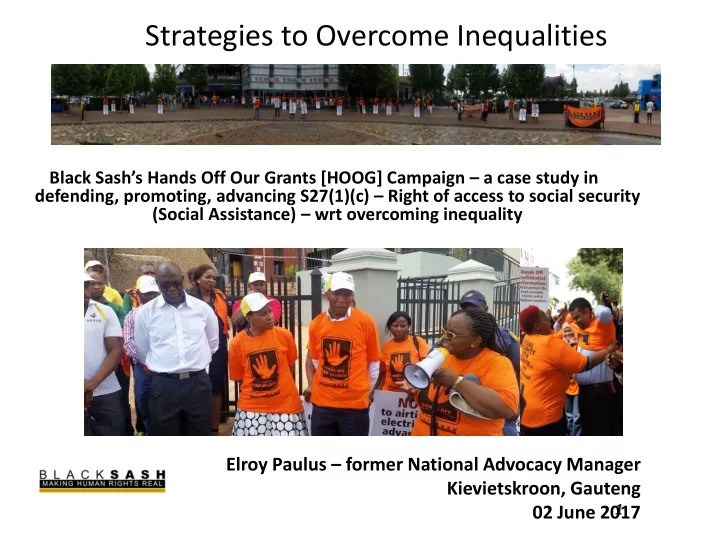
SLIDE 1 Strategies to Overcome Inequalities
Black Sash’s Hands Off Our Grants [HOOG] Campaign – a case study in defending, promoting, advancing S27(1)(c) – Right of access to social security (Social Assistance) – wrt overcoming inequality
Elroy Paulus – former National Advocacy Manager Kievietskroon, Gauteng 02 June 2017
1
SLIDE 2 The Black Sash – impact of its work wrt inequality
- 62 year old organisation – established 1955, formerly a federal, member-based organisation
- Worked towards ending apartheid – pre 1994 – largely civil rights issues – formerly disbanded in 1995, but
established the Black Sash Trust.
– Has been instrumental in establishing many organisations, including the Parliamentary Monitoring Group (PMG) – wrt access to information (Legislature) – Key player in the Basic Income Grant Campaign (2004) – co-publishing the Financing the Basic Income Grant publication (summary of 4 SA economists work who all stated that it is necessary and affordable at the time) – Was known for its work in Extension of the Child Support Grant to 18 – Stopped providing paralegal advice at regional offices – but continues to provide a HelpLine – Helped incubate NADCAO (National Association of Democratic Community Advice Offices) Association of Community Advice Offices in South Africa (ACAOSA)
- Since 2013 was the lead organisation in the Hands Off our Grants Campaign
- Aspects of its work was critical and related to addressing issues of income inequality (through social
assistance) – worked in the political space – where some argued that its work promoted “nanny state,” “dependency” (wrt grants) another view that recognized its work towards a “developmental state”, and others expressing views that it was not sufficiently critical of the macro- economic policy and agenda of South Africa in the late 1990’s onward.
- Work by Prof Servaas (Univ Stell) and others– impact of social grants on income inequality – and
that SA’s Gini Coefficient would have been much worse if this had not been for impact on grants.
- Millenium Development Goals – in particular MDG1 and effect of access to grants on MDGs 4,5
- Disproportionate impact of food inflation and transport costs in the SA context.
- Unique characteristics of SA context – unemployment, inequality, poverty – poor health and
developmental outcomes wrt other middle income countries
- However – we appear to be on the low road – in terms of the Dinokeng Scenarios
- Along came a spider…..
2
SLIDE 3 Section 27 of the Constitution Health care, food, water and social security 1.Everyone has the right to have access to
- a. health care services, including
reproductive health care; b.sufficient food and water; and
- c. social security, including, if they are unable
to support themselves and their dependants, appropriate social assistance. 2.The state must take reasonable legislative and other measures, within its available resources, to achieve the progressive realisation of each of these rights.
- 3. No one may be refused emergency medical
treatment
SLIDE 5 Scope of developmental impact
- 17 Million SASSA beneficiaries (total pop 55 million)
- 10,5 million bank accounts
- Annual Budget of R157 billion Rand for a range of
grants – SOAP, CSG, Disability Grant, Foster Care Grants and others
- Huge consequences if allowed to continue – gains
made by the State will be eroded in many ways – social determinants of health and well-being hugely impacted
- MDG and SDG Goals negatively impacted
SLIDE 6
PROBLEM Identification
▪ In 2012 our monitoring work identified debit deductions from grant beneficiaries’ SASSA bank accounts as a major issue. ▪e.g. KOOR in Keimoes, NC alerted us to women, covered in blankets, at ATM points at midnight to draw cash from their SASSA bank account,
before 3rd parties deduct claims.
▪ In 2013 the Black Sash, launched the Stop SASSA- CPS debit deduction Campaign, now known as the Hands Off Our grants (HOOG) Campaign.
SLIDE 7 PROBLEM identification
▪ We identified 5 demands:
- SASSA, DSD & 3rd party service providers to be
held individually & institutionally accountable for debit deductions
- Amend Social Assistance Act to criminalise lenders
using social grants as collateral for loans
- SASSA owned & controlled recourse system
- SASSA to in-source national administration of
social grants
- Establish Inspectorate to ensure integrity of social
assistance frameworks and systems; investigate fraud and corruption.
SLIDE 8 South African Population Pyramid (10 years ago – not much has changed – arguably worsened)
Source: StatsSA Census 2001 and mid-year 2006 population estimate;
Alex van den Heever; 13 November 2007
Total population mid-2006 estimated to be 47.4 million people. 43% are under age 20 and 62% are under age 30. Only 5% of the population are over age 65. Unemployed and working poor
Economically Active Population (EAP)
Other negative factors include the impact of HIV/AIDS;
- ccupational injuries and poor
nutrition
8
SLIDE 9
PROBLEM identification
▪The RFP, Contract & Service Level Agreement are interpreted by CPS/Net1 to permit deductions (e.g. airtime & electricity advances, loans etc.) from the Grindrod owned SASSA bank accounts in violation of the Constitution, Social Assistance Act and Regulations ▪ Net1 with Grindrod bank created a (current) bank account for grant beneficiaries to facilitate EFT, debt & stop order deductions by 3rd parties -
“BIG SHARKS, FROM SANDTON WITH SUITS IN THE TANK”
SLIDE 10 SA Constitution:
- 27. Health care, food, water and social security
(1) Everyone has the right to have access to – (a) health care services, including reproductive health care; (b) sufficient food and water; and (c) social security, including, if they are unable to support themselves and their dependants, appropriate social assistance. (2) The state must take reasonable legislative and other measures, within its available resources, to achieve the progressive realisation of each of these rights.
- 195. Basic values and principles governing public administration
(1) Public administration must be governed by the democratic values and principles enshrined in the Constitution, including the following principles:......... (f) Public administration must be accountable. (g) Transparency must be fostered by providing the public with timely, accessible and accurate information.
CONTEXT: Applicable Laws & Regulations
10
SLIDE 11 Social Assistance Act 13 of 2004 Restrictions on transfer of rights and payments of social assistance
- 20. (1) A grant may not be transferred, ceded, pledged or in any other way encumbered or disposed of unless the
Minister on good grounds in writing consents thereto. (2) Any act in contravention of subsection (1) is void and if the Minister becomes aware of any such act, he or she may order that payment of the relevant grant be terminated or suspended immediately and the Agency must, in writing by registered mail at the last known address of that beneficiary or procurator, as the case may be, inform him or her in the official language of the Republic in which he or she made the application for the grant- (a) of the Minister's decision; (b) of the reasons for that decision; and (c) that he or she has a right of appeal contemplated in section 18 and of the mechanisms and procedure to invoke that right. (3) A beneficiary must without limitation or restriction receive the full amount of a grant to which he or she is entitled before any other person may exercise any right or enforce any claim in respect of that amount. (4) Despite subsection (3), the Minister may prescribe circumstances under which deductions may be made directly from social assistance grants: Provided that such deductions are necessary and in the interest of the beneficiary. (5) An amount that accrues or has accrued to a beneficiary or his or her estate in terms of this Act may not be attached or subjected to any form of execution under a judgment or order of a court or by law, or form part of his or her insolvent estate. (6) Notwithstanding the provisions of subsection (1), in the case of death of a parent, procurator or primary care giver receiving a grant on behalf of or in respect of another person or child as the case may be, the Agency must appoint a person to receive the grant on behalf or in respect of such person or child, and to use it for his or her benefit without suspending the grant, subject to prescribed conditions.
CONTEXT: Applicable Laws & Regulations
11
SLIDE 12 CONTEXT: Applicable Laws & Regulations
The Agency may allow deductions for funeral insurance or scheme to be made directly from a social grant where the beneficiary of the social grant requests such deduction in writing from the Agency.
Subject to the provisions of sub regulation (1), the Agency may only allow deductions to be made directly from a social grant where the insurance company requiring such deduction or to whom the money resulting from the deduction is paid, is a financial services provider as defined in section 1 of the Financial Advisory and Intermediary Services Act, 2002 (Act No. 37 of 2002) and authorised to act as a financial services provider in terms of section 7 of that Act.
Notwithstanding the provisions of sub-regulation (1), the Agency may only authorise one deduction for a funeral insurance or for a funeral scheme not exceeding ten percent of the value of the beneficiary's social grant.
- Promulgation of Amended Regulations to the Social Assistance Act 6 May 2016 that
amongst other prevents deductions from temporary and children’s grants and currently a matter that is hotly disputed – with civil society supporting government’s attempts to prevent unlawful deductions from unscrupulous businesses
SLIDE 13
CONTEXT: Prior relation with SASSA
▪ Prior to Hands Off our Grants Campaign (HOOG), Black Sash had an established relationship with SASSA via an MOU through its Community Monitoring and Advocacy Project (CMAP) ▪ Black Sash is identified as a critical stakeholder in SASSA’s 5 year plan
SLIDE 14 CONTEXT: AllPay2 April 2014
▪ The ConCourt in AllPay2 matter:
- Declared 2012 CPS/SASSA contract, to
administer social grants, invalid
- Suspended invalidity, as beneficiaries must be
paid grants monthly
- Ordered a new tender process
- If tender is awarded, contract runs for 5 years
- If not awarded, CPS continues 5-year term
(ending March 2017), after which SASSA take
SLIDE 15 CONTEXT: AllPay2 April 2014
▪ ConCourt further ruled:
- CPS is performing an “organ of state ” function
due to social grants
- SASSA to protect personal and confidential
data of social grant beneficiaries
SLIDE 16 ROLE PLAYERS
▪ Social grant beneficiaries
▪ SASSA (Implementation) ▪ DSD (policy) ▪ Cash Paymaster Services (CPS) ▪ Grindrod Bank ▪ Net1 & subsidiaries such as Moneyline, Manje Mobile, Smartlife, Easy Pay (see organogram – next slide) ▪ Funeral Insurance underwriters, brokers ▪ Civil Society: Black Sash, ACAOSA, Independent Advice Offices, NGOs, CBOs, social movements with support from COSATU
SLIDE 17 ROLE PLAYERS
Extract of Organogram – Group Structure of Net1 - April 2016
17
1 6 5 4 3 2 7
Net1 Companies effecting deductions:
Technologies SA (Pty)Ltd
Services (Pty) Ltd
- 3. The SmartLife Insurance
Company Ltd
Services (Pty) Ltd
Electronic Payment Services (Pty) Ltd
- 6. Finbond Group Ltd
- 7. EasyPay (Pty) Ltd
- 8. Net1 Mobile Solutions
(Pty) Ltd
8
SLIDE 18 Net1’ s business strategy
first wave/second wave” approach to expand into new markets www.net1.com/about/strategic-direction-our-strategy/
- “First wave/Second wave" approach to market expansion:
– “First Wave" - identify an application for which there is a demonstrated and immediate need in a particular territory and then sell and implement its technology to fulfill initial need – Results deployment of the required technological infrastructure and the registration of a critical mass of cardholders or customers – Generate revenues from the sale of software and hardware devices and
- ngoing revenues from transaction fees, maintenance services and use of our
biometric verification engine. – Once infrastructure has been deployed and a critical mass of customers is achieved, – Net1 then focuses on the "second wave" – enabling them to use this infrastructure to provide users, at a low incremental cost, with a wide array of financial products and services for which fees are charged based on the value
- f the transactions performed.
18
SLIDE 19 SASSA and EasyPay Everywhere Cards
19
SLIDE 20 Easy Pay Everywhere “Green” Card
20
- New problem since 1st quarter of 2015 - Easy Pay Everywhere (EPE) bank card,
dubbed ‘green card’, is product of Grindrod bank & Moneyline, a Net1subsidiary. Serge Belamant is an EPE director
- Civil Society tabled cases on how grant beneficiaries’ are coerced & “tricked” into
- pening EPE bank accounts.
- Some were told they need EPE to receive social grants.
- Others were told they need EPE account to access loans.
- Some found out afterwards they have a Smartlife funeral policy.
- Beneficiaries pay extra bank charges.
- EPE Term and Conditions is only available in English, which many do not
understand
- Beneficiaries are asked to provide their ID & SASSA card. Funds from the SASSA
card is automatically transferred to EPE account.
- Closing the EPE accounts are near impossible and many are struggling to migrate
back to the SASSA card – see Aletta Bezuidenhout case study.
- Social grant money in the EPE account is game for predatory behaviour, keeping
beneficiaries in a debt trap and/or fuelling indebtedness.
SLIDE 21
SLIDE 22 Source: www.tekano.org.za Determinants of health are well documented – but not determinants of effective social determinants of social security – for the SA context
SLIDE 23 The gains made by the State towards reducing poverty and inequality have been seriously compromised – however it stills requires quantification – these effects are emerging based on dialogues, affidavits, evidence-based monitoring
www.un.org/millenniumgoals/mdgmomentum.shtml
SLIDE 24
SLIDE 25 Source: Health Economics Unit (HEU) – UCT – see “Eliciting public preferences for health system reform incl NHI” – Black Sash, HEU (UCT) and Health-e (2012)
Income distribution in SA – what has impact been of grants – and belatedly disputed, unlawful deductions from SASSA bank accounts?
SLIDE 26 The impact of this form of extractive practices – exacerbation of inequality
When we began the full scope and impact of deductions nationally – we heard from a range of quarters that:
- People were not able to access recourse to dispute deductions due
to travel costs, and the cost of the burden to provide proof – SAPS affidavits, statements of SASSA grants – provided by CPS (bizarrely) – see organogram
- Tensions and accusations in families – at one stage the stock
response was “these are unintended consequences” – poor choices by beneficiaries “either a daughter or family member” that made the deduction
- Unable to eat most basic food. Worse if medication is taken –
people unable to buy food
- Fuelling consumptive lending at very high interest and admin fees
- The more rural – the more difficult to access recourse, repayment
- Rolling back the gains made by the State
SLIDE 27 DIFFERENT INTERVENTIONS
27
- Rights Education
- Contextual research – in particular citizen based monitoring – see
cbm.code4sa.org – collecting evidence ourselves and with our partners
- Use of media – in particular social media – its critical role
www.groundup.org.za Later – impact of press coverage of Bloomberg Africa - in terms of corporate governance, shareholder activism
- Citizen based monitoring – building on CMAP and MAVC – the
cbm.code4sa.org platform
- Ministerial Task Team and
- Litigation – (ConCourt) amicus curiae, supporting government (North
Gauteng High Court 2 x) , or litigating against SASSA and DSD (Concourt)
- Advocacy – Hands off our Grants Campaign
SLIDE 28 Stopping Deductions via New Tender Process ▪ Civil society working with government changed tender specifications of new Request for Proposals (RFP)issued in October 2014:
- Ring fenced bank account
- No EFT, debit & stop order deductions from SASSA
bank account
- No marketing of financial & other products by 3rd
parties
▪ CPS challenges RFP via AllPay2 court matter, but unsuccessful to change ring fenced account & other gains
SLIDE 29 New Tender Process... continue ▪ Black Sash intervened as Amicus Curiae demanding timeframes from SASSA for new tender process ▪ In March 2015 ConCourt ruled:
- April 2015: SASSA issues finalised RFP
- May 2015: Submissions by potential bidders
- 15 October 2015: SASSA appoint new service provider
▪ In May 2015 CPS/ Net1 announced publically it will not make a submission as SASSA/ government
- bligations onerous & restrictive
SLIDE 30
New Tender Process... continue
▪ June 2015, Net1 subsidiary Moneyline & Grindrod Bank launch Easy Pay Everywhere (EPE) bank account, transferring money from the SASSA bank account. 1.1 million SASSA beneficiaries with EPE bank accounts by June 2016. Concerns – how the business was obtained & the EPE account T&C ▪15&16 October 2016: Mass action in CT, JHB & Pretoria, SASSA to announce new tender outcome. ▪ New Tender not awarded in Oct, CPS continue until 2017 ▪ The reworked tender specifications will be used in the new model being developed by SASSA
SLIDE 31 SASSA owned & controlled recourse system
▪CPS/Net1 administered social grants. It also controlled recourse in an arbitrary manner. CPS/Net1 both player &
- referee. SASSA was reluctant to take on recourse system
as it blindly outsourced this component too, with no regard for the beneficiaries. ▪Deductions framed as individual behaviour & not a systemic problem. CPS & SASSA blamed beneficiaries & relatives for deductions, fuelling household conflict. ▪Civil Society (CS) via MTT, with support from Minister Dlamini, forced SASSA to develop & implement Recourse mechanism, independent of CPS/Net1...e.g. SASSA issue instructions for refunds. Still an ongoing challenge.
SLIDE 32
SASSA owned & controlled recourse system ▪Parts of 2014/15 was spent on developing recourse system including Beneficiary Affidavit form. CS provided feedback ▪ CS brought cases studies of deduction types, harm suffered & implications of Recourse ▪ CS forced SASSA to make available statistics on deductions, delivered for the 1st time in 2016 CS noted under reporting due to a range of challenge
SLIDE 33 33
▪Unresolved cases were escalated to SA Reserve Bank & Payment Association of SA (PASA) via MTT ▪ CS continually monitors recourse of repayments & system in 2016 we experienced spikes in deductions
SLIDE 34 New Regulation – May 2016 ▪ Section 26A – Funeral deduction challenges
1) Lion of Africa case was forcing SASSA to effect funeral deductions from children’s & temporary grants; 2) Channel Life case legally challenged SASSA’s Sect 26A Funeral clean-up
- project. The project was placed temporary on hold, but is back in operation
▪ New Regulations rendered both Channel Life (Pretoria High Court and Lion
- f Africa (ConCourt) cases moot.
▪New regulations outlaws deductions from children’s and temporary grants, with 6 month transition period.
SLIDE 35 New Regulation – May 2016 ▪ Section 21 – Method of Payment: 1) New Regulation require beneficiaries to lodge consent with SASSA if they want to transfer funds to
- wn bank account or to the account of an institution
where beneficiary resides 2) SASSA payment mechanism will have no deductions other than Sect 26A funeral cover (1 deduction not exceeding of 10% of grant value) ▪ But the new Regulations are being challenged.
SLIDE 36 New Regulation – May 2016
▪During June 2016 separate court interdicts from 1)Net1, Moneyline & Manje Mobile; 2) Smartlife;3) Information Technology Consulting; & 4) Finbond
- to not restrict beneficiary bank accounts (financial
inclusivity)
- claims that DSD Minister has no jurisdiction over the
banking system, pitting SARB/PASA & DSD/SASSA mandate against each other
- Section 21 of New Regulation challenge the Net1 core
business strategy – 1st wave, 2nd wave – EFT, debit & stop
- rder deductions from the account is key
▪BS joining as Amicus alongside others. ▪Cases will be heard on 17 &18 October.
SLIDE 37
Attempts at establishing an Inspectorate
▪ Inspectorate Mandate - to ensure integrity of social assistance frameworks & systems; investigate fraud and corruption. ▪Inspectorate organogram & budget of R70million was presented ▪ A unit would be incubated from within DSD. SASSA fraud unit to be assimilated into Unit. 3 senior managers were appointed. ▪ Establishment of Inspectorate stalled. Unit does not have the appropriate powers to function. ▪ May have to evolve SASSA fraud unit into Inspectorate or change the Social Assistance Act – longer process
SLIDE 38
Lessons/ Questions on government & Civil Society relations
▪ The outsourcing of grant payments (Social Assistance) nationally to CPS/ Net1 made grant beneficiaries open game for predators. Was SASSA naive, captured by business or adhering to political party policies with so-called unintended consequences? ▪ Can a Section 27 right particularly social security to a vulnerable section of the population be performed via an outsourced arrangement with a commercial company with profit as its primary motif?
SLIDE 39 Lessons/ Questions on government & Civil Society relations ▪ Government has appropriated commercial language “banking the unbanked”, “financial inclusivity”, “cost savings & recovery” at the expense of a culture and practice of human rights, particularly socio economic rights.
- Government was not very explicit in the
procurement documentation.
- Corporates tend to have deep pockets and their
lawyers help them to string out cases to buy time.
SLIDE 40 Recent developments – SASSA, Social Development and Net1 - Governance, and leadership – ethical choices made
- The favourable outcome of 17 March Concourt judgement (and events from
October 2016 – current) – wrt insourcing plan of SASSA and further continuation
- f an unlawful and invalid contract are associated with/contributed to:
– Resignation of Zane Dangor – Director General of Dept Social Development – Contradictory affidavits of CEO Thokozani Magwaza against Minister – reporting on parallel reporting structures – Evidence of poor governance, non-compliance, wasteful and fruitless expenditure – through hearings in Parliament – Standing Committee on Public Accounts (SCOPA) and Portfolio Committee on Social Development – Minister of Social Development having to prove to Concourt why she should not be held liable for legal costs in her personal capacity – Net1 – 2 largest shareholders – Allan Gray and IFC World Bank – put pressure on Net1 Board – – 2 days ago CEO CPS, Net1 resigns – changes to Board demanded – Green Card closure demanded by SASSA beneficiaries
40
SLIDE 41 Insights /CSO relationship to society and to the state (wrt inequality)
▪ CS operates as equal partner with government. Black Sash is co- chair of MTT. CS do not take any funds from government for HOOG
- work. MTT ToR explicit on BS/CS advocacy role. All documents/
information are public unless indicated.
▪ MTT gave CS access to other entities – SARB, PASA, Treasury & regulatory bodies such as NCR, FSB etc. ▪ Both CS & government have learn how to use the media strategically to advance the campaign e.g Lion of Africa actuary study, Net1 share price dropped by 10%
- It is critical to take organized community with you, especially in
such a large and complex Campaign, both big and small stakeholders
41
SLIDE 42 RECOURSE – SASSA Refunds (April 2016- date)
42 Source: Dianne Dunkerley – Exec Head Grant SASSA Grant Administration 24 Apr 2017
SLIDE 43 Keeping public involved, promoting agency and working collaboratively with community partners and SASSA Beneficiaries
43
SLIDE 44 Evidence of civil society efforts to keep issue in public domain
SLIDE 45 Thank you!
“Hide nothing from the masses of our people. Tell no lies. Expose lies whenever they are told. Mask no difficulties, mistakes,
- failures. Claim no easy victories...” ― Amílcar Cabral
45