Strategic Programmatic Overview of the New Reactors Business Line - - PowerPoint PPT Presentation

strategic programmatic overview
SMART_READER_LITE
LIVE PREVIEW

Strategic Programmatic Overview of the New Reactors Business Line - - PowerPoint PPT Presentation

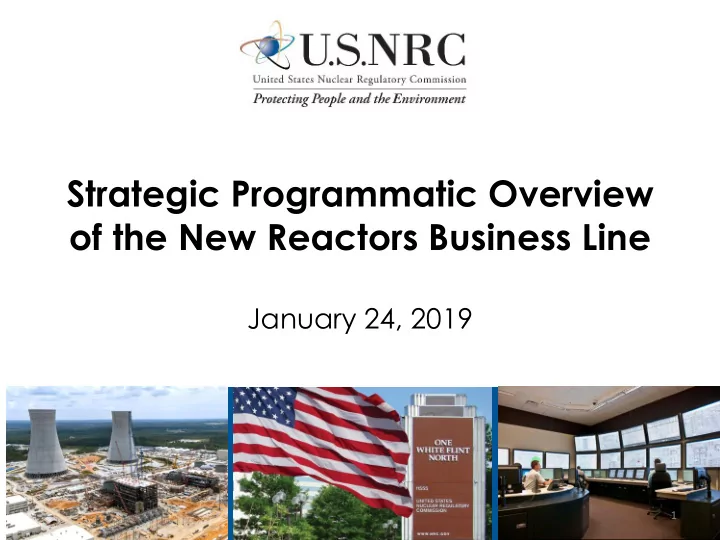
Strategic Programmatic Overview of the New Reactors Business Line January 24, 2019 1 Agenda Introduction Margaret Doane Strategic Direction for the New Reactors Business Line Fred Brown Large Light Water and Small Modular

slide-1
SLIDE 1

Strategic Programmatic Overview

  • f the New Reactors Business Line

January 24, 2019

1

slide-2
SLIDE 2

Agenda

  • Introduction – Margaret Doane
  • Strategic Direction for the New

Reactors Business Line – Fred Brown

  • Large Light Water and Small Modular

Reactor Licensing Activities – Rob Taylor

  • Initiatives to Modernize Reviews – Anna

Bradford

2

slide-3
SLIDE 3

Agenda (continued)

  • Vogtle 3 & 4 Construction Oversight –

Bill Jones

  • Advanced Reactor Readiness – John

Monninger

3

slide-4
SLIDE 4

Strategic Direction for the New Reactors Business Line (NRBL)

Frederick Brown Director Office of New Reactors

4

slide-5
SLIDE 5

Summary of NRBL strategic direction

  • Complete work before us with an

appropriate focus on “reasonable assurance of adequate protection”

  • Be agile in responding to workload

changes

  • Develop enduring guidance and

direction to facilitate both clarity and reliability for future applicants

5

slide-6
SLIDE 6

Effectively Executing Our Current Workload

  • “Whole Team” effort with our agency

partner offices

  • Reliable in our approach to licensing

and inspection

  • Efficient in the timeliness of our

decisions

  • Open in our communications and

engagement

6

slide-7
SLIDE 7
  • Combining internal work units
  • “Pre-merging” work units with the

Office of Nuclear Reactor Regulation

  • Maintaining staff continuity and

minimizing disruption where possible

7

7

Scaling the Office of New Reactors for Current and Future Workload

slide-8
SLIDE 8

Planning and Preparing for the Future

  • Improving internal processes
  • Preparing for the transition to
  • perations at Vogtle
  • Focusing guidance documents and

pursuing approved rulemaking

  • Executing the vision for advanced

reactor licensing

8

8

slide-9
SLIDE 9

Large Light Water and Small Modular Reactor Licensing Activities

Robert M. Taylor Director Division of Licensing, Siting, and Environmental Analysis

9

slide-10
SLIDE 10
  • Completed

APR1400 DC Review on 42 month schedule

  • Pursuing direct

final rulemaking for certification

Effective and Timely (1/4)

10

Photo of NRC and KHNP staffs during the signing of the APR1400 Standard Design Approval issued on September 28, 2018.

slide-11
SLIDE 11
  • Completed 50

licensing actions supporting construction schedule

  • Improved licensing

efficiency – RAI enhancements – Clear review standards

Effective and Timely (2/4)

11

Installation of Ring 3 on Vogtle Unit 3 Source: Southern Nuclear Company

slide-12
SLIDE 12
  • Clinch River ESP

– Leveraged audits – Reduced RAIs significantly – Completed SER with no open items – Assessed emergency planning zone size creatively

Effective and Timely (3/4)

12

Photo of NRC staff examining core borings at Clinch River

slide-13
SLIDE 13
  • NuScale SMR Design Certification

–Phase 1 complete –Phase 2 progressing –Resolving challenging issues –Focus on safety and risk significance

Effective and Timely (4/4)

13

New Reactors, Region II and Technical Training Center staff in NuScale Simulator Source: NuScale Power

slide-14
SLIDE 14

Preparing for Licensing Work in FY 2019 and Beyond

14

  • Continuing licensing support of Vogtle

construction

  • No new light water reactor DC or ESP

applications expected

  • Completing current applications under

review

  • Preparing for new combined license

application

slide-15
SLIDE 15

Initiatives to Modernize Reviews

Anna Bradford Deputy Director Division of Licensing, Siting, and Environmental Analysis

15

slide-16
SLIDE 16

Improved Processes

  • Improving the use of Requests for

Additional Information (RAI) –Ensuring an RAI is necessary to reach a regulatory finding –Linking each RAI to the applicable requirement –Resulting in better use of resources

16

slide-17
SLIDE 17

Improved Processes (cont’d)

  • Refining the use of Audits

–Applying lessons learned from a successful review –Keeping audits focused, short, and well documented –Benefiting staff and applicants

17

slide-18
SLIDE 18

Transformation of Framework

18

  • Initiated Part 50/52 Rulemaking

– Ensuring consistency between the two regulations – Addressing lessons learned from the initial uses of Part 52 for certification, permitting, licensing, and construction – Goal to provide appropriate flexibility for applicants and licensees, and improved opportunity for staff to focus

  • n safety
slide-19
SLIDE 19

Transformation of Framework (cont’d)

19

  • Refocusing of Standard Review Plan

– Current content results in an in-depth review across all topic areas – Revise the SRP to focus on the regulatory requirement and necessary finding, not

  • n historical information and prescriptive

language – Provide a structure for staff reviews to be innovative and flexible, better tailored to specific applications

slide-20
SLIDE 20

Original Approaches for Issues

20

  • Departing from past practice while

achieving desired safety and security

  • utcomes
  • Tier 2* license amendment request for

Vogtle

  • General Design Criterion 27 exemption

for NuScale design certification

  • Demand to capacity ratio for structural

analysis in APR-1400 design certification

slide-21
SLIDE 21

Vogtle 3&4 Construction Oversight

William Jones Director Division of Construction Oversight Region II

21

slide-22
SLIDE 22
  • Effectively

implementing inspections through well qualified staff

  • Previous
  • rganizational

changes established foundation for transition to

  • perations

Resources Aligned with Construction and Operational Inspection Challenges

22

NRC inspector with French regulator NRC inspector

  • bserving

Unit 4 accumulator lift

slide-23
SLIDE 23
  • Construction status
  • ITAAC and
  • perational

programs inspection status

  • Effectively

executing inspections associated with ITAAC closures

Effectively Meeting the Construction and Operational Inspection Challenges

23

* Unit 4 Metrics Similar to Unit 3

slide-24
SLIDE 24

Innovative Project Oversight

24

  • Vogtle Readiness Group
  • Effective oversight through cognizant
  • ffices throughout agency
  • Independence from organizational

changes

  • Ensures integration of guidance and

resources for the transition to

  • perations
  • Provides agency and licensee

continuity in licensing and oversight activities

slide-25
SLIDE 25

Transformational Initiative

25

  • Integrated Project Plan supports agency

readiness

  • Informed by licensee milestones
  • Supports Vogtle Readiness Group

decision making

  • Aligns agency staff on program

activities through plant operations

slide-26
SLIDE 26

Supportive Infrastructure

26

  • Well established programs and

processes

  • Maintains a forward inspection focus

and ITAAC review

  • Independent of agency
  • rganizational changes in structure
  • r leadership
  • Joint NRO/NRR Office instruction

developed for 10CFR52.103(g)

slide-27
SLIDE 27
  • Enhanced NRC staff

transition to

  • perations readiness
  • Gained AP-1000

startup program experience

  • Effective knowledge

transfer

Leveraging International Experience

27

NRC Staff at top of the Sanmen Unit 2 steam generator TTC AP1000 Simulator

slide-28
SLIDE 28

Advanced Reactor Readiness

John Monninger Director Division of Safety Systems, Risk Assessment, and Advanced Reactors

28

slide-29
SLIDE 29

High-Temperature Gas-Cooled Reactors (HTGR) Liquid Metal Cooled Fast Reactors (LMFR) Molten Salt Reactors (MSR)

GE-H ARC TerraPower

Westinghouse Columbia Basin Hydromine Framatome X-energy StarCore General Atomics Kairos Terrestrial Thorcon Flibe TerraPower Elysium

Liquid Salt Fueled TRISO Fuel Sodium-Cooled Lead-Cooled

Alpha Tech Muons Micro Reactors

Oklo Westinghouse

Broad Landscape

29

slide-30
SLIDE 30

Working the Action Plan

Strategy 1 Knowledge, Skills and Capability Strategy 2 Computer Codes & Review Tools Strategy 3 Flexible Review Processes Strategy 5 Policy and Key Technical Issues Strategy 6 Communication Strategy 4 Consensus Codes and Standards ONRL Molten Salt Reactor Training Knowledge Management Competency Modeling Regulatory Roadmap Prototype Guidance Non-LWR Design Criteria ASME BPVC Section III Division 5 ANS Standards 20.1, 20.2 30.2, 54.1 Non-LWR PRA Standard Siting near densely populated areas Insurance and Liability Consequence Based Security (SECY-18-0076) NRC DOE Workshops Periodic Stakeholder Meetings NRC DOE GAIN MOU Identification & Assessment of Available Codes International Coordination Licensing Modernization Project Functional Containment (SECY-18-0096) EP for SMRs and ONTs (SECY-18-0103) Environmental Reviews Potential First Movers Micro-Reactors Updated HTGR and Fast Reactor Training

30

slide-31
SLIDE 31

Integrated Evaluation of the Licensing Framework

  • Removing unnecessary barriers to

incentivize holistic approach to safety

  • Systematic use of risk assessment tools
  • Balancing accident prevention and

consequence mitigation

  • Inter-relationship and linkage of

initiatives being pursued

31

slide-32
SLIDE 32

Developing a Risk-Informed and Performance-Based Framework

  • Evaluating NEI 18-04, “Risk Informed

Performance-Based Guidance for Non- Light Water Reactor Licensing Basis Development” for NRC endorsement – Systematic process – Identification of licensing-basis events – Classification of structures, systems, and components – Consideration of Defense-in-Depth

32

slide-33
SLIDE 33

Developing a Risk-Informed and Performance-Based Framework (continued)

  • Significant stakeholder interactions

including coordination with Department of Energy and Department of Defense

  • Engagement with the Advisory

Committee on Reactor Safeguards and international community

33

slide-34
SLIDE 34

Improving the Focus of the Content of Applications

34

slide-35
SLIDE 35

Addressing Challenges

  • Planning for the broad range of

designs under development

  • Expanding NRC staff organizational

capacity

  • Ensuring coherence of new licensing

approaches

35

slide-36
SLIDE 36

Acronyms

36

  • DC – design certification
  • ESP – early site permit
  • FY – fiscal year
  • IPP – Integrated Project Plan
  • ITAAC – Inspections, tests, and

acceptance criteria

  • NEI – Nuclear Energy Institute
  • RAI – request for additional

information

  • SER – safety evaluation report
slide-37
SLIDE 37

Acronyms

36

  • SMR – small modular reactor
  • TVA – Tennessee Valley Authority