
SLIDE 1
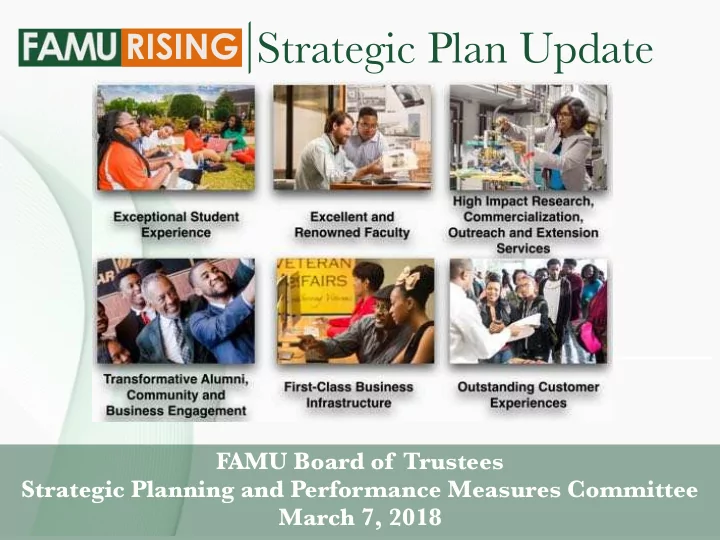
Strategic Plan Update
RISING
FAMU Board of Trustees Strategic Planning and Performance Measures Committee March 7, 2018
Strategic Plan Update RISING FAMU Board of Trustees Strategic - - PowerPoint PPT Presentation
Strategic Plan Update RISING FAMU Board of Trustees Strategic Planning and Performance Measures Committee March 7, 2018 RISING Living-Learning Communities Strategic Priority: Exceptional Student Experience Goal: Achieve national distinction
RISING
FAMU Board of Trustees Strategic Planning and Performance Measures Committee March 7, 2018
Living-Learning Communities
RISING
Strategic Priority: Exceptional Student Experience Goal: Achieve national distinction for success in retention and graduation rates
2
FTIC 2nd-year retention rate
Academic progress rate
(2nd year retention with GPA above 2.0)
FTIC 4-year graduation rate
Key Metrics
Living-Learning Communities
RISING
3
Academic Integration and Student Transitional Services Undergraduate Student Success Center
Living-Learning Communities (LLC)
RISING
A living-learning environment, where freshman students with common professional goals live together and participate in a variety
activities.
4
FAMU LLC FAQ
RISING
5
Housed in FAMU Village
Different LLCs
Honors Allied Health Sciences Agriculture and Food Sciences Business and Industry Education Environment Engineering
Journalism and Graphic Communication
Science and Technology
Coordinated by faculty and student mentors Increases Student Success GPAGraduation Rates
Retention Rates
Total Annual Budget
Travel, refreshments, peer mentors, part- time staff, outings
RISING
6
Foster and enhance learning through participation in group activities Increase first-year retention rates and academic performance
Provide networking and professional development opportunities
RISING
7
Group and peer-led study sessions Active learning Professional development workshops Social activities Community service projects International experiences Networking Research
placeholder photo
LLC Expenses and Admission Criteria
RISING
8
LLC Expenses Admissions Criteria
Honors
$88K
Essay
College of Agriculture and Food Science
$4K
Essay
College of Education
$3.5K
2.75 GPA, 21 ACT Math, Essay
FAMU-FSU College of Engineering
$32K
2.75 GPA, 21 ACT Math, Essay
College of Science and Technology
$20K
2.75 GPA, 21 ACT Math, Essay
School of Allied Health Sciences
School of Business and Industry
$4K
Essay
School of the Environment
$10K
3.0 GPA, Essay
School of Journalism and Graphic Communications
LLC Student Success Metrics
RISING
9 LLC All Students in FTIC Cohort
Current Cohort GPA Comparison Current Cohort Retention Rate Comparison
LLC Participation
RISING
10
LLC 2015-16 2016-17 2017-18 2018-19 Target
Honors
40 42 25 40
College of Agriculture and Food Science
16
College of Education
26
FAMU-FSU College of Engineering
17 25 47 60
College of Science and Technology
43 51 35 60
School of Allied Health Sciences
29 29 27 36
School of Business and Industry
63 57 58 60
School of the Environment
20
School of Journalism and Graphic Communication
26 19 21 22
Nursing (new in Fall 2018)
30
Total
218 223 235 370 ๏Limited space to house additional LLC students ๏Need to identify additional housing to expand LLCs beyond the first year ๏Need additional academic support and study space
Challenges
LLC Retention Rate (as of Fall 2017)
RISING
11
LLC 2015-16 Cohort 2016-17 Cohort 2017-18 Cohort
Honors
83% 93% 96%
College of Agriculture and Food Science
College of Education
FAMU-FSU College of Engineering
76% 92%
100%
College of Science and Technology
74% 94%
100%
School of Allied Health Sciences
86% 83% 100%
School of Business and Industry
81% 84% 98%
School of the Environment
School of Journalism and Graphic Communications
88% 95% 100%
Total University FTIC Cohort
66.6% 77.3% 93%
LLC 1st Semester GPA (Fall 17 Cohort)
RISING
12
College/School LLC GPA Entire Freshman Class % of Freshman Cohort in LLC
College of Agriculture and Food Science
2.90 2.49 23%
College of Education
3.01 2.92 22%
FAMU-FSU College of Engineering
2.65 2.51 52%
College of Science and Technology
2.68 2.45 17%
School of Allied Health Sciences
2.78 2.68 27%
School of Business and Industry
2.78 2.79 30%
School of the Environment
2.67 1.72 38%
School of Journalism and Graphic Communication
3.11 2.97 35%
Average
2.86 2.65 235
LLC Successes
RISING
13
Higher GPAs, retention rates and persistence Increased levels
engagement Increased interactions with faculty & staff
Future Plans
RISING
14
Expand the LLC Program Additional colleges/schools Thematic LLCs & Sophomore LLCs Increase funding allocation (~$250K/yr) Enhance coordination and synergy
Move the “Learning Community” concept beyond the LLCs
Identify additional housing options
FAMU Board of Trustees Strategic Planning and Performance Measures Committee March 7, 2018
Budget Update
RISING
16
Currently developing the budget for Year 2
Strategic Plan Initiative Strategic Priority 2017-18 Budget
Student Success Initiatives 1 $2,000,000 Online Education 1 $1,570,000 Honors Program 1 $260,000 International Education 1 $260,000 Strengthening Academic Programs (focus on Law, Pharmacy, Business) 1 $1,959,484 Financial Literacy/Student Debt 1 $105,433 Faculty Recruitment & Retention (includes faculty development) 2 & 3 $1,748,715 Brooksvillle 3 $200,000 Fundraising 4 $330,000 Staff Professional Development/ Customer Service 5 & 6 $330,000 Sources of new funding in Year 2:
Priorities for new funding in Year 2:
initiatives
programs
FAMU Board of Trustees Strategic Planning and Performance Measures Committee March 7, 2018
Tracking Institutional Goals
18
BOT will receive updates on progress at each meeting
trends
improving low performance One scorecard to track high-level institutional goals
Real-time progress can be monitored via dashboard site
19
FAMU - Scorecard for Institutional Goals (March 2018 BOT Update)
Metric Baseline 2018 Goal 2018 Actual Trend Alignment President’s Annual Goals (Reported Each Summer/Fall) 20
FAMU - Scorecard for Institutional Goals (March 2018 BOT Update)
Metric
Baseline 2018 Goal 2018 Actual Alignment Increase FAMU’S Overall Score on PBF Metrics 65 >65 TBD P, PBF, SP Graduation, Retention and Licensure Pass Rates Six-Year Graduation Rate 40.7% 45.7% 47.3% P, PBF, SP, WP Four-Year Graduation Rate 19.2% 20% 21.8% SP, WP Achieve First-Time Licensure Pass Rates that Meet or Exceed State/National Benchmarks in Law (Goal: >70%), Nursing (>87%), Pharmacy (>93%) and Physical Therapy (>91%) 0 of 4 1 of 4 TBD P, SP, WP Academic Progress Rate (2nd Year Retention with GPA Above 2.0) 74.6% 77% TBD PBF, SP, WP FTIC Second-Year Retention Rate 83% 84% 82.6% SP, WP Degree Production and Employment Outcomes Percent of Bachelor's Graduates Enrolled or Employed ($25,000+) in the U.S. One Year After Graduation 64.6% 66.5% TBD PBF, SP, WP Median Wages of Bachelor’s Graduates Employed Full-time One Year After Graduation $32,700 $33,350 TBD PBF, SP, WP Bachelor's Degrees within Programs of Strategic Emphasis (PSE) 48% 49% TBD PBF, SP, WP Graduate Degrees within Programs of Strategic Emphasis (PSE) 58.2% 58% TBD PBF, SP, WP Percent of Bachelor’s Degrees without Excess Hours 39% 43.7% TBD PBF, SP, WP Bachelor’s Degrees Awarded 1,675 1,709 1,562 SP, WP Graduate Degrees Awarded 597 609 579 SP, WP Time to Degree for FTICs in 120-hr Programs 5.2 5.1 5.7 SP, WP Enrollment and Online Education Increase Total Headcount Enrollment 9,614 10,095 9,909 P, SP, WP FCS AA Transfers Fall Headcount Enrollment 749 794 854 SP, WP Percent of Undergraduate FTE in Online Courses 2% 4% TBD SP, WP University Access Rate (Percent of Undergraduates with a Pell-grant) 65.4% 65% TBD PBF, SP, WP Number of Students Enrolled in Graduate Online Programs 29 50 TBD SP, WP Research Productivity Increase Total R&D Expenditures by 1% $45.4M $45.8M TBD P, SP, WP Percent of R&D Expenditures Funded from External Sources 84% 80% TBD PBF, SP, WP Number of Patents 3 4 TBD SP, WP Number of Research Doctorates Awarded 20 22 22 SP Financial Health Reduce Overall Expenditures by 5% and Continue to Invest in the University’s Key Initiatives and Strategic Priorities, while Increasing Cash Flow and Liquidity (reserves) N/A $2.2M TBD P, SP Strengthen the University’s Financial Health by Achieving or Exceeding a Minimum Debt Ratio of 0.84Trends: Improving Declining Constant Alignment: P (President) SP (Strategic Plan) PBF (Performance Based Funding) WP (Work Plan)
Tracking Institutional Goals
21
Monitoring & Reporting at Senior Leadership Level
Goal: transfer responsibility for outcomes to leaders/managers within the organization
Update on Performance Based Funding
Metric 2016 2017 Anticipated 2018 Trend
and/or Continuing their Education (1 Yr after Graduation)
70.1% 64.6%
Employed Full-time One Year After Graduation
$31,100 $32,700
$44,520 $11,020
Part-Time FTIC)
38.6% 40.7%
with GPA Above 2.0)
75.4% 74.6%
Strategic Emphasis
49.6% 48%
Undergraduates with a Pell Grant)
64.7% 65.4%
Strategic Emphasis
51.5% 58.2%
Without Excess Hours
29% 39%
External Sources
81% 84% Total Score 65 65 TBD*
*2018 results must be validated by BOG Tentative Projection
PBF Metric Leading Indicator Baseline Update/Trend (March 2018)
1
Number and percent of graduates who have completed at least one internship or research experience
2
Number and percent of students above 90 hours enrolled in the top 20 majors with highest earning potential
3
Average amount of financial aid provided to students (grants, scholarships and waivers)
TBD
4
Number and percent of students in each cohort who have accumulated the required number of credits earned at the end of each semester
5
Number and percent of FTIC cohort who return after the first and second semesters (fall and spring) with GPA above 2.0
6
Number and percent of undergraduate degrees awarded each term in PSE
TBD
7
Number and percent of undergraduate students enrolled with a Pell grant award
8
Number and percent of students enrolled in graduate PSE
9
Number and percent of students in each cohort who have attempted more than 110% of required credit hours at the 60 and 90 hour mark
TBD TBD
10
Number and dollar amount of active R&D grants and contracts from external sources
2016-17 Exit Survey of Graduates 506 (24.55%) Fall 2016 831 (11.28%) Fall 2015 985 (12.8%) 1st semester 942 (71%) 2nd semester 917 (73.42%) 2015-16 199 ($45.9M) 2016-17 214 ($45M) 2017-18 136 ($36.1M) Fall 2015 965 (55%) Fall 2016 1,001 (55.5%) Fall 2017 982 (52.7%) Fall 2015 4,972 (64.5%) Fall 2016 4,541 (61.7%) Fall 2017 4,891 (64.8%) Spring 2018 1,273 (75.6%) Spring 2016 1,323 (80.5%) Spring 2017 1,049 (79%) Fall 2017 976 (12.9%) Fall 2017 137 (24.25%) 3rd semester 840 (77.14%) 2016-17 FTIC cohort
(completed >15 hrs each term)
Employed Enrolled
Wages Cost Grad Rate APR B-PSE Access Gr-PSE Credit R&D
Fall 2015 $3,721 (5,314) Fall 2016 $3,896 (4,982) Fall 2015 264 (48%) Fall 2016 213 (44.7%)
Update on Strategic Plan/Work Plan
(Reported in Summer of Each Year)
Metric Baseline 2018 Goal 2018 Actual 2018 Trend Goal Met
1 Four-Year Graduation Rates
19.2% 20% 21.8%
✅
2 Six-Year Graduation Rates
40.7% 45.7% 47.3%
✅
3 Bachelor’s Degrees Awarded
1,675 1,709 1,562
"
4 Graduate Degrees Awarded
597 609 579
"
5 FCS AA Transfers Headcount Enrollment
749 794 854
✅
6 Total Headcount Enrollment
9,614 10,029 9,909
"
7 FTIC Second Year Retention Rates
83% 84% 82.6%
"
8 Time to Degree for FTICs in 120-hr Programs
5.2 5.1 5.7
"
9 Percent of Undergraduate FTE in Online Courses
2% 4% TBD TBD
10Number of Students Enrolled in Graduate Online Programs
29 50 TBD TBD
11Number of Research Doctorates Awarded
20 22 22
✅
12Number of Patents
3 4 TBD TBD
PREPARING STUDENTS FOR SUCCESS