
SLIDE 1
6.2020
Strategic Plan 2018-2021
Website: www.lrcc.edu
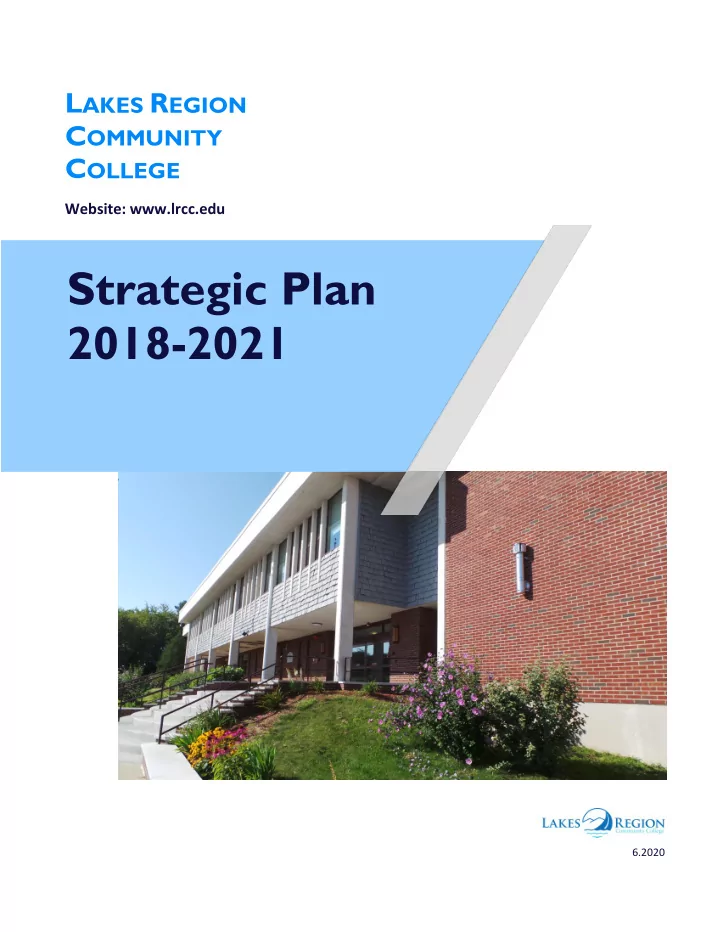
Strategic Plan 2018-2021 6.2020 1 CONTENTS Executive Summary - - PDF document
L AKES R EGION C OMMUNITY C OLLEGE Website: www.lrcc.edu Strategic Plan 2018-2021 6.2020 1 CONTENTS Executive Summary .................................................................................................... 2 LRCC Spotlight
6.2020
Website: www.lrcc.edu
1
Executive Summary .................................................................................................... 2 LRCC Spotlight ............................................................................................................ 3 Mission and Values ..................................................................................................... 4 Strategic Goal Alignment ............................................................................................ 5 Strategic Goals ............................................................................................................ 6
2
The Strategic Plan is centered around 6 strategic objectives which frame the College’s activities and align to our mission and vision. The Strategic Objectives are: Increase Enrollment Build Partnerships with the Community Improve Revenue and Sustainability Enhance the Quality of Academic Programs Improve/Enhance the Student Experience Create an Environment of Collaborative Planning, Effective Communication and Operational Transparency
3
Lakes Region Community College is a rural, non-profit, public, two-year institution located in Laconia, NH. The College takes its name from its beautiful region which is home to several lakes including New Hampshire’s largest lake, Lake Winnipesaukee. LRCC is one of seven community colleges making up the Community College System of New Hampshire (CCSNH). We enroll approximately 1200 students per year in credit, non-credit and workforce training programs. As a comprehensive community college with a technical history, we
and Business to technical degrees in Nursing, Fire Science, Automotive Technology and Culinary Arts. We are one of seven community colleges in the State and one of only two which offer housing. Residential students not only have the Lakes Region as their backyard, but also experience college life in furnished apartments just one mile from campus.
4
Lakes Region Community College provides a dynamic, community-based, high- quality learning environment, delivering a personalized education experience that prepares learners for success.
Lakes Region CC will continue its development as a learning-centered institution, characterized by innovation, responsiveness, flexibility, caring, collegiality, accountability and educational excellence.
Our purpose is to provide residents with affordable, accessible education and training that aligns with the needs of New Hampshire’s businesses and communities, delivered through an innovative, efficient and collaborative system of
Hampshire economy.
65 by 25: To maintain New Hampshire’s positive economic indicators, including low unemployment and high per capita income, NH will need 65 percent of adults with education beyond high school. CCSNH is committed to achieving this vision by 2025.
5
Increase Enrollment Increase enrollment across NH’s community colleges Build Partnerships with the Community Serve as a strong bridge for pathways from high schools and to 4-year institutions and employment with a focus on STEM and high demand careers Improve Revenue and Sustainability Improve CCSNH’s net revenue and financial sustainability, as well as overall financial and budget processes Enhance the Quality of Academic Programs Serve as a strong bridge for pathways from high schools and to 4-year institutions and employment with a focus on STEM and high demand careers Improve/Enhance the Student Experience Address the unique needs of our rural colleges and communities Create an Environment of Collaborative Planning, Effective Communication and Operational Transparency Foster an environment where CCSNH is an employer of choice and works to continuously improve employee engagement
6
Goal: Increase Enrollment
Strategic Initiative Deliverable Status
marketing plan
in recruitment
completed Feb. 2019. Currently being implemented.
Retention
programming
part-time students
to include: tutoring, support services, library and career planning.
4-yr institutions
Laconia High School and Plymouth State University unsuccessful. Intend to revisit in AY 20-21. Dual enrollment (Running Start and Early College) continue to grow.
Strategic Goal 1:
7
Goal: Build Partnerships with the Community
Strategic Initiative Deliverable Status
Industry
advocacy
program advisory boards
Adoption of by-laws and new subcommittees.
membership review is ongoing.
campus.
dramatically since 2018.
Strategic Goal 2:
8
Goal: Improve Revenue and Sustainability
Strategic Initiative Deliverable Status
revenue
Second half of 2019 showed increase in revenue as well as new energy grants.
NBRC and two energy grants, Workforce Energy Training grant from NH Charitable Foundation and Rural Energy for America Program.
for cost savings
completed in 2020.
floor of housing lease.
Strategic Goal 3:
9
Goal: Enhance Quality of Academic Programs
Strategic Initiative Deliverable Status
academic program
program outcomes
assessment measures/activities
tracking of program outcomes via LMS.
curriculum.
Strategic Goal 4:
10
Goal: Improve the Student Experience
Strategic Initiative Deliverable Status
development and cross-training is
Management System
FY 19 $14K investment in library
in classrooms
expected to utilize LMS for
adoption.
and community service opportunities.
Strategic Goal 5:
11
Goal: Create an Environment of Collaborative Planning, Effective Communication and Operational Transparency
Strategic Initiative Deliverable Status
Communication
administrative area
across the College
campus community
development employees and
direction for potential investments.
2018, employees have much more access to data through a variety of software tools (Veera Bridge, Navigate and Target X (expected 2021))
Comprehensive List of Plans
master plan in 2020.
Strategic Goal 6: