
SLIDE 1
STOPPING THE BUYING:
Strategies to reduce consumption of Endangered Species in Asia
Scott Roberton Ph.D Wildlife Conservation Society sroberton@wcs.org / @owstons
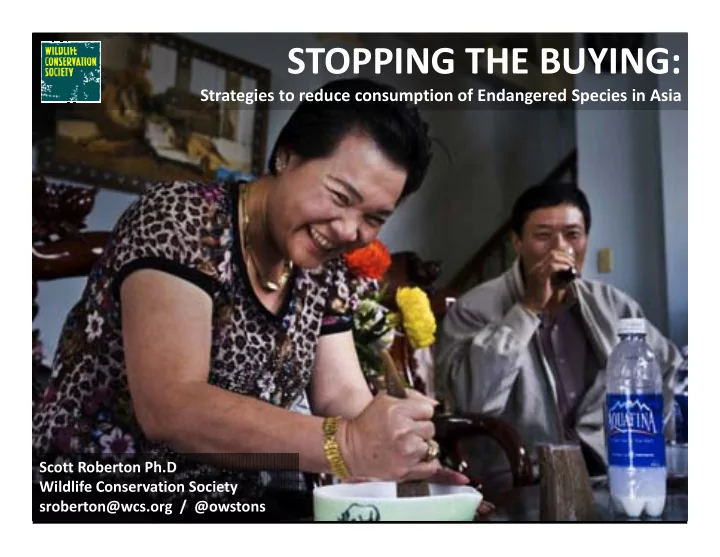
STOPPING THE BUYING: Strategies to reduce consumption of Endangered - - PowerPoint PPT Presentation
STOPPING THE BUYING: Strategies to reduce consumption of Endangered Species in Asia Scott Roberton Ph.D Wildlife Conservation Society sroberton@wcs.org / @owstons Global attention to address poaching, trafficking and demand for Endangered species
Strategies to reduce consumption of Endangered Species in Asia
Scott Roberton Ph.D Wildlife Conservation Society sroberton@wcs.org / @owstons
Robust monitoring is required to enable more accurate measurement of consumption and assessment of demand reduction efforts
2006‐2012, shark protection themed commercials by sport celebrities
2002 2006‐2012 2013‐2014 2000‐2001 unaware of shark protection 2002‐2003, hydrogen peroxide fins were investigated in Guangdong, resulting in decrease of fin wholesale volume 2007, Yao Ming vowed to “refuse fin dishes under any circumstanc es” 2007, WildAid released the “Species Extinction” report on global threats to sharks 2008‐2009, top restaurants like South Beauty joined in the “anti‐finning” campaign 2008‐ 2012Entrep reneurs start to have relevant appealing proposals 2009, Nutriological Report on Shark Fins 2010, Canadian & US gov. announced the banning on “fin consumption” 2011, the CCTV reports led to more proposals which was implicitly connected to the anti‐ corruption appealing 2011, the OCEANS film inspires the buzz of maritime life protection highlighted by KOLs’ tweets
July 2012, competent administration under the State Council replied to NPC representative Ding Liguo, expressing to stipulate on the “removal of fin dishes from governmental menus” in three years February 20, 2013, MOC Spokesman said the sales of top‐grade dishes dropped markedly, with the fins sale down by over 70% around the Chinese New Year period December 2013, the General Office of the State Council issues the administration rules for
to refuse the offering of fins, bird’s nest and other top‐grad dishes or wildlife dishes for work meals, provision of cigarette and expensive wines, use of private clubs or high consumption venues. Latest data in 2014 shows, volume of fins products from Hong Kong to Mainland decreased from 1170 tons in 2012 to 114 tons in 2013
source: “The Ivory Road Study” (National Geographic/ifop research), December 2012
Greater efforts are required to generate the political support for effective crime prevention strategies that will not only have impact on reducing consumption but also strengthen enforcement to combat wildlife trafficking networks.
Building an influential, active conservation constituency (Parliamentarians, high‐ wealth individuals, Government ‘champions’, and media) to strengthern accountability and advocate for policy/legal reforms
Most netizens were from top‐tier cities (Beijing, Chongqing, Guangdong).
Providing assistance to develop Government strategies and measures that demonstrate political commitment and inform retailers, traders and consumers to the enhanced policy to tackling trafficking and consumption of focal species.
Generating data and actionable intelligence that enables measurement of impact in changes in attitudes, behavior, policy, law enforcement effectiveness, criminal network integrity
Ivory Crush in China Yaoming Documenta ry in Africa WCS Campaign with Customs The World’s largest ivory storage, by British Daily Mail Elephant s’ poachin g in Kenya, by British Daily Mail HK destroys 28‐ton ivory WCS Campaign with Customs Kenya elephant king killed crucially Controversial discussion on China supports terrorism LRA WCS c o llabo rate d with Artro n.ne t