? Steve Thomas CBE Chief Executive WLGA Welsh Government approach - - PowerPoint PPT Presentation

steve thomas cbe chief executive wlga welsh government
SMART_READER_LITE
LIVE PREVIEW

? Steve Thomas CBE Chief Executive WLGA Welsh Government approach - - PowerPoint PPT Presentation

Local, Regional and National - Where do the town and community councils fit? ? Steve Thomas CBE Chief Executive WLGA Welsh Government approach to Public services reform feels a bit like this at present. The current financial climate times


slide-1
SLIDE 1

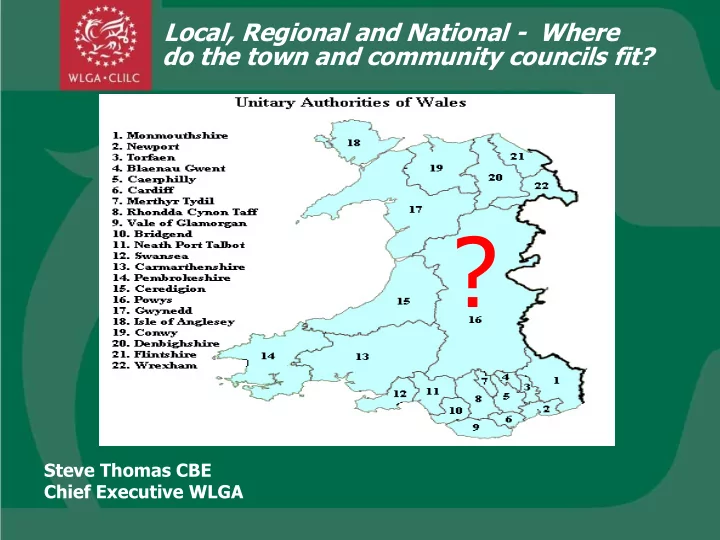
Local, Regional and National - Where

do the town and community councils fit?

Steve Thomas CBE Chief Executive WLGA

?

slide-2
SLIDE 2

Welsh Government approach to Public services reform feels a bit like this at present.

slide-3
SLIDE 3

The current financial climate – times are very tough

  • Local government £57m in redundancy costs thus far
  • Capital spending cut by 40%
  • No protection to NHS spending has led to smaller cuts than England
slide-4
SLIDE 4

Wales – From a potential train wreck

to Opportunity Knocks?

slide-5
SLIDE 5
  • Huge Pressures on the NHS and social care budgets
  • 21st Century Schools capital bids equals £5.7billion. Money

available £300million.

  • Massively variable local government performance. ESTYN

inspection reports are mostly a “celebration of the adequate”

  • Perceived track record of failure on Shared Services
  • Costs of Welsh approach to University tuition fees.
  • Council tax freeze? Impact on the precept?

The Welsh public sector might be financially better off than across Offa’s Dyke but…..

slide-6
SLIDE 6
  • The Simpson Report: “Local, Regional, National: What

Services are Delivered Where?” –

  • The Vivian Thomas Report: “The Structure of

Education Services in Wales

  • The Gwenda Thomas Review - “Sustainable Social

services for Wales – A Framework for Action” –

Enough Reviews to shake a stick at!

slide-7
SLIDE 7
  • Ministers would love to reorganise local government but

hold on a moment ………………

  • Cost, impact on service delivery, potential rows
  • ver councillor numbers and boundary disputes.
  • Are reorganised services inherently more efficient?
  • DELIVERY - collaboration not competition, regionalism

not reorganisation.

  • Reorganisation will happen some time, but by that time

will it be of “super districts” rather than “unitary authorities”?

  • Reality – Reorganisation is happening in functions not

structures.

  • What options do town and community councils
  • ffer?

Background - 1996 and all that

slide-8
SLIDE 8

The context of Welsh politics – Delivery, delivery, delivery

  • “I want much greater efficiency

across the board”

  • “If we are to avoid financial

pressures turning into crude service cuts, we have to accelerate the pace of change dramatically.”

  • “Public services in Wales must get

used to fact that the words status quo are not longer part

  • f the lexicon”

“Establish an Independent Commission to review the governance and delivery arrangements of public services in Wales and make recommendations on the most effective delivery of those public services”.

slide-9
SLIDE 9

Education – The John Riggins approach to driving policy

  • “There are fundamental questions

about the strategic capabilities of LEAs in education…..22 directors are too many”

  • “We need a proper debate on the

role of councils in education”

  • “I want money to go on clear

priorities, not simply disappear into county hall budgets”

  • Issues – The PISA report, Estyn inspections etc
  • Result - The most profound changes occurring in education

policy and delivery.

  • Viv Thomas Report - For local government possibility of

Education being delivered through 4 regional boards?

slide-10
SLIDE 10

Local Government – 22 is not the magic number but what is?

  • “The days of Wales' 22 local

authorities having 22 chief executives 'are coming to an end‘

  • “Why do we need 22 of everything

– 22 fleets of council vehicles; 22 education services; 22 trading standards? We cannot afford just to accept traditional service models and ways of thinking”.

  • Result –Local Government Measure can force collaboration and

mergers – Can also see the devolution of services

  • An emerging fixation on the need to share senior posts as “THE

ANSWER”

  • Social Services White Paper – 3 regional commissioning

hubs

slide-11
SLIDE 11

The Compact – Opportunity or Threat. Its all about economies of scale.

slide-12
SLIDE 12

The Big Offer – the big ticket stuff moving to the regions

  • Education and school improvement shared

services to be in place by September 2012

  • Regional commissioning hubs and improvement

collaboratives for of Social Care to be in place by 2012/13

  • Waste management collaboration on procurement

plus examination of the management organisation of the service

  • The formation of 2 Trunk Road Agencies leading to an

examination of the expansion of role of Regional Transport consortia

  • Regional Delivery of the Supporting People

Programme to commence in 2013-14.

slide-13
SLIDE 13

Service delegations - Being aware of all the pitfalls as well as the positives.

A R

slide-14
SLIDE 14

The Role of Charters and building trust. What’s your relationship like?

A R

slide-15
SLIDE 15

Meaningful delegation of services or the local government version of a “hospital pass”?

QUESTIONS -

1.What are the sorts of services that may be delegated; 2.What are the different types of delegation scheme; 3.What are the considerations for setting up a scheme; 4.What is typically involved in taking on a service delegation;

ISSUES -

  • Is it delegation or dumping? Real Partnerships
  • Is sufficient funding passed on and is lack of resources the best

driver for service change?

  • What are the legal issues?
  • Do you really want it? The key question of capacity
  • What’s the view of council tax payers
slide-16
SLIDE 16

Examples of the “57 varieties” of functions which could be devolved Some of the many functions that might be considered for delegation:

  • Winter maintenance
  • Maintenance of highway verges,
  • Open spaces, Tree preservation orders
  • Street cleansing (such as litter picking, sweeping and graffiti

removal)

  • Public conveniences
  • Street lighting (except on principal roads)
  • Parking restrictions
  • Cutting grass verges and looking after local footpaths;
  • Managing council allotments.
  • Street naming
slide-17
SLIDE 17

Need for honesty around the flashpoints – plenty of good and bad examples

  • Planning issues
  • Slow response to

correspondence

  • Proper consultation
  • Double taxation
  • Institutional

relationships can be cumbersome

slide-18
SLIDE 18

Conclusions

  • All the meaningful discussions occurring with the Welsh

Government currently are about regionalisation and economies of scale

  • There appears to be no robust debate about the “localist”

agenda in Wales, but what could be the new service models?

  • What are the governance models for big regional

collaborations and what does this mean for local democratic control and for your influence.

  • Would Local Government Reorganisation be a cleaner
  • ption?
slide-19
SLIDE 19

Thanks for listening

Steve Thomas CBE Chief Executive WLGA steve.thomas@wlga.gov.uk