
SLIDE 1
Stephen Powell, Richard Millwood, Mark Johnson & Margaret Nelson - - PDF document
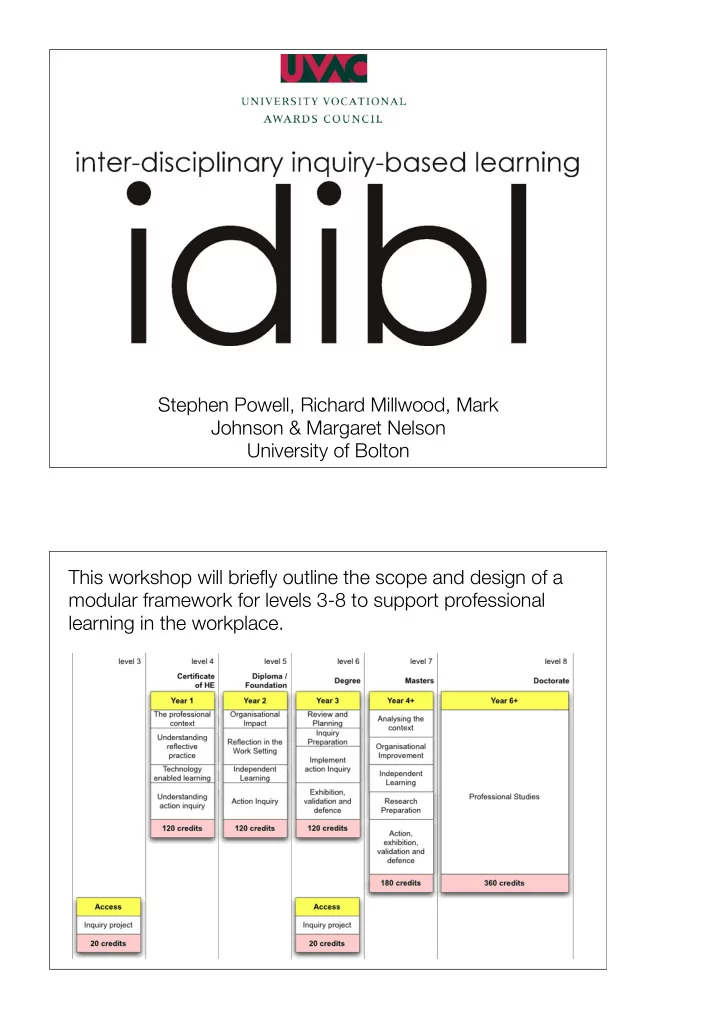
Stephen Powell, Richard Millwood, Mark Johnson & Margaret Nelson University of Bolton This workshop will briefly outline the scope and design of a modular framework for levels 3-8 to support professional learning in the workplace. OUTLINE
August 2007
May 2008
Masters in Learning with Technology November 2008
Sustainable Communities
Future developments
degree to Bachelors in Nursery Education September 2008
Masters LwT
new staff in UAE January 2003
May 2003
July 2003
students July 2006
students 2005
15-30 credit restructure February 2006
Media Practice validated
Negotiation about student numbers One-size-fits-all content curriculum agreed Learning ‘diet’ delivered Learning individually & frequently re-negotiated to meet needs of student and employer Personal development planning and
planning Personal development planning
Process curriculum designed
Objective Learning outcomes at Level 7 - the postgraduate with Masters Degree will be able to:
curious, evaluative and effective 'improvers' in society Independently identify opportunities to take actions for improvement at an organisational level, systematically implement innovative solutions and critically evaluate the outcomes.
analysis and insight Undertake a significant piece of research that fully and critically explores key issues demonstrating rigor in the research process.
dissemination of improved practice Synthesize sources and communicate orally, in writing, and in appropriate media, in academic and professional contexts making well informed, coherent and persuasive arguments.
professional knowledge for depth of understanding of practice Critically analyse and evaluate complex issues and lead reasoned argument around topics of debate or controversy drawing on knowledge at the forefront of their field including a historical perspective.
sustain lifelong learning and community of practice Take a leadership role to articulate philosophies of lifelong learning, the applications of technology, and the way organisations work.
contexts of organisation and society Use organisational theories to inform analysis and evaluation of their work context at a strategic level, critiquing local and national policies and develop recommendations for change.
for individuals and society Analyse and manage the implications of ethical dilemmas including social implications of activities and work pro-actively with others to formulate solutions.
confidence and competence with technology as a modern practitioner Evaluate technology for its contribution to communication, co-ordination and an organisation's enterprise activities.
Benefits for: Flexibility in: Student University Employer Time
Full time work, family, best time for learning Timetable, staffing No release needed
Place
As above and best place to study No rooms, no car parking As above
Assessment
Finding voice, creativity, technology Retention, graduate competencies Communicative employees
Negotiated curriculum
Motivation, perseverance, meaningfulness. Retention, focus on process quality, relevance to society. Relevance
Action Inquiry
Basis in ‘delight’ - zest and interest Practitioner data eg collection of case studies Effective improvement