
SLIDE 1
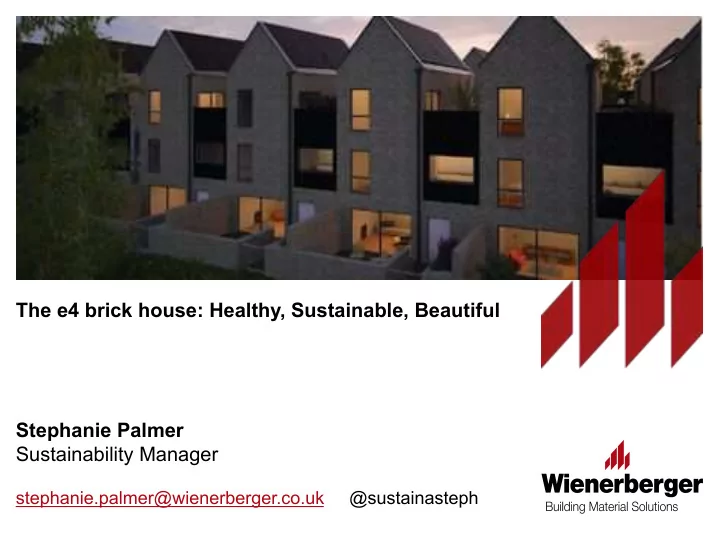
The e4 brick house: Healthy, Sustainable, Beautiful Stephanie Palmer Sustainability Manager
stephanie.palmer@wienerberger.co.uk @sustainasteph
stephanie.palmer@wienerberger.co.uk @sustainasteph Material - - PowerPoint PPT Presentation
The e4 brick house: Healthy, Sustainable, Beautiful Stephanie Palmer Sustainability Manager stephanie.palmer@wienerberger.co.uk @sustainasteph Material solutions for a better quality of life ! What does society need? ! What does society want
The e4 brick house: Healthy, Sustainable, Beautiful Stephanie Palmer Sustainability Manager
stephanie.palmer@wienerberger.co.uk @sustainasteph
! What does society need? ! What does society want?
104.7 143.8 116.0 155.1 198.1 0.0 25.0 50.0 75.0 100.0 125.0 150.0 175.0 200.0 F NL BE SCAN UK
What do we need?
24 June 2016 3
2.22 3.51 4.02 3.05 5.01 0.0 2.0 4.0 6.0 8.0 10.0 F NL BE SCAN UK
Housing starts (residential) per 1,000 residents 1)
Western European average 2003-2008 = 5.95
Time in years to replenish housing stock at 2013 build rate
1) Source: Euroconstruct (June 2014), data for 2013
energy efficiency
noise disturbance
size of rooms
recommended size
day ayli ligh ght
What do we want?
Energy
! Efficient materials: Manufacture & Performance ! Efficient fittings & systems ! CfSH equiv. Level 4 (without renewables)
Economy
! Affordable to construct, and/or buy ! Affordable to live in ! Durable by material and design – low maintenance
Environment
! BES 6001 ! BRE Green Guide ! Low water usage ! CfSH equiv. Level 4
Emotion
! Healthy non-toxic materials ! Promote wellbeing with thermal comfort, space, sound and light ! Flexibility
! Air tightness result = 2.96 m3/(hr/m2) at @50Pa ! DER 6.95 < TER 27.31 ! DFEE 43.40 < TFEE 60.91 ! CfSH level = 5 ! Estimated energy cost per year = £230 ! RHI and Feed-In Tariff ! Estimated PV generation = 1,235 kWh/year ! Estimated Net Heat Pump generation = 1,348 kWh/year
0" 5" 10" 15" 20" 25" 30" 35" 40" 6" 7" 8" 9" 10" 11" 12" 1"
Internal(Temperature(-(Upstairs( External(Temperature(
Internal temperature range been between 18-25 ˚C summer 2015
internally and externally.
walls
(adjacent to the patio door) demonstrates almost no corner effect at all
coating used to seal the surface.
“E4 at BRE is probably the most energy efficient example that we have seen in over 8 years of thermal imaging surveys.”
For clients building e4 houses - Wienerberger’s Built Environment team offers full support ! Design advice and tender support using WB as a principal designers ! Guidance on applying and adhering to e4 principles as outlined in the
Technical Manual
! Compliance with National Standards and BIM Level 2 ! Fully digitised proposition including all specifications, BoQ’s, Call-offs etc ! SAP assessments and energy strategy ! Home Quality Mark, CODE and Passivhaus Assessments ! e4 certification through a QA process
e4 Case study: Hanslope, Milton Keynes
Developer: Tag Information Technology Ltd Brick: Hestia Multi Block: Porotherm 100 Tile: New rivius antique slate Solar: PV48
The e4 brick house: Healthy, Sustainable, Beautiful Stephanie Palmer Sustainability Manager
stephanie.palmer@wienerberger.co.uk @sustainasteph
A PAINT FOR ALL REASONS `HEALTHY, SUSTAINABLE, BEAUTIFUL‘
HANNAH MAIDEN, BUSINESS DEVELOPMENT ADVISOR KEIM MINERAL PAINTS VISION LONDON 2016
24/06/2016 / 18
Healthy -
Sustainable –
paint
Beautiful -
deliver design concepts
A PAINT FOR ALL REASONS
24/06/2016 / 19
What do we mean by healthy?
HEALTHY
24/06/2016 / 20
POTENTIAL HEALTH RISKS OF CONVENTIONAL PAINTS
Toxins and poisons
24/06/2016 / 21
POTENTIAL HEALTH RISKS OF CONVENTIONAL PAINTS
Health risks
24/06/2016 / 22
POTENTIAL HEALTH RISKS OF CONVENTIONAL PAINTS
Existing health conditions
24/06/2016 / 23
POTENTIAL HEALTH RISKS OF CONVENTIONAL PAINTS
Unhealthy environments
24/06/2016 / 24
MINERAL PAINTS – A HEALTHY ALTERNATIVE
24/06/2016 / 25
MINERAL PAINTS – A HEALTHY ALTERNATIVE
24/06/2016 / 26
What do we mean by sustainable?
SUSTAINABLE
24/06/2016 / 27
SUSTAINBLE ISSUES WITH CONVENTIONAL PAINTS
Environmental impact
both during manufacture and upon use Construction impact
protection
24/06/2016 / 28
MINERAL PAINTS – A SUSTAINABLE ALTERNATIVE
24/06/2016 / 29
What do we mean by beautiful?
BEAUTIFUL
24/06/2016 / 30
MINERAL PAINTS - BEAUTIFUL SOLUTIONS
HISTORIC RESTORATION PROJECTS
24/06/2016 / 31
MINERAL PAINTS - BEAUTIFUL SOLUTIONS
INNOVATIVE ARCHITECTURAL DESIGN
24/06/2016 / 32
MINERAL PAINTS - BEAUTIFUL SOLUTIONS
HOUSING SCHEMES
24/06/2016 / 33
MINERAL PAINTS - BEAUTIFUL SOLUTIONS
EDUCATIONAL DESIGNS
24/06/2016 / 34
MINERAL PAINTS - BEAUTIFUL SOLUTIONS
PRIVATE HOMES
24/06/2016 / 35
WHATEVER THE REASON – THINK PAINT, THINK MINERAL PAINTS
Annual production of commercially significant fibres >36 mmt p.a. (excl. Wood, straw, paper) = 60+ mmt CO2 sequestered
Need to be affordable and readily available
Fibres need to be fine
Irregular Fine Durable Renewable
Individual properties provide performance but performance is enhanced when properties work together. For example: Fine fibre = high internal surface area combined with breathability = extremely large breathable surface = efficient moisture control. Renewable fibres = carbon sequestration combined with durability = larger carbon sink.
Breathable
they can bind charges sites on the natural fibre molecule.
and released as water vapour (gas).
content (emc) with surrounding air
vice versa. Water of Hydration Water Vapour
and release moisture is almost entirely dependent on the RH
air can hold @ 70% RH falls from 16gm-3 to 5gm-3.
surface.
capture and release of water since very little energy is taken to transport moisture from and to the fibre surface.
Air Temp Falls RH increases Fibre binds water vapour RH falls Condensation risk reduced
No liquid water involved
As RH increases natural fibre pulls RH away from dew point. This always happens below the fibre saturation point of the fibre
Frequency (Hertz) 125 250 500 1K 2K 4K Product 50mm Nominal Density Practical Absorption Coefficient Rockwool RWA 45 45 kgm-3 0.20 0.50 0.85 1.00 1.00 1.00 Rockwool RW 3 60 kgm-3 0.11 0.60 0.96 0.94 0.92 0.82 Thermafleece UltraWool 31 kgm-3 0.20 0.55 0.85 0.90 1.00 1.00 Natural Fibre Insulation can provide comparable or better acoustic insulation compared to mineral based products at a lower density. Variation in fibre diameter and length help absorb different frequencies. Absorption coefficient – fraction of sound energy absorbed by a material at a given frequency. 1 = 100%, 0 = 0%
insulation varies between 0.035 WmK-1 to 0.044 WmK-1.
the fibre saturation point (approx 30% mc).
product and source but all natural fibres sequester atmospheric carbon for their lifetime.
A P R E S E N T A T I O N W I T H C H R I S B R O O K M A N
W W W. B A C K T O E A R T H. C O. U K
W W W. B A C K T O E A R T H. C O. U K
W W W. B A C K T O E A R T H. C O. U K
W W W. B A C K T O E A R T H. C O. U K
W W W. B A C K T O E A R T H. C O. U K
W W W. B A C K T O E A R T H. C O. U K
A N Y Q U E S T I O N S?
W W W. B A C K T O E A R T H. C O. U K
W A N T T O V I S I T M Y P A S S I V H A U S ? G R A B M E
A F T E R
UK"
UK"
1."Internal"vapour"pressure""
(vapour"producCon,"low"venClaCon..)"
2."Wind"driven"rain "" 4."ConstrucCon"moisture"&"" ground"moisture" 3."Reverse"vapour"pressure" gradient"(solar"radiaCon..)"
Moisture Control
1.( 2.( 3.( 4.(
Quick Guide; Moisture sources and movement
WDR map
Quick Guide; Design a) 75%+ of building failure is due to moisture. b) You cannot stop moisture getting into the building fabric.
preventing it getting in, while accepting b).
levels within the fabric for when it gets in.
Quick Guide; Materials
can buffer and wick moisture.
any synthetic insulation in this way.
Vapour"check"based"system" Breathable"system"
Quick Guide; Systems
((PAVAFLEX(((((((((((
www.naturalVbuilding.co.uk"
87
Healthy, Sustainable, Beautiful
Insulate naturally
88
Healthy, Sustainable, Beautiful
Overview
" Introduction " Summer Heat Protection " Vapour open construction " Importance of Workmanship
89
Healthy, Sustainable, Beautiful
Overview
90
Introduction
Martin Twamley Technical Manager STEICO UK Ltd
Based near Munich in Germany, STEICO SE are the worlds leading producer of wood fibre insulations. Production is based at 3 European locations which include Czarnkow in Poland, Europes largest production facility for ecological insulation materials.
91
Healthy, Sustainable, Beautiful
Overview
" Introduction " Summer Heat Protection " Vapour open construction " Importance of Workmanship
92
Principles of effective insulation
Principles of Insulation
In order to achieve a robust and securely insulated structure the following key elements should be considered:
93
" low thermal conductivity λ " high specific heat capacity cp " high density ρ " low thermal diffusivity a
Principles of Insulation
Summer Heat Protection
The following mix of material properties provide the ideal combination for Summer Heat Protection
94
External temperature Internal temperature with mineral wool Internal temperature with wood fibre insulation
Temperature range at the roof with different insulation materials
Principles of Insulation
95
Amplitude Suppression Phase Shift
Ext variation = 40º-10º = 30º Int variation = 21º-18º = 3º
Reduction of temperature across a building component
Principles of Insulation
96
Achieving 0.13 W/m2K
U value = 0.13 W/m2K Phase Shift = 16 Hours U value = 0.13 W/m2K Phase Shift = 7.2 Hours Woodfibre Glasswool Mineralwool PIR U value = 0.13 W/m2K Phase Shift = 7.2 Hours U value = 0.13 W/m2K Phase Shift = 8.1 Hours
97
Healthy, Sustainable, Beautiful
Overview
" Introduction " Summer Heat Protection " Vapour open construction " Importance of Workmanship
98
Getting it right......
Roof Renovation
Condensation … … can be beautiful!
99
Condensation … … not so nice here !!
Grafiken: Quadriga / E.U. Köhnke
Getting it right......
Roof Renovation
100
" No condensation will occur if water vapour resistance on the warm side (internal) of the construction is 10 times lower as on the cold side (external) " Example: Internal: OSB 15 mm, µ = 200 ⇒ sd – value = 3 m External: STEICOuniversal 35 mm, µ = 5 ⇒ sd – value = 0.18 m
Condensation risk
Principles of Insulation
101
Healthy, Sustainable, Beautiful
Overview
" Introduction " Summer Heat Protection " Vapour open construction " Importance of Workmanship
102
Workmanship
Principles of Insulation
Regardless of which materials are used the installation process needs to be correct. Use materials that reduce the risk of poor site practices
103
Thank you for your attention…
Q & A Session