
SLIDE 1
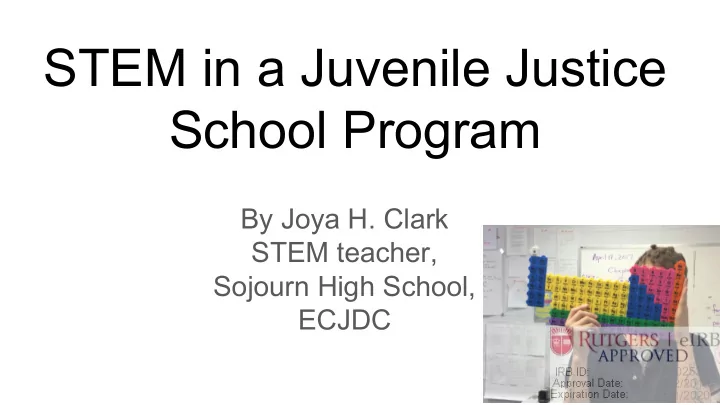
STEM in a Juvenile Justice School Program
By Joya H. Clark STEM teacher, Sojourn High School, ECJDC
Pro2018002522 5/2/2019 5/1/2020
STEM in a Juvenile Justice School Program By Joya H. Clark STEM - - PowerPoint PPT Presentation
STEM in a Juvenile Justice School Program By Joya H. Clark STEM teacher, Sojourn High School, ECJDC Pro2018002522 5/2/2019 5/1/2020 What does STEM stand for? Science - Traditional subjects such as Biology, Chemistry, Earth Science, and
Pro2018002522 5/2/2019 5/1/2020
Science - Traditional subjects such as Biology, Chemistry, Earth Science, and Physics. Technology - Newer subjects that have been added to the curriculum such as computer programming, computer-aided design and 3D printing, or robotics. Engineering - designing new technology and revising the old. Mathematics - the abstract science of number, quantity, and space.
Pro2018002522 5/2/2019 5/1/2020
In the K–12 context, “science” is generally taken to mean the traditional natural sciences: physics, chemistry, biology, and (more recently) earth, space, and environmental sciences . . . .
Pro2018002522 5/2/2019 5/1/2020
We use the term “engineering” in a very broad sense to mean any engagement in a systematic practice of design to achieve solutions to particular human problems. Likewise, we broadly use the term “technology” to include all types of human-made systems and processes—not in the limited sense often used in schools that equates technology with modern computational and communications devices.
Pro2018002522 5/2/2019 5/1/2020
Technologies result when engineers apply their understanding of the natural world and of human behavior to design ways to satisfy human needs and wants. (NRC 2012, p. 11-12)
Pro2018002522 5/2/2019 5/1/2020
Sort of ... Most science and math teachers have talked about it as a career, but very few actually tried to integrate it into their lessons until our standards changed. In other words, when the Next Generation Science Standards were introduced, science and engineering practices became the rule instead of the exception. Now, we are all challenged to integrate these three components of engineering design into all science instruction:
Pro2018002522 5/2/2019 5/1/2020
to be solved as clearly as possible in terms of criteria for success, and constraints
number of different possible solutions, then evaluating potential solutions to see which ones best meet the criteria and constraints of the problem.
systematically tested and refined and the final design is improved by trading off less important features for those that are more important.
Pro2018002522 5/2/2019 5/1/2020
In our context, many students do not see the relevance of school. Engineering projects are focused on solving practical, real-world problems. In most cases, students are willing to engage. Yes, engineering involves physics, but most projects can be completed with an explanation of the application of physics, even before students attempt to solve any physics problems.
Pro2018002522 5/2/2019 5/1/2020
Sure, they can. It takes a ton of time and patience.
Pro2018002522 5/2/2019 5/1/2020
Absolutely, yes! They can learn about construction, cosmetology, electrical & electronics, computer programming, and architecture. What ideas do you have?
Pro2018002522 5/2/2019 5/1/2020
We use technology to connect our science and math teachers! I am here today to request your permission to create secure meeting space for us to meet.
What would be a “dream come true” for you to support your science and math teachers?
Pro2018002522 5/2/2019 5/1/2020
Some of the things I love the most for engineering are free! Such as:
Some of them are inexpensive: Less than $20: https://www.kiwico.com/tinker Expensive, but really worth it: $2,400 for 100 student licenses: https://www.ixl.com/
Pro2018002522 5/2/2019 5/1/2020
Joya Clark E-mail: j.clark@eresc.com, or jc346@njit.edu Mobile Phone: (973) 951-9263 Sojourn High School 80 Duryea Street Newark, NJ 07103
Pro2018002522 5/2/2019 5/1/2020