STEAMING TOWARD WAR: ON THE ROAD TO PEARL HARBOR THE JAPANESE AND - - PowerPoint PPT Presentation

steaming toward war on
SMART_READER_LITE
LIVE PREVIEW

STEAMING TOWARD WAR: ON THE ROAD TO PEARL HARBOR THE JAPANESE AND - - PowerPoint PPT Presentation

STEAMING TOWARD WAR: ON THE ROAD TO PEARL HARBOR THE JAPANESE AND AMERICAN NAVIES 1 1922: The Washington Treaty Constrains Force Levels Battleship Ratio is 5 to 3 in Favor of the US Navy Battleship Tosa, used as a target in 1924-1925 2 The


slide-1
SLIDE 1

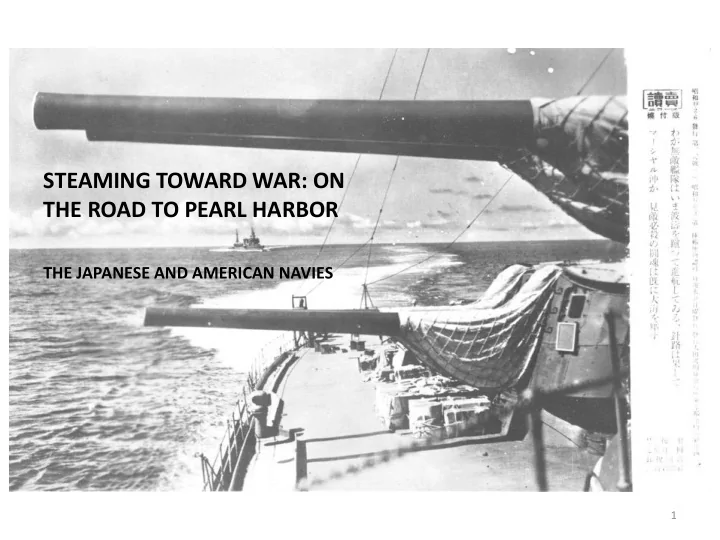
STEAMING TOWARD WAR: ON THE ROAD TO PEARL HARBOR

THE JAPANESE AND AMERICAN NAVIES

1
slide-2
SLIDE 2

2

1922: The Washington Treaty Constrains Force Levels Battleship Ratio is 5 to 3 in Favor of the US Navy

Battleship Tosa, used as a target in 1924-1925

slide-3
SLIDE 3

3

Battlecruiser Akagi being rebuilt as an aircraft carrier The Two Navies Adapt

slide-4
SLIDE 4

4

Japanese Naval Strategy: Initially Wait and React to US Move Japanese Operational Approach: Aggressive Defense Based on Cumulative Attrition of US Battleships Japanese Tactical Doctrine: Daytime Submarine Attacks and Night Torpedo Attacks by Cruisers and Destroyers

Heavy Cruiser Aoba

slide-5
SLIDE 5

5

US Naval Strategy: Offensive, to Blockade Japan US Operational Approach: Aggressive Movement into Japanese Waters to Force an Major Fleet Engagement US Tactical Doctrine: Repel Torpedo Attacks; Maneuver Away from Japanese Night Battle Formations

slide-6
SLIDE 6

6

The Clash of Battlefleets: Planned but Not Executed

slide-7
SLIDE 7

7

Why Wasn’t It Executed? Air Power. Kaga 1937.

slide-8
SLIDE 8

8

TBD-1s on Saratoga 1938.

slide-9
SLIDE 9

9

Nevada at Pearl Harbor 6 IJN Carriers, 353 Aircraft

slide-10
SLIDE 10

Learning to Fight:

USN Interwar Doctrinal Development

Trent Hone @Honer_CUT

Trent Hone | @Honer_CUT

slide-11
SLIDE 11

In the early years of the 20th century the U.S. Navy developed a sophisticated learning system that led to repeated doctrinal innovations

How was this done?

The U.S. Navy’s Learning System

Trent Hone | @Honer_CUT

slide-12
SLIDE 12

“Planning System”

Trent Hone | @Honer_CUT

slide-13
SLIDE 13

Interwar Learning Cycles

Trent Hone | @Honer_CUT

Chief of Naval Operations Fleet Command Naval War College General Board

slide-14
SLIDE 14

Annual Cycles of Exercises

Trent Hone | @Honer_CUT

slide-15
SLIDE 15

Fleet Problems

Trent Hone | @Honer_CUT

slide-16
SLIDE 16

1919: Principles of War

  • 1. The Objective
  • 2. The Offensive
  • 3. Superiority
  • 4. Security
  • 5. Surprise
  • 6. Simplicity
  • 7. Movement
  • 8. Economy of

Force

  • 9. Cooperation

Trent Hone | @Honer_CUT

slide-17
SLIDE 17

New Tactical Approaches

Trent Hone | @Honer_CUT

slide-18
SLIDE 18

1930: Vocabulary for Battle Plans

Trent Hone | @Honer_CUT

slide-19
SLIDE 19

Tactical Heuristics

  • Aggressive Action to Seize the Initiative
  • Attack Effectively First

– Long Range Gunnery – Carrier Strikes – Night Battle Practice

  • Decentralized Decision-Making

(and Doctrinal Development)

Trent Hone | @Honer_CUT

slide-20
SLIDE 20

By 1941…

  • Learning system is well-established
  • Doctrine presents a diverse set of options

Trent Hone | @Honer_CUT

slide-21
SLIDE 21

1942: Carrier Raids

Trent Hone | @Honer_CUT

Remaining Options Exploited

slide-22
SLIDE 22

1942: Guadalcanal

Trent Hone | @Honer_CUT

Heuristics Prove Effective

slide-23
SLIDE 23

1943: Learning System

Trent Hone | @Honer_CUT

Lessons from First Year of War Exploited