Status of Revercomb Evaluation/Validation Activities Noise - - PowerPoint PPT Presentation

status of revercomb evaluation validation activities
SMART_READER_LITE
LIVE PREVIEW

Status of Revercomb Evaluation/Validation Activities Noise - - PowerPoint PPT Presentation

Status of Revercomb Evaluation/Validation Activities Noise characterization using Earth scene data (7/3, 8/1 Net-Meetings) Cloud flag using AIRS and MODIS data (7/3, 8/1, 8/15 Net-Meetings) Broadband radiance comparisons with GOES


slide-1
SLIDE 1

Dave Tobin, CIMSS/SSEC/UW-Madison AIRS Science Team Meeting Camp Springs, MD 18-20 September 2002

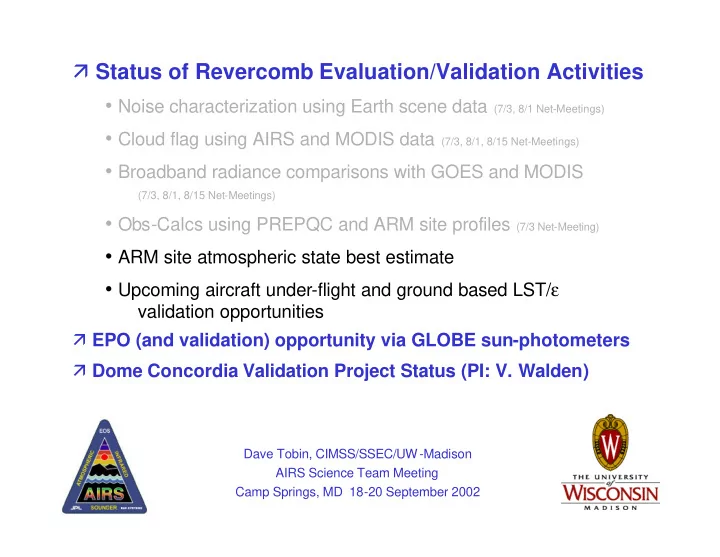
Status of Revercomb Evaluation/Validation Activities

  • Noise characterization using Earth scene data (7/3, 8/1 Net-Meetings)
  • Cloud flag using AIRS and MODIS data (7/3, 8/1, 8/15 Net-Meetings)
  • Broadband radiance comparisons with GOES and MODIS

(7/3, 8/1, 8/15 Net-Meetings)

  • Obs-Calcs using PREPQC and ARM site profiles (7/3 Net-Meeting)
  • ARM site atmospheric state best estimate
  • Upcoming aircraft under-flight and ground based LST/ε

validation opportunities EPO (and validation) opportunity via GLOBE sun-photometers Dome Concordia Validation Project Status (PI: V. Walden)

slide-2
SLIDE 2

ARM Site Atmospheric State Best Estimate

  • Now using JPL matchup files to initiate algorithm
  • Algorithm is initiated for each *Match_Fixed_ValSites* matchup file
  • found. Uses closest (in space) ARM site matchup per overpass

found in matchup file.

  • Overpass dedicated sonde launches began in last week of July.
  • Some new fields in output file: lwpSite, granule_number, matchupFile, matchup_index
  • Southern Great Plains
  • “Full” algorithm (v1.0) in place. Well, almost - currently working on uncertainty estimates.
  • Files available from weather:/dom/files/ops/correl/point/YYYY/MM/ded_site/armbe*.cdf
  • Auxillary images and plots available from http://airs3.ssec.wisc.edu/~airs/aaasbe/
  • North Slope of Alaska and Tropical Western Pacific
  • Currently using a simplified algorithm. Does “plain” interpolation in time

between sondes to overpass time and MWR pwv scaling.

  • NSA sonde data ingest being worked
  • TWP sonde data accessible 1-2 months after collection
  • Upper trop sonde water vapor corrections
  • to be implemented, based on recent Wang et. al JTECH paper
slide-3
SLIDE 3
  • Assessment of Upper Troposphere Water Vapor Measurements

during AFWEX using LASE. c/o R. Ferrare, Water Vapor Breakout Meeting, ARM STM

April 2002.

  • PWV derived from 23.8 GHz MWR at SGP site accurate to ~1 percent.

PWV values from standard ARM processing of MWR are ~1 percent too moist. Based on 22 GHZ line analysis c/o S. A. Clough using a multi-frequency MWR-profiler.

  • 40
  • 30
  • 20
  • 10

10 20 30

Drier than LASE Wetter than LASE

Vaisala corrected 2 Vaisala corrected 1 scaled to match MWR PWV uncorrected corrected for temperature initial corrected for overlap and temperature corrected for

  • verlap

initial

Upper Troposphere (7 km to tropopause, 0.0-0.2 g/kg)

DC-8 cryo hygrometer DC-8 DLH CM sonde

Vaisala radiosonde GSFC Scanning Raman Lidar CART Raman Lidar

% Difference in Water Vapor (Sensor-LASE)

ARM Water Vapor Research. Updates

slide-4
SLIDE 4

25-Jul-2002 08:35 ARM SGP Overpass

slide-5
SLIDE 5

25-Jul-2002 08:35 ARM SGP Overpass

slide-6
SLIDE 6

25-Jul-2002 08:35 ARM SGP Overpass

SGP emissivity estimate Best estimate profiles

slide-7
SLIDE 7

Not Cloudy Uncertain Probably Confident Determined Clear Clear

0940

25-Jul-2002 08:35 ARM SGP Overpass. Is it clear ?

MODIS cloud mask Vaisala Ceiliometer

0910 0840 0810 0740 0710

GOES Sounder 12µm AERI

slide-8
SLIDE 8

25-Jul-2002 08:35 ARM SGP Overpass

  • bs=mean(golfball)

calculation

  • bs - calculation

This calculation uses “old” kCARTA and AMSU-fov best estimate T, q, and LST/ε + U.S. Standard atmos

CO2 lineshape U.S. Standard Atmosphere (?) H2O continuum

slide-9
SLIDE 9

25-Jul-2002 08:35 ARM SGP Overpass

25-July ARM case w/ old kCARTA 20-July bias w/ new kCARTA 20-July bias w/ SARTA_m16

(25-July ARM site case) versus (20-July clear/night/ocean ECMWF-based cases ala Strow et al)

ARM Site case:

  • bs - calculation

std(golfball) site calc - amsu calc H2O uncertainty

slide-10
SLIDE 10

25-Jul-2002 08:35 ARM SGP Overpass

Obs-Calcs with “new” kCARTA using ARM best estimate supplemented with ECMWF (ala Strow et al)

slide-11
SLIDE 11

upcoming aircraft under-flight opportunities

ARM “Grand Tour”, SGP CART field program

  • ARM objectives with Aqua underflights of opportunity
  • Scanning-HIS on Proteus
  • Based out of Ponca City, OK with flights over SGP ARM site
  • Science flights from November 3rd to 16th

Texas 2002

  • Dedicated Aqua MODIS Level 1B validation mission. Chris Moeller

(CIMSS/SSEC/UW) is the mission scientist.

  • Scanning-HIS, NAST-I, MAS, and CPL on NASA ER-2
  • Ground based AERI-bago observations for LST/ε validation
  • Based out of San Antonio with flights over the Gulf of Mexico and

SGP ARM site

  • Science flights from November 20th to December 12th
slide-12
SLIDE 12

Sun/Haze Water Vapor Photometer

An Education and Outreach Activity for validating Total Column Water Vapor from space based measurements with surface observations from schools around the world in collaboration with GLOBE Program

http://tellus.ssec.wisc.edu/outreach/gifts/sp_measure/sp_meas_home.htm

For more information, Contact: sanjayL@ssec.wisc.edu

slide-13
SLIDE 13

UPDATE: Validation of AIRS over the Antarctic Plateau: Low radiance, low humidity, and thin clouds

Von P. Walden Dave Tobin Bob Stone

University of Idaho University of Wisconsin-Madison NOAA-CMDL

+

Dome C

slide-14
SLIDE 14

Scheduling of Experiment

  • 2 January 2003

Field team arrives at Dome C

  • 2 – 9 January 2003

Set up for validation experiment

  • 9 – 31 January 2003

Acquire validation data

  • 4 February 2003

Field team leaves Dome C

  • Dome C validation experiment is scheduled to begin around 9

January 2003, which is currently Launch + 251 (Launch + 8 months).

slide-15
SLIDE 15

Validation Instruments

  • PAERI – Polar Atmospheric Emitted

Radiance Interferometer (Von P. Walden, University of Idaho)

  • IRT - Infrared Radiometric Thermometer

(Bob Stone, NOAA-CMDL)

  • Atmospheric Sounding System – in

collaboration with French Astrophysics group (Eric Fossat, U. Nice)

slide-16
SLIDE 16

AIRS TOA simulations using kCARTA

  • Used radiosonde data from January at South Pole Station

– Similar meteorological conditions to Dome C

  • Ran kcarta with measured radiosonde data, then again with

large uncertainties added in both T and H2O profiles.

– T : +0.5K (0-30 km), +1K (30-60km) ; RHice: +10% (0-4km), +25%(4-7km) [Walden et al. (1998), JGR, 3825-3846]

  • Compared brightness temperature spectra for two cases.
  • Determined which wavenumbers would be best for

validation – Category 1: < +/- 0.05 K, – Category 2: < +/- 0.1 K, – Category 3: > 0.1 K

slide-17
SLIDE 17

AIRS TOA Simulation Results

slide-18
SLIDE 18

AIRS TOA Simulation Results

  • 46% of AIRS

frequencies can be validated with errors less than 0.05 K due to radiosondes.

  • Frequencies can be

validated throughout the H2O ν2 band.

  • Many validation

frequencies exist in the 2616 cm-1 region

slide-19
SLIDE 19

20-July-2002 Ascending LW_Window

From Hot to Cold ...

slide-20
SLIDE 20

To Coldest …

Dome Concordia 20 July 2002 Obs-Calc

AIRS (20 July 2002) calculation

Sub-Arctic Winter May 2001 S. Pole radiosonde profile used in calculation (0.365 mm H2O)