Status of Present Chip Submission M.Winter / CERN, 17th of February - - PowerPoint PPT Presentation

status of present chip submission
SMART_READER_LITE
LIVE PREVIEW

Status of Present Chip Submission M.Winter / CERN, 17th of February - - PowerPoint PPT Presentation

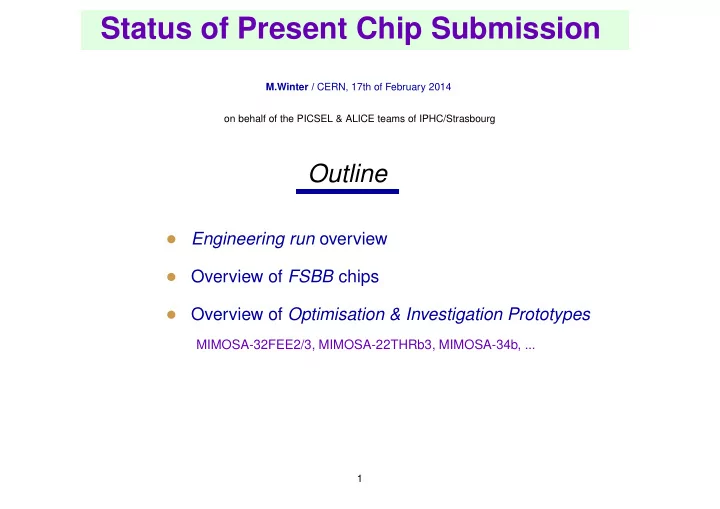
Status of Present Chip Submission M.Winter / CERN, 17th of February 2014 on behalf of the PICSEL & ALICE teams of IPHC/Strasbourg Outline Engineering run overview Overview of FSBB chips Overview of Optimisation & Investigation


slide-1
SLIDE 1

Status of Present Chip Submission

M.Winter / CERN, 17th of February 2014

  • n behalf of the PICSEL & ALICE teams of IPHC/Strasbourg

Outline

  • Engineering run overview
  • Overview of FSBB chips
  • Overview of Optimisation & Investigation Prototypes

MIMOSA-32FEE2/3, MIMOSA-22THRb3, MIMOSA-34b, ...

1

slide-2
SLIDE 2

Sensor Development Organisation

2

slide-3
SLIDE 3

Engineering Run Status

  • List of chips :

FSBB-M0a & -M0b: ∼ complete chain of MISTRAL components FSBB-A0 : ∼ complete chain of ASTRAL components MIMOSA-32FEE2 : in-pixel circuitry optimisation MIMOSA-32FEE3 : pixel circuitry without MIM-cap MIMOSA-22THRb2 : large pixel array with 2-row r.o. & e.o.c. discri. MIMOSA-34b : large pixels with various dim. & sensing nodes various test structures : SEL-test array, etc.

  • Status :

submitted 07/02/2014 expected return form foundry ∼ mid-May

3

slide-4
SLIDE 4

FSBB-M0a/b Overview

  • Main characteristics :

pixels of 22×33 µm2 including pre-amp. & CDS (clamping) staggered sensing nodes double-row rolling shutter read-out (≡ MIMOSA-22THRb) 416 columns of 416 rows 13.7×9.2 mm2 active area

֒ → becomes 13×10 mm2 with 31×24 µm2 pixels

3 stages zero-suppression (≡ SUZE-02)

֒ → windows of 4×5 pixels encoded on 32 bits

4 output buffers of 512×32 bits each 2 output nodes at 320 Mbits/s (160 MHz clock) integrated JTAG, regulators, VDD, GND, ... tr.o. ≃ 35 µs 2 slightly different sub-arrays in each sensor : optimisation of sensing node geometry & in-pixel circuitry

  • Design not final, e.g. in terms of :

pixel dimensions power consumption SUZE-02 throughput vs power peripheral circuitry area pad implementation trigger implementation

4

slide-5
SLIDE 5

FSBB-A0 Overview

  • Identical to FSSB-M0a except :

in-pixel circuitry incorporates one discriminator uniform pixel design (≡ AROM-1b) tr.o. 20 µs

  • Design not final :

similar degree of finalisation as FSBB-M0a/b moreover : in-pixel circuitry optimisation

(noise suppression) still on-going

5

slide-6
SLIDE 6

In-Pixel Circuitry Optimisation

  • 2 MIMOSA-32 FFE chips

Pixels of 20×20/33 µm2 32 sub-arrays of 16×64 pixels Read-out time ≃ 10–13 µs

  • Parametres modified :

Improve pre-amp performances :

  • Pre-amp input transistor design against RTS
  • Pre-amp feedback loop transistors
  • N-MOS vs P-MOS transistors for gain optimisation

MIM capacitors replaced by MOS capacitors

֒ → avoid using ML5 & ML6

Simplified low power pre-amp design

6

slide-7
SLIDE 7

Validation of Large Pixel Sensor

  • MIMOSA-22THRb2 chip :

Goal : confirm 2-row read-out performances with large pixels 64×64 pixels of 22×66 µm2 in-pixel circuitry like MIMOSA-22THRb1 (pre-amp + CDS)

(modified pre-amp input T)

end of column discriminators read-out time ≃ 3.2 µs

  • MIMOSA-34b chip :

Goal : optimise pixel charge collection system ∼ 30 different pixels grouped

in sub-arrays of 16×64 pixels

large pixels only:

33×44/55/66 µm2 & 40×44/55/66 µm2

various sensing node geometries :

CCE vs pixel noise ⇛ SNR

few pixels with AC coupling

7

slide-8
SLIDE 8

SUMMARY

  • Engineering run submitted aiming at :

validation of ∼ full chain of MISTRAL validation of ∼ full chain of ASTRAL

  • ptimisation of in-pixel circuitry

validation of large pixel variants of ASTRAL & MISTRAL investigation of in-pixel circuitry design adapted to pads over pixels assessing SEE sensitivity

֌

expecting first lab test results in June

beam tests foreseen in Octobre 2014

  • Next step :

AROM version compatible with on-pixel pads Shuttle of May 12th ?

  • Final 2014 objective : complete sensor composed of 3 multiplexed FSBB-A units

8