
SLIDE 1
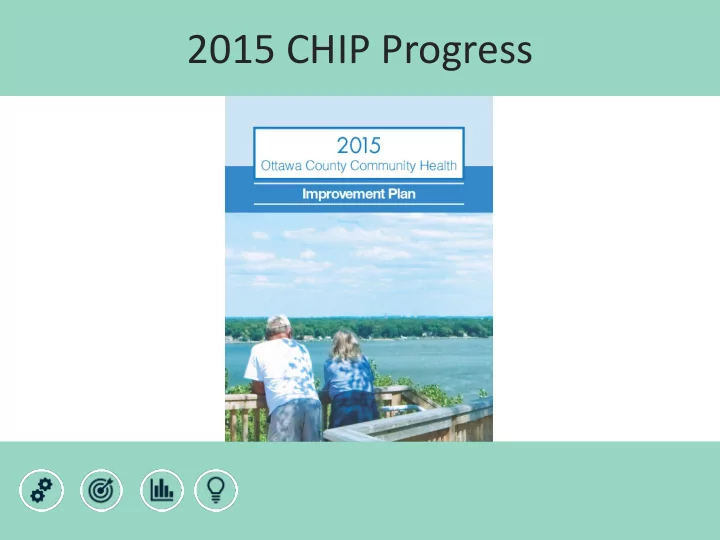
2015 CHIP Progress 2015 CHIP Overview In May-August 2015, Ottawa - - PowerPoint PPT Presentation
2015 CHIP Progress 2015 CHIP Overview In May-August 2015, Ottawa County developed its first Community Health Improvement Plan (CHIP) The most prevalent health issues according to the 2014 CHNA included: Access to Health Care
developed its first Community Health Improvement Plan (CHIP)
the 2014 CHNA included:
– Access to Health Care – Mental Health – Healthy Behaviors
Community Foundation for the Holland/Zeeland Area awarded $490,000 in grants from the MHEHOF.
– focused on youth, seniors & other high-need groups. – demonstrated the most potential for addressing the 3 prevalent issues identified in the 2015 CHIP.
– Access to Health: $130,000 (HH & Love in Action) – Mental Health: $110,000 (Wayne Elhart be nice. fund & TCM Counseling) – Healthy Behaviors: $100,000 (Ottawa Food) – Covering all 3 priorities: $150,000 (Pathways to Better Health)
community integrated system of care.
– ↑ the amount of adults who are confident navigating the health care system. – ↑ the amount of adults who report their general health is better than fair or poor.
– Implement community health worker (CHW) model – Increase care coordination – Increase health literacy
– To improve care coordination for individuals at highest risk for poor health outcomes – Evidence-based model to identify & address individual risk factors – CHWs assist adult Medicaid/Medicare beneficiaries with 2 or more chronic diseases & health/social service needs. – CHWs use a standard checklist to identify needs, assess progress, help reduce barriers & provide education /support.
Implement CHW Models
– Meet with clients at their convenience (home/elsewhere). – Help clients set goals. – Help guide clients through the health care system. – Link clients to medical care based on their specific needs. – Help clients manage their health conditions and prescriptions. – Help clients reduce hospital and emergency room visits. – Link clients to community services and resources (transportation, housing, food, clothing employment and education).
Pathways to Better Health
– Community Mental Health of Ottawa County (CMH) – Community SPOKE – Greater Ottawa County United Way – Holland Hospital (HH) – North Ottawa Community Health System (NOCHS) – Ottawa County Department of Public Health (OCDPH) – Spectrum Health Zeeland Community Hospital (SHZCH)
Pathways to Better Health
Pathways to Better Health
Pathways to Better Health- Year 1
Pathways to Better Health- Year 1
Client Evaluation
Pathways to Better Health- Year 1 Outcomes
Pre-Survey Post-Survey
have a school nurse. 753 student/family encounters
Implement CHW Model
during student/family encounters:
Implement CHW Model
Increase Care Coordination
– Added 3 case managers.
– ↑ access to primary & specialty care in northern OC.
Public Schools
– NOCHS providing training services, funding telemedicine program & other medical services.
Increase Care Coordination
– Expanded hours to more broadly meet the community’s needs.
Health Clinic
– Providing dental services to low income, uninsured adults & Medicaid insured adults.
– Provided marketplace education sessions. Financial counselors provided ~ 200 community members with information about the Affordable Care Act. – Conducted breast cancer awareness campaigns
2014.
Increase Health Literacy
health conditions.
– More people will seek & receive appropriate mental health (MH) treatment.
– Partner & promote the be nice. campaign. – Train primary point of contact people in MH. – Develop & distribute treatment resource materials. – Improve & promote existing resources.
be nice. campaign
– 55,000 students in OAISD area received be nice. education – 4,000 school staff trained – Among students receiving training:
from 36% to 60%
The "be nice." education program is one prevention initiative in my opinion that does make a difference. This is one of the most significant and dynamic processes I have come across in nearly 30 years in education."
be nice. campaign
– Approximately 20 companies offered the be nice. training, impacting 5,000 employees
– All City of Holland & Ottawa County police officers received be nice. action plan training
– Staff at Christ Memorial received be nice. training
Train Primary Points of Contact
– Building Resilient Youth (BRY) provided 3 trainings. – CMH trained 185 people. – SHZCH hosts quarterly training sessions.
– BRY provided 18 QPR trainings. – CMH trained 73 people in QPR. – TCM provided 62 QPR trainings to 1,350 people. – All staff at Grand Haven Area Public Schools & Spring Lake Public Schools were trained in QPR.
Develop & Distribute Treatment Resource Materials
distributed to a listserv of over 25 agencies and to hundreds of organizations.
– MH Crisis Warning Signs & Resource Guide – Training Resource Guide – MH Insurance Flow Chart
Improve & Promote Existing Resources
– Extended counseling & school services to the Holland/Zeeland area, & ↑ counseling/psychiatric services in the Tri-Cities.
– New building to respond to the growing demand for no-cost counseling services for uninsured/ underinsured community members with mental health issues.
– Expanded hours for social workers in its ED.
messages & decrease barriers to healthy living.
– ↑ F/V consumption – ↑ people who have enough to eat – ↑ people at a healthy weight – ↑ leisure time physical activity
– Support the efforts of Ottawa Food – Support the efforts of Shape Michigan
Ottawa Food
individuals that exists to ensure that all Ottawa County residents have access to healthy, local & affordable food choices.
– Eliminate hunger – Encourage healthy eating – ↑ sourcing of local food
Ottawa Food
– Provides free, nutritious summer meals to children 18 & younger. – 68,850 meals served in 2017 in 5 different communities, including 2 new Ottawa Food sites.
Ottawa Food
– 50 participants received $10 in tokens to purchase fresh local produce per visit to the farmers market—up to $100 in a single market season. – Participants reported a 0.9 cup increase in daily F/V consumption, surpassing program goal.
Ottawa Food
– Provides qualifying older adults with $20 vouchers to purchase unprocessed, MI-grown produce at authorized farmers markets/roadside stands in MI. – OF distributed 375 vouchers in 2017. – 75% redemption rate
Ottawa Food
– Connected 2 farmers with 2 local food pantries – 120 low-income households received fresh, local produce; 36 participated in cooking classes
– Grand Haven FM: 575# – Holland FM: Over 475# – U pick Donations: Over 300#
Ottawa Food
– 20+ media placements for programs – 1 million+ media impressions – Raised awareness of Ottawa Food on radio, TV, print & online.
Initiatives
– updated space which serves >200 meals/day & >75,000 meals/year to residents in need.
– A New Growth Center
– Step It Up! 286 fall program participants – 46 million steps taken
– piloting Fit & Healthy Families & Healthy Me programs
– free community health lectures on healthy lifestyles topics.
Ottawa County Department of Public Health
“There is power in collaboration. Just by coming together as a community of organizations committed to population health, we have leveraged more financial support, more services and more community benefit than we could have on our own.”
Questions?
For questions, contact: Lisa Uganski, MPH, RD Health Educator/Ottawa Food Coordinator Ottawa County Department of Public Health (616) 393-5770 or luganski@miottawa.org
Community Health Improvement Plan (CHIP)
A community health improvement plan (or CHIP) is a long-term, systematic effort to address public health problems based on the results
the community health improvement process.
The problems and challenges we face as it relates to public health are simply too great for a single individual,
Only through true collaboration can we meet the pressing and systemic needs as identified in the Community Health Needs Assessment
health priority
for each outcome
recommended strategies
efforts aimed at influencing the desired outcomes
February 28th – CHIP Kickoff March 22nd (8:30 – 10:30am) – Key Metrics / Root Causes April 19th (8:30 – 10:30am) – Root Causes / Strategies May 31st (8:30 – 10:30am) – Strategies / Action Plan June/July – Finalize Plan September/December – Implement Plan
CHIP IP Advi visory ry Council il
For questions, contact: Patrick Cisler, Executive Director Community SPOKE & Lakeshore Nonprofit Alliance (616) 594-7133 patrick.cisler@gmail.com