SLIDE 1
1
Final Assembly
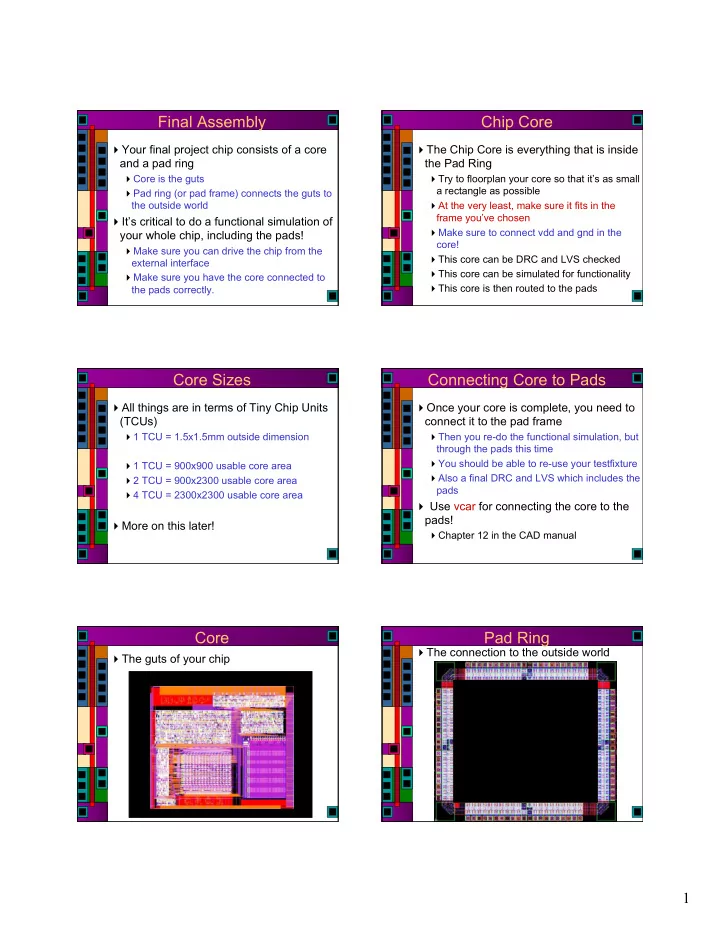
Your final project chip consists of a core and a pad ring
Core is the guts Pad ring (or pad frame) connects the guts to the outside world
It’s critical to do a functional simulation of your whole chip, including the pads!
Make sure you can drive the chip from the external interface Make sure you have the core connected to the pads correctly.
Chip Core
The Chip Core is everything that is inside the Pad Ring
Try to floorplan your core so that it’s as small a rectangle as possible At the very least, make sure it fits in the frame you’ve chosen Make sure to connect vdd and gnd in the core! This core can be DRC and LVS checked This core can be simulated for functionality This core is then routed to the pads
Core Sizes
All things are in terms of Tiny Chip Units (TCUs)
1 TCU = 1.5x1.5mm outside dimension 1 TCU = 900x900 usable core area 2 TCU = 900x2300 usable core area 4 TCU = 2300x2300 usable core area
More on this later!
Connecting Core to Pads
Once your core is complete, you need to connect it to the pad frame
Then you re-do the functional simulation, but through the pads this time You should be able to re-use your testfixture Also a final DRC and LVS which includes the pads
Use vcar for connecting the core to the pads!
Chapter 12 in the CAD manual
Core
The guts of your chip
Pad Ring
The connection to the outside world
SLIDE 2 2
The Connected Chip Tutorial Example
A tiny state machine in a 1-tiny-chip frame
Pad Cells
Started with a set of pads from MOSIS
Originally from Tanner Tools pads Problem: the pads don’t DRC, LVS, or simulate!
Cameron Charles re-did the cells in 2002 (as a grad student) to fix these issues Result is UofU_Pads
/uusoc/facility/cad_common/local/Cadence/lib/OA/UofU_Pads
Use library manager to add this library Name it UofU_Pads They now DRC, LVS, and simulate!
Driving Large Capacitances Using Cascaded Buffers
?
How to Design Large Transistors
SLIDE 3 3
Tristate Buffers Bonding Pad Design
Bonding Pad Out In VDD GND 100 µm GND Out
UofU_Pads UofU_Pads
255u
Tanner Pads (prototype of UofU_Pads)
UofU_Pads
SLIDE 4
4
UofU_Pads ESD and Analog Pads ESD Protection Pads from MOSIS ASIC Pads UofU_Pads
pad_bidirhe
Bidirectional pad with high enable
pad_in
Digital input pad
pad_out
Digital output pad
pad_vdd, pad_gnd
Power supply pads
pad_io, pad_io_nores
Analog pads (with and without series resistor)
pad_nc, pad_space
Non-connecting pad and spacer
SLIDE 5 5
Pad Interfaces
- DataOut drives a 78(p) x 45(n) inverter (30x)
- Which then drives a 200(p) x 200(n) output driver (133x)
- DataIn and DataInB come from 96(p) x 54(n) inverters (36x)
- EN drives a 16(p) x 9(n) inverter (6x)
- All signal pads are built from this one
- All signals on are M2
(EN) (DataOut) (DataIn, DataInB) (pad) pad_bidirhe pad_bidirhe
pad_bidirhe
Moderately complex pullup/pulldown structure
pad_bidirhe
M2 connections for EN, DataOut, DataIn, DataInB
pad_bidirhe
Look at just the metal layers…
EN, DataOut, DataInB, DataIn is the order
Middle connection is direct connection to the pad (don’t use it!) You put metal2 shape pins over the connection points (for icc)
UofU Pads
(DataOut) (DataIn, DataInB) (pad) (pad) pad_out pad_out pad_in pad_in
pad_out
Like pad_bidirhe but with EN already tied high for you
All you need to connect is DataOut
SLIDE 6 6
pad_out
You connect your signal to the DataOut connection into 78(p) x 45(n) inv (30x)
pad_out
You connect your signal to the DataOut connection into 78(p) x 45(n) inv (30x)
pad_in
Like pad_bidirhe but with EN tied low already for you
Connect to the DataInB and DataIn port
pad_in
DataIn and DataInB provide input signals Driven from 94(p) x 54(n) inverters (36x)
Power Supply Pads
pad_vdd
pad_vdd pad_gnd
pad_gnd
pad_vdd
Vdd is on a big fat metal1 line
28.8u wide
SLIDE 7
7
pad_gnd
GND is also on a big fat metal1 line
Also 28.8u
More Pads Timetable
Final Chip Assembly
Due Wednesday, December 14th Take the pad cells and make a pad ring Connect your working core to the pad ring
Remember that Tiny Chip Units are 1.5mm X 1.5mm and are not divisible
A 3.1mm X 2.8mm chip would cost 6 TCUs! Preference will go to the well-simulated chips Secondary preference will be for the smaller well-simulated chips
Available Frames
Frame1_38 Frame2h_70 Frame2v_70 Frame4_78, Frame4_80
1,2,4 indicate how many Tiny Chip Units h and v indicate horizontal and vertical for the rectangular core frames _# indicates how many signal pins are available Vdd and gnd are in the right spots – DON’T MOVE THEM!
Frame1_38
40 pins total (38 signal pins) 10 on each side 990 x 990 core Save room for Routing to pads! 900 x 900 Usable core
Frame1_38
40 pins total (38 signal pins) 10 on each side 990 x 990 core Save room for Routing to pads! 900 x 900 Usable core
SLIDE 8
8
Frame1_38
40 pins total (38 signal pins) 10 on each side 990 x 990 core Save room for Routing to pads! 900 x 900 Usable core
Example Frame1 Chip Example Frame1 Chip Frame2h_68
72 pins total, 70 signal pins 990 x 2430 core (900 x 2300 usable)
Frame2h_68
72 pins total, 68 signal pins 990 x 2430 core (900 x 2300 usable)
Frame4_78
84 total pins (78 signal pins) 2490 x 2490 (2300 x 2300 usable)
SLIDE 9 9
Frame4_78
84 total pins (78 signal pins) 2490 x 2490 (2300 x 2300 usable)
How to Use the Rings
Copy the pad ring of your choice
/uusoc/facility/cad_common/local/Cadence/lib/OA/UofU_Pads
From UofU_Pads To your project directory
Leave the pad_vdd and pad_gnd where they are! Select other pads, use properties to change to the pad type you want
DON’T move them! Use pad_bidirhe, pad_out, and pad_in
Frame Schematic
Frame1_38 with the right pads for the drink_machine
Frame layout
Frame1_38 with the right pads for the drink_machine
Pins
Frame1_38 with the right pads for the drink_machine
Pins
Frame1_38 with the right pads for the drink_machine
SLIDE 10
10
Frame symbol
Frame1_38 with the right pads for the drink_machine
Connect to Core
Use this to start the ccar routing process
Layout with Virtuoso-XL
Do placement, and connect vdd and gnd
Connect with icc
Let ccar the routing
Vdd Connections
Notice how the pad frame is connected
Gnd Connections
Notice how the pad frame is connected
SLIDE 11 11
Now Simulate the Whole Chip
Use essentially the same testbench that you used for the core
This time you’ll be simulating with the pads in place You’ll need to place one more set of pins so that the wholechip cell has connection points
What Does This Mean?
For now, concentrate on getting your chip core assembled, working, DRCed and LVSed.
You need a working core before you need pads!
Make sure your core fits in the pad ring that you want to use Then, use vcar to assemble the frame and core
Simulate, LVS, DRC with the whole thing!
Output to GDS (Stream)
Once everything is completely finished, you need to export the whole chip to GDS (stream) format
Use the export->stream function in CIW use stream4gds.map as the Layer Map Table From
/uusoc/facility/cad_common/local/class/6710/F11/cadence/map_files
Fill in Library Name, Top Cell Name and Output File Name I will read this GDS file in and re-DRC that layout...
Fabrication Schedule
MOSIS educational run
Chips that go into the fab queue need to be absolutely and completely ready to go:
Friday Jan 10th at the LATEST
There are a few more steps that projects need to go through to make them fab-ready even after DRC/LVS If you make logos and names, those have to pass DRC too!
Metal3 is recommended for logos…
Final Report
Final Report, due Wed, December 14 Three parts:
First: Technical Paper (about project)
Not more than 10 pages IEEE two-column format Describe what makes your chip interesting This is a self-contained paper of the form that might be submitted to a conference or journal
Second: Project Details
Floorplan, pinout, and system block diagram Schematics and layouts for all major parts A table of contents or readme guide
Final Report
Third: Standard Cells
Standard Cell layouts, schematics, etc. User’s guide Email .lib, .lef, and .v files to me at teach-cs6710@list.eng.utah.edu Also tell me where your Cadence libraries are. I can slurp up the cell libraries if they are readable by your group.