Status of Geophysics Interferometer KIW3@Academia Sinica, 1 - - PowerPoint PPT Presentation

status of geophysics interferometer
SMART_READER_LITE
LIVE PREVIEW

Status of Geophysics Interferometer KIW3@Academia Sinica, 1 - - PowerPoint PPT Presentation

Status of Geophysics Interferometer KIW3@Academia Sinica, 1 Kouseki Miyo Mar 21, 2017 * Earthquake Research Institute ** Disaster Prevention Research Institute Institute for Cosmic Ray Research *A.Araya, *A.Takamori, **W.Morii, M.Ohashi


slide-1
SLIDE 1

Status of Geophysics Interferometer

KIW3@Academia Sinica, 1
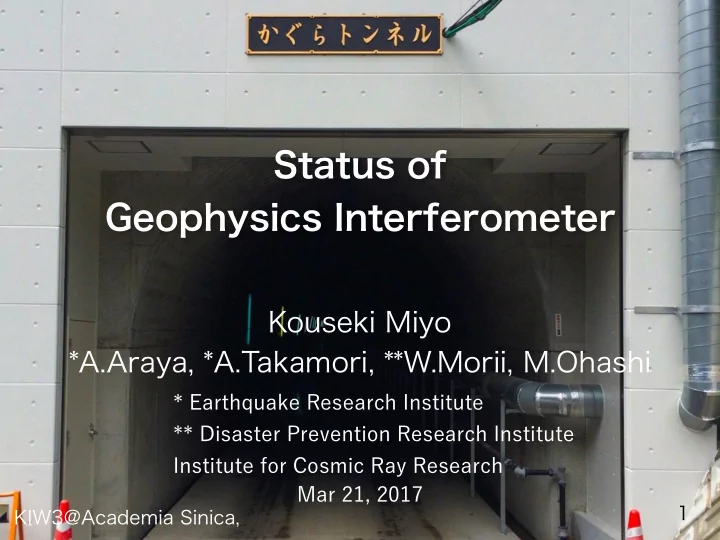
Kouseki Miyo

Mar 21, 2017 * Earthquake Research Institute ** Disaster Prevention Research Institute Institute for Cosmic Ray Research

*A.Araya, *A.Takamori, **W.Morii, M.Ohashi

slide-2
SLIDE 2

Contents

2

  • Introduction
  • Subsystem
  • Optical system
  • Vacuum system
  • DAQ system
  • Observation results
  • Baseline monitor for KAGRA
  • Plan for Crustal motion compensation system
  • Summary
slide-3
SLIDE 3

3000 m 500 m 1500 m 1000 m X arm Y arm

3

  • GIF is …
  • used for geophysical observation
  • used to provide baseline monitor for

KAGRA

  • two 1500 m antisymmetric

Michelson Interferometer using a fixed mirror

  • Installed X arm only

Introduction

KAGRA has a long baseline strain meter named “GIF” We can observe the crustal motion very precisely.

slide-4
SLIDE 4

4

Subsystem/

  • Subsystem
  • Main Interferometer
  • Input & Output optics
  • Laser
  • Vacuum system
  • DAQ system

Main Interferometer Vacuum system DAQ Input/Output optics Laser

slide-5
SLIDE 5

5

GIF/ Main Interferometer

sin cos +ΔL

  • ΔL

Front Reflector BS End Reflector 1/2WP 1/4WP

cos sin

p - polarized s - polarized

circular - polarized

PD

PBS

Stabilied Laser

1500 m +ΔL

  • ΔL

Δstrain = 2π ΔL λ/2 1 1500

  • Strain signal is displayed as a

rotation in left figure

slide-6
SLIDE 6

6

GIF/ Input & Output optics

From A. Takamori Slide in ELiTES 5th meeting

slide-7
SLIDE 7

7

GIF/ Laser

From A. Takamori Slide in ELiTES 5th meeting

slide-8
SLIDE 8

8

GIF/ Vacuum System

From A. Takamori Slide in ELiTES 5th meeting

slide-9
SLIDE 9

9

GIF/ Convert to Strain

PD2 PD1 PD1 PD2

Time [sec]

Angle Strain

Time [sec]

Obtain continuous strain data 
 using unwrap function Fitting ellipse ① ③ Obtain rotate angle using arctan function ②

Basically, measurement range is not limited. Wide range measurement.

  • Data sampling rate is 50

kHz for tracking rotate motion certainly.

slide-10
SLIDE 10

10

GIF/ DAQ

  • We are taking the strain data from last August.

3000 m 500 m 1500 m 1000 m X arm Y arm

PXI

LAN Strage 
 Server NAS Strain
 Converter Client user Outside mine

  • PXI is for ADC and laser

control.

  • Client user can get the strain

data outside of KAGRA.

  • Strain data is almost realtime

( 1 minutes delay due to a converting time ).

  • DAQ is designed

independently from KAGRA

slide-11
SLIDE 11

11

Observation result/

Dec 5, 4:30 - Dec 4, 08:30 Strain 1.3e-7 7.33 hour Time

DAQ monitor

Solomon Islands M7.8 Solomon Islands M6.9

2016-12-09 19:10:06 UTC 2016-12-08 17:38:46 UTC

4000 km

11

  • We could observe strain signal which

contains earthquake.

slide-12
SLIDE 12

12

Result/ Comparison of Theoretical model

12

Strain 時間 [hour]

Measurement GOTIC2 GOTIC2×0.9

Time [hour]

1e-7

  • Measured strain signal

consistents with theoretical model (GOTIC2) which includes under ground effect ( × 0.9 ).

  • This effect was evaluated by

100 m laser strainmeter located on same KAGRA

  • mountain. ( Takemoto et al.

2006 )

  • GIF observed local place effect.
  • We are evaluating the underground information e.g.

inhomogeneous, shape of the tunnel.

slide-13
SLIDE 13

13

Observation result/ Sensitivity

  • Lowest back ground, especially around 1-10 mHz

Frequency [Hz] Strain [1/√Hz]

GIF

Earth
 Tide microseismic

slide-14
SLIDE 14

14

Baseline Monitor for KAGRA

  • The same as GW detector, GIF’s sensitivity is getting

worse above a few Hz. ( ~ 7 Hz ).

  • Fortunately, We can directly measure 


microseismic ( ~ 0.1 Hz < 7 Hz ) which is the biggest reason of GW detector instability.

  • GIF also measure lower frequency crustal motion.

Seismometer can’t measure below mHz.

  • Because GIF can measure low frequency and directly

unlike seismometer, GIF data is a good baseline monitor for KAGRA.

slide-15
SLIDE 15

15

Baseline Monitor/ Crustal Motion Compensation

  • Feedforward CARM and DARM which converted from

the X and Y arm crustal motion signal to wide range actuator e.g. LVDT at Type-A.

  • However, we have only X arm.
  • First, We compensate only CARM.
  • We can calculate CARM using coupling matrix of

KAGRA mountain (Takemoto et al. 2006)

slide-16
SLIDE 16

16

Baseline Monitor/ Plan

Phase-2( Full configuration ) Phase-1( Cryo Michelson )

KAGRA schedule

Phase-3( Commissioning ) Observation

2018 Apl 2019 Apl 2020 Apl 2017 Apl

Some adjustment for suppressing air fluctuation Restart Observation

Non-Realtime Observation Build Compensation system

Make Program for realtime phase converter Prepare KAGRA DAQ Complete baseline monitor for KAGRA Commissioning Design Control Scheme Activate Crustal Motion Compensation System

Now

slide-17
SLIDE 17

17

  • GIF is a baseline monitor for KAGRA
  • We installed X arm. We are observing crustal motion
  • We are planning the crustal motion compensate

system

Summary