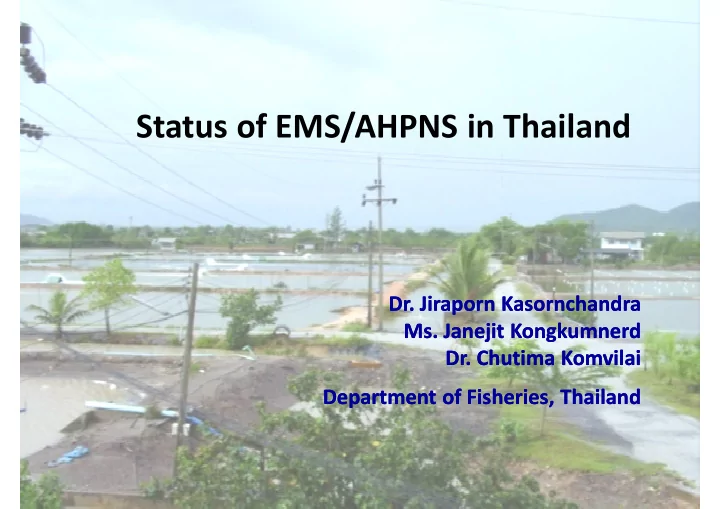
Status of EMS/AHPNS in Thailand Dr. Jiraporn Kasornchandra Dr. - - PowerPoint PPT Presentation

status of ems ahpns in thailand
SMART_READER_LITE
LIVE PREVIEW

Status of EMS/AHPNS in Thailand Dr. Jiraporn Kasornchandra Dr. - - PowerPoint PPT Presentation

Status of EMS/AHPNS in Thailand Dr. Jiraporn Kasornchandra Dr. Jiraporn Kasornchandra Ms. Janejit Kongkumnerd Ms. Janejit Kongkumnerd Dr. Chutima Komvilai Dr. Chutima Komvilai Department of Fisheries, Thailand Department of Fisheries,


slide-1
SLIDE 1

Status of EMS/AHPNS in Thailand

  • Dr. Jiraporn Kasornchandra
  • Dr. Jiraporn Kasornchandra
  • Ms. Janejit Kongkumnerd
  • Ms. Janejit Kongkumnerd
  • Dr. Chutima Komvilai
  • Dr. Chutima Komvilai

Department of Fisheries, Thailand Department of Fisheries, Thailand

slide-2
SLIDE 2
  • Shrimp farming in Thailand has been

practiced more than 30 years,but develop and expand very rapidly during mid 1980s. There are 2 major species have been cultured P. monodon and P. vannamei

  • P. vannamei was first introduced to

Thailand in 1997 but the cultivation was not succeeded. The development of white shrimp culture began in 2002, since then, this shrimp has become very popular and the cultivation of black tiger shrimp was replaced.

slide-3
SLIDE 3

History

Disease similar to EMS/AHPNS was first reported in shrimp farm located in the eastern Gulf of Thailand in late

  • 2011. It was claimed that those

farms used the same stock of PLs. In early 2012 (January-April), EMS/AHPNS was reported in the east coast (Gulf of Thailand): Rayong, Chantaburi , Trad and Chachoengsao provinces.

slide-4
SLIDE 4

Rayong (Pra-sae) Chantaburi (Nayai-am) Trad Chachoengsao

slide-5
SLIDE 5

Technical update for EMS/AHPNS

1. Causative agent: Suspected V. parahemolyticus has been isolated from Pls and affected shrimp with EMS/AHPNS and Koch’s postulate has been confirmed the cause.

slide-6
SLIDE 6

Technical update for EMS/AHPNS

  • 2. Epidemiology and risk factors study

2.1 Cross sectional study: emphasize in Rayong and Chantaburi provinces;

  • To identify risk factors associated with

EMS/AHPNS on farm and pond levels

  • To understand spreading pattern of

EMS/AHPNS in the area of study

slide-7
SLIDE 7

Case definition at pond level:

  • Ages: <35 days DOC
  • Cumulative mortality: >40% within 5-7 days
  • Gross sign: soft or loose shell, pale

coloration, lethargy and anorexia, significant atrophy of HP At farm level:

  • At least a pond in that farm affected by

EMS (since 1 January 2012 to the date of doing questionnaire)

slide-8
SLIDE 8

Risk factors at pond level: preliminary analysis

  • 1. Source of Pls
  • 2. Chlorine treatment before stocking
  • 3. Feed quantity
slide-9
SLIDE 9

Technical update for EMS/AHPNS

  • 2. Epidemiology and risk factors study

2.2 Cohort study:

  • To confirm the potential risk factors

associated with EMS/AHPNS from previous study (by collecting systematic data from shrimp ponds in the affected areas)

  • 3. Risk Management Measures will be applied to reduce

EMS/AHPNS

slide-10
SLIDE 10

The activities of concern in order to control EMS in shrimp farms and hatcheries:

  • shrimp farmer biosecurity training,
  • diagnostic procedures,
  • environmental and epidemiological

studies,

  • national strategy,
  • farmer training,
  • emergency preparedness guidelines
slide-11
SLIDE 11
  • 1. EMS/AHPNS has now being

controlled under the Animal Epidemic Act at the national level

  • 2. EMS/AHPNS has been in

part of the National Surveillance Program – disease distribution and zoning

slide-12
SLIDE 12

Histopathology finding for confirmation of EMS/AHPNS

  • Lack of B, F and R cells
  • Low mitotic rate in E-cells
  • Sloughing of HP tubule epithelial cells
  • Intertubular hemolytic congestion
  • Proximal-to-distal pattern of lesion

spread and distal end last to be affected

  • Enlarged nuclei with prominent nucleoli
  • Secondary bacteria infection during

terminal stages

karyomegaly

(From Prof. T.W. Flegel with permission)

slide-13
SLIDE 13

AquaThai Thai Aquatic Animal Disease Surveillance Information System This site provides access for registered users to the disease surveillance

  • database. The system enables users to submit reports of disease
  • bservations and surveillance activities. It also supports disease zoning for

export under OIE rules. This site contains: Surveillance DatabaseDownloadable ResourcesImage Library Links

slide-14
SLIDE 14

Current status:

EMS/AHPNS has been reported in 11 provinces (total 25 provinces) Central: Nakorn-platom Eastern: Rayong, Chantaburi , Trad and Chachoengsao Southern: Chumporn, Surattani, Nakorn-Sithumarat, Songkhla, Krabi and Phuket

slide-15
SLIDE 15

Month (2013) % Prevalence Provinces February 3.0 Chantaburi, Rayong, Chachoengsao, Songkhla, Surattani March 4.7 Chantaburi, Rayong,Trad, Songkhla, Surattani, Krabi April 3.4 Rayong, Trad, Chumporn, Songkhla, Surattani, Krabi May 3.5 Trad, Songkhla, Surattani, Nakorn- Sritumarat, Phuket

EMS/AHPNS survey during February-May 2013

slide-16
SLIDE 16

DOF has launched a “STOP EMS Program”

  • 1. Improvement of hatchery sanitation,

broodstock management, quality of PLs

  • 2. Screening shrimp pathogens including
  • V. parahaemolyticus
  • 3. Improvement of shrimp farm management
  • 4. Control the use of antibiotics – Food safety
  • 5. For import quality assurance- both

antibiotic residues and V. parahaemolyticus are subjected to test

slide-17
SLIDE 17

In case of EMS/AHPNS occur within the farm:

1. Shrimp farmer must inform DOF local staff within 24 h according to Animal Control Act (Article No.8) 2. If disease is confirmed, eradication procedure will be applied to stop the spreading

slide-18
SLIDE 18

Communication and public awareness:

1. Arrange seminar and farm visit 2. Provide leaflet and brochure to farmers 3. Public awareness through media

slide-19
SLIDE 19

National level actions and management plans:

Government action:

  • 1. DOF has taken an action on surveillance and monitoring programs.
  • 2. Communication on disease situation between officers and shrimp

farmers

  • 3. Close collaboration among officials, researchers, universities and

Thai Shrimp Farmers Association to control EMS/AHPNS.

  • 4. Provide on farm services.
  • 5. Provide diagnostic services.
  • 6. Increasing public awareness
slide-20
SLIDE 20

National level actions and management plans:

Private Sector action: Thai Shrimp Farmer Association 1.Communication on disease situation at farm level 2.Close collaboration among officials, researchers, universities and Private sectors on researches, health management and control of EMS 3.Provide funding for researches. 4.Hold a seminar regarding EMS including shrimp farm management throughout the country 5.Increasing Public awareness

สุขภาพสัตวน้ําชายฝงสงข สุขภาพสัตวน้ําชายฝงสง

slide-21
SLIDE 21

Thank you for your kind attention