Tako-Tsubo Syndrome Jon Levine EMTP I/C EMS TRAINING LTD Jon - - PowerPoint PPT Presentation

tako tsubo syndrome
SMART_READER_LITE
LIVE PREVIEW

Tako-Tsubo Syndrome Jon Levine EMTP I/C EMS TRAINING LTD Jon - - PowerPoint PPT Presentation

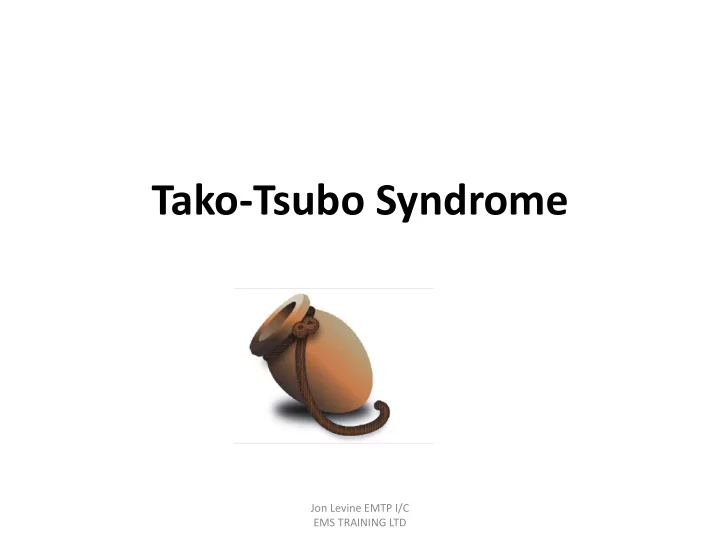
Tako-Tsubo Syndrome Jon Levine EMTP I/C EMS TRAINING LTD Jon Levine EMTP I/C EMS TRAINING LTD Jon Levine EMTP I/C EMS TRAINING LTD Tako-Tsubo Syndrome Tako-tsubo " is the japanese name for an octopus traps Jon Levine EMTP I/C


slide-1
SLIDE 1

Tako-Tsubo Syndrome

Jon Levine EMTP I/C EMS TRAINING LTD
slide-2
SLIDE 2

Jon Levine EMTP I/C EMS TRAINING LTD

slide-3
SLIDE 3

Jon Levine EMTP I/C EMS TRAINING LTD

slide-4
SLIDE 4

Tako-Tsubo Syndrome

  • Tako-tsubo" is the

japanese name for an

  • ctopus traps
  • Jon Levine EMTP I/C

EMS TRAINING LTD

slide-5
SLIDE 5

Tako-Tsubo Syndrome

  • Tako-Tsubo Cardiomyopathy also known as:

Stress Cardiomyopathy Transient (Catecholaminergic) Myocardial Stunning Transient (neurogenic) Myocardial Stunning

  • transient left ventricular apical ballooning,
  • "ampulla" cardiomyopathy
  • "broken heart syndrome".

Jon Levine EMTP I/C EMS TRAINING LTD

slide-6
SLIDE 6
  • Tako-Tsubo syndrome thought somewhat rare

appears under circumstances of extreme stress, often associated with anger

  • About 70-80% of cases of Tako-tsubo

Syndrome (TTS) occur in post-menopausal women under some form of extreme stress,...

Jon Levine EMTP I/C EMS TRAINING LTD

slide-7
SLIDE 7

Tako-tsubo Syndrome TTS

  • The tako-tsubo syndrome is characterized by transient left

ventricular dysfunction in the absence of obstructive coronary disease, typically precipitated by severe emotional or physical stress

  • In this syndrome, the left ventricle takes the shape of an
  • ctopus trap (tako-tsubo). During contraction (systole)
  • Takotsubo cardiomyopathy mimics ACS/AMI:

– Clinical presentation; symptoms

  • acute chest pain and dyspnea,
  • ST-segment elevations
  • Cardiogenic dysfunction

.

Jon Levine EMTP I/C EMS TRAINING LTD

slide-8
SLIDE 8

Phenomena Noted for Long Time

  • Multi-vessel coronary artery spasm is a possibility

– Dote K, Sato H, Tateishi H, Uchida T, Ishihara M. Myocardial stunning due to simultaneous multivessel coronary spasms: a review of 5 cases. [Article in Japanese] J Cardiol. 1991;21(2):203-14.

  • Neurogenic cause is quite likely.

– Akashi YJ, Nakazawa K, Sakakibara M, Miyake F, Musha H, Sasaka K.. 123I-MIBG Myocardial Scintigraphy in Patients with “Takotsubo” Cardiomyopathy. J Nucl Med 2004; 45:1121–1127

Jon Levine EMTP I/C EMS TRAINING LTD

slide-9
SLIDE 9

Local Famous Case

  • Syndrome seen in Worcester woman for a long

time ( 11 years), multiple acute “heart attacks”,but no damage or ‘culprit vessels”. Reported and named differently.

  • "Massive T wave inversion mainly in women, with

prognosis independent of ECG changes". LA Walder and DH Spodick.

  • Global T wave inversion: long-term follow-up. J

Am Coll Cardiol, 1993; 21:1652-1656. Division of Cardiology, St. Vincent Hospital, Worcester, Massachusetts

Jon Levine EMTP I/C EMS TRAINING LTD

slide-10
SLIDE 10

Answer Found in Full Cardiac Examination

  • Echos displays that the left ventricle takes a

ampule like shape (tako-tsubo shape)

  • Nuclear medicine demonstrates that portions of

the Left ventricle are not contracting equally.

  • Some portions are in a a state of complete

exhaustion (myocardial stunning) often the mid- section and apex (tip)

  • But Angiography showed that the patients had

no significant blockage (stenosis) of their coronary arteries

Jon Levine EMTP I/C EMS TRAINING LTD

slide-11
SLIDE 11
  • Normal left ventricular contraction
  • Abnormal contraction of left ventricle taking

the shape of a "Tako-Tsubo

Jon Levine EMTP I/C EMS TRAINING LTD

slide-12
SLIDE 12

So What’s Happened ??

Must Current Theory

Jon Levine EMTP I/C EMS TRAINING LTD

slide-13
SLIDE 13

Jon Levine EMTP I/C EMS TRAINING LTD

slide-14
SLIDE 14

Jon Levine EMTP I/C EMS TRAINING LTD

slide-15
SLIDE 15

Jon Levine EMTP I/C EMS TRAINING LTD

slide-16
SLIDE 16

Jon Levine EMTP I/C EMS TRAINING LTD

slide-17
SLIDE 17

Jon Levine EMTP I/C EMS TRAINING LTD

slide-18
SLIDE 18

1.Ennezat PV, Pesenti-Rossi D, Aubert JM, Rachenne V, Bauchart JJ, Auffray JL, Logeart D, Cohen-Solal A, Asseman P. Transient left ventricular

Jon Levine EMTP I/C EMS TRAINING LTD

slide-19
SLIDE 19

Ventriculogram during systole in a patient with takotsubo cardiomyopathy demonstrating apical akinesis Ventriculogram during diastole in a patient with takotsubo cardiomyopathy

Jon Levine EMTP I/C EMS TRAINING LTD

slide-20
SLIDE 20

Same patient, 3 months after the tako- tsubo episode: there is full recovery. The tip of the left ventricle contracts normally again Previous Post-menopausal woman – demonstrating at onset of tako-tsubo syndromeagain

Jon Levine EMTP I/C EMS TRAINING LTD

slide-21
SLIDE 21

Post-menopausal woman - Cardiac ultrasound in the E.R. - Day 1 of a tako-tsubo syndrome: the left ventricular tip (apex) is "paralyzed

Jon Levine EMTP I/C EMS TRAINING LTD

slide-22
SLIDE 22

ECG Changes in Tako-Tsubo Cardiomyopathy

  • The electrocardiogram can evolve through 3 stages:
  • Stage 1: acute stage,

This stage lasts only a few hours. Stage of ST elevation and fairly short QT interval. The R wave might be preserved.

  • Stage 2: sub acute stage.

This stage can last days. QT segment prolongation and large and deep negative T waves.

  • Stage 3: recovery stage. Flipped T wave persists for

days to weeks, but QT interval is again normal.

Jon Levine EMTP I/C EMS TRAINING LTD

slide-23
SLIDE 23

Electrocardiogram of a patient with takotsubo cardiomyopathy demonstrating ST-segment elevation in anterior and inferior leads.

Jon Levine EMTP I/C EMS TRAINING LTD

slide-24
SLIDE 24
  • Not always so evident
  • ECG showing sinus tachycardia and non-

specific ST and T wave changes from a patient with confirmed takotsubo cardiomyopathy.

Jon Levine EMTP I/C EMS TRAINING LTD

slide-25
SLIDE 25

Management Tako-Tsubo Cardiomyopathy

  • Just like any other possible STEMI

– 12 Lead , IV, NTG, O2, ?MS – Code AMI Notification

  • Patient will get CLA

– Possible no culprit vessel – Echo will demonstrate TTS – Bur require management for cardiogenic dysfunction

Jon Levine EMTP I/C EMS TRAINING LTD

slide-26
SLIDE 26

good news

  • Treatment: Tako-tsubo syndrome is only

treated with support measures. Maintenance

  • f cardiac output and reduction of

catecholamine effect (B-Blockers etc)

  • Outcome: Excellent in 95% of cases. Recovery

takes place over a few days with full recovery

  • ver a few weeks. Recurrence rare /c Rx.

Jon Levine EMTP I/C EMS TRAINING LTD

slide-27
SLIDE 27

But Complications are Possible

  • Complications occur in 20% of takotsubo

cardiomyopathy cases and include the following:

– Left heart failure with and without pulmonary edema – Cardiogenic shock – Left ventricular outflow obstruction – Mitral regurgitation – Ventricular arrhythmias – Left ventricular mural thrombus formation – Left ventricular free-wall rupture – Death

Jon Levine EMTP I/C EMS TRAINING LTD

slide-28
SLIDE 28

Medicolegal Pitfalls

  • EMS should be aware of the presentation of

takotsubo cardiomyopathy (TCM) because as described above,

– chest pain after a recent stressor is not necessarily due to anxiety. – The chest pain may be more complicated and deteriorate into dysrhythmias and/or shock. – Patients with takotsubo cardiomyopathy do not usually have cardiac risk factors, but their pain should be taken seriously. – Patients presenting after a natural disaster, MCI or acute stress event should be evaluated for takotsubo cardiomyopathy – These patients should be treated as having acute coronary syndrome (ACS), given supportive treatment, and undergo subsequent cardiology evaluation.

Jon Levine EMTP I/C EMS TRAINING LTD

slide-29
SLIDE 29

Conclusion...

Jon Levine EMTP I/C EMS TRAINING LTD