statement: There are no competing interests relevant to this - - PowerPoint PPT Presentation

statement
SMART_READER_LITE
LIVE PREVIEW

statement: There are no competing interests relevant to this - - PowerPoint PPT Presentation

Geriatric Grand Rounds: What drives health care costs ? Dr. Richard Lewanczuk Senior Medical Director (not what you think) Primary Health Care Alberta Health Services What drives health care costs ? What drives health care costs ? (not what


slide-1
SLIDE 1

Geriatric Grand Rounds: What drives health care costs ? (not what you think)

  • Dr. Richard Lewanczuk Senior Medical Director

Primary Health Care Alberta Health Services http://bit.ly/2jlpuWR January 17, 20171

“This event is a self-approved group learning activity (Section 1) as defined by the Maintenance of Certification Program of The Royal College of Physicians and Surgeons of Canada.” “This event is eligible for 1 “MAINPRO-M1” credit from the Maintenance of Proficiency Program of College of Family Physicians of Canada.” Members of the Colleges planning on claiming the credit are requested to sign the appropriate attendance records at the entrance.

  • Dr. Bill Black Auditorium

Glenrose Rehabilitation Hospital VC#827633 What drives health care costs ? (not what you think)

REMOTE SITES: PLEASE MUTE YOUR AUDIO AT ALL TIME EXCEPT WHEN ASKING QUESTION/COMMENTING AT Q/A.

Noon, January 17, 2017

What drives health care costs ? (not what you think)

  • Dr. Richard Lewanczuk

Senior Medical Director Primary Health Care Alberta Health Services

Conflict of interest statement:

There are no competing interests relevant to this presentation

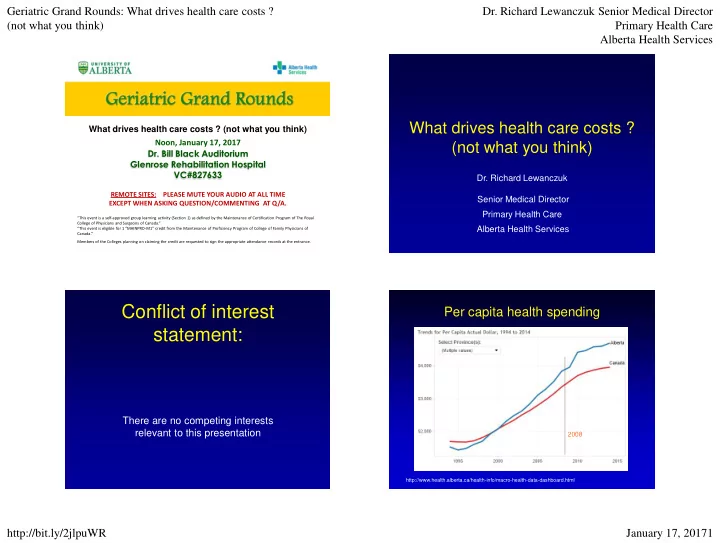
Per capita health spending

http://www.health.alberta.ca/health-info/macro-health-data-dashboard.html

2008

slide-2
SLIDE 2

Geriatric Grand Rounds: What drives health care costs ? (not what you think)

  • Dr. Richard Lewanczuk Senior Medical Director

Primary Health Care Alberta Health Services http://bit.ly/2jlpuWR January 17, 20172

Alberta spent 25% faster on Hospitals over the period than Other Provinces

Alberta Other Provinces

250 500 750 1,000 1,250 1,500

1996 1997 1998 1999 2000 2001 2002 2003 2004 2005 2006 2007 2008 Expenditure per Adjusted Capita

Canada

Source: Canadian Institute for Health Information, National Health Expenditure Trends, 1975 – 2008

Provincial Government Constant (2002)1 Expenditure2 on Hospitals

per Adjusted 3 Capita, by Jurisidiction, 1996 to 2008

1 Source: Statistics Canada, CANSIM, table 326-0021 and Catalogue nos. 62-001-X and 62-010-X. 2 Source: Canadian Institute for Health Information, National Health Expenditure Trends, 1975 – 2008 (Ottawa, Ont.: CIHI, 2008). 3 Adjusted Population is Weighted by All-Sector Expenditure by Age and Gender (2007/2008 Population-Based Funding Weights for Alberta). Alberta’s weights were applied across all provinces.

Higher hospital expenditure is associated with greater utilization – more bed days

Alberta Other Provinces

200 400 600 800

2003 2004 2005 2006 2007 Days per Adjusted Capita

Canada

Source: Canadian Institute for Health Information, National Health Expenditure Trends, 1975 – 2008

Acute Bed Days, All Cases (Typical and Non-Typical)1

per Adjusted 2 Capita, by Jurisidiction, 2003 to 2007

1 Source: Canadian Institute for Health Information Portal. Extracted 08/28/2009. Parts of this material are based on data and information provided by the Canadian Institute for Health Information

(CIHI). However, the analyses, conclusions, opinions and statements expressed herein are those of the author, and not necessarily those of the Canadian Institute for Health Information.

2 Adjusted Population is Weighted by All-Sector Expenditure by Age and Gender (2007/2008 Population-Based Funding Weights for Alberta). Alberta’s weights were applied across all provinces.

80 84 92 117 102 89 89 93 108 112 122 130 161 91

  • 0.50

1.00 1.50 2.00 2.50 3.00 3.50 20 40 60 80 100 120 140 160 180 Beds per 1000 Visits per 1000

Acute Inpatient Beds per 1000 Vs Acute Inpatient Hospital Visits per 1000 (Correlation=84%)

Hospital Visits per 1000 (Age/Sex Standardized) 2014/15 Acute + Psychiatric Beds Per 1,000

There is strong correlation between beds per 1000 and hospital inpatient visits per 1000.

Courtesy DIMR July 2016

Beds vs Admissions by AHS Sub- Zone

R² = 0.7915 1.7 1.9 2.1 2.3 2.5 2.7 2.9 75 95 115 135 155 175 Beds/1000 Admissions/1000
slide-3
SLIDE 3

Geriatric Grand Rounds: What drives health care costs ? (not what you think)

  • Dr. Richard Lewanczuk Senior Medical Director

Primary Health Care Alberta Health Services http://bit.ly/2jlpuWR January 17, 20173

Higher occupancy strongly correlated with higher case mix

10

2013 The Commonwealth Fund

Hypothesis

If we spend more on primary and community care will we have lower costs, better outcomes and higher quality?

Primary Care Score vs. Health Care Expenditures, 1996 0.5 1 1.5 2 1000 1500 2000 2500 3000 3500 4000 Per Capital Health Care Expenditures Primary Care Score Primary Care Score: 2 = Stronger From Barbara Starfield, MD

US UK SP

slide-4
SLIDE 4

Geriatric Grand Rounds: What drives health care costs ? (not what you think)

  • Dr. Richard Lewanczuk Senior Medical Director

Primary Health Care Alberta Health Services http://bit.ly/2jlpuWR January 17, 20174

Utilization by attachment to a family doctor (in the top 5%)

10 20 30 40 50 60 70 80 hospitalizations LOS cost % <50 50-75 >75

Work in progress, Interdisciplinary Chronic Disease Collaborative – courtesy of Dr. Paul Ronksley

14

Continuity vs cost by CRG

9 – catastrophic 8 – dominant malignancy 7 – chronic disease 3 or more organ systems 6 – significant chronic disease multiple organ systems 5 – single dominant or moderate chronic disease 4 – minor chronic disease in multiple organ systems 3 – single minor chronic disease 2 – significant acute disease 1 - healthy

Mortality by continuity of care

Health Trends Alberta 2016

End of part 1

slide-5
SLIDE 5

Geriatric Grand Rounds: What drives health care costs ? (not what you think)

  • Dr. Richard Lewanczuk Senior Medical Director

Primary Health Care Alberta Health Services http://bit.ly/2jlpuWR January 17, 20175

17

Top diseases by cost in Alberta in rank order

  • 1. Hypertension
  • 2. Diabetes
  • 3. Depression
  • 4. Asthma
  • 5. Dyslipidemia
  • 6. Coronary artery disease

Leading diagnoses resulting in visits to physician offices in Canada

Million visits/year 5 10 15 20 25

Hypertension Depression Diabetes Routine medical exams Acute respiratory tract infection

Source: IMS HEALTH Canada 2002. http://www.imshealthcanada.com/

Health care costs are driven by the common chronic diseases that are managed by primary care every day

19

Impact of common chronic diseases in Alberta

slide-6
SLIDE 6

Geriatric Grand Rounds: What drives health care costs ? (not what you think)

  • Dr. Richard Lewanczuk Senior Medical Director

Primary Health Care Alberta Health Services http://bit.ly/2jlpuWR January 17, 20176

It therefore makes sense why health systems that invest in primary care have lower costs and better outcomes

21

How are health care costs driven ?

0-25th Cost Percentile ($10) 25-50th Cost Percentile ($131) 50-75th Cost Percentile ($369) 75-90th Cost Percentile ($911) 90-95th Cost Percentile ($2288) 95-99th Cost Percentile ($6367) 99-100th Cost Percentile ($34407) % Of Population 25% 25% 25% 15% 5% 4% 1% % Of Costs 0% 3% 9% 14% 12% 26% 35% 0% 5% 10% 15% 20% 25% 30% 35% 40%

Alberta Population Proportions Versus Health Care Cost Proportions – 2009/10

Notes: 1)Costs only include direct costs for inpatient, emergency, and urgent care and total physician costs for these same sectors and community primary care (approx. $3.7 billion). Costs in parantheses are average costs per person for the group. 2)Total population includes anyone active as of April 2010 or anyone who died within 2009/10. 3)Cost percentiles were: 90th=$1,511; 95th=$3,504; 99th=$13,977. In other words 5% of folks used $3,504 or more and consumed 61% of total reported costs. Source: Strategic Analytics - DIMR - Alberta Health Services

Determinants of appearing in HC5

sex, age group, days spent in inpatient, death, number of previous years in the HC5, average rank in previous years, and the 6 Group A CACP chronic diseases included in model – on IP days had any significant bearing

slide-7
SLIDE 7

Geriatric Grand Rounds: What drives health care costs ? (not what you think)

  • Dr. Richard Lewanczuk Senior Medical Director

Primary Health Care Alberta Health Services http://bit.ly/2jlpuWR January 17, 20177

Keeping people out of hospital, is the single most important way of reducing health care costs Who are these people?

27 28

Complex High Needs Patients

  • Financial Impact
slide-8
SLIDE 8

Geriatric Grand Rounds: What drives health care costs ? (not what you think)

  • Dr. Richard Lewanczuk Senior Medical Director

Primary Health Care Alberta Health Services http://bit.ly/2jlpuWR January 17, 20178

29

Frail Elderly Clinical Profile (Partial)

 Hypertension 72.5%  Acute Musculoskeletal Diagnosis 39.3%  Acute Respiratory Diseases/COPD 33.7% / 22.6%  Osteoarthritis 31.8%  Diabetes 28.5%  Congestive Heart Failure 20.8%  Neuromuscular/Neurological Diagnoses 20.7%  Depressive and/or Other Psychoses 20.2%  Average IP days 20.6

Note: Data shows averages based on physician visit billing

Composition of “top 5%” by age Why are they being admitted into hospital?

slide-9
SLIDE 9

Geriatric Grand Rounds: What drives health care costs ? (not what you think)

  • Dr. Richard Lewanczuk Senior Medical Director

Primary Health Care Alberta Health Services http://bit.ly/2jlpuWR January 17, 20179

Longitudinal outcome of top 5%

Courtesy of Michael Sanderson, Alberta Health, 2015

Outcome of top 5% from 2003-2010

Courtesy of Michael Sanderson, Alberta Health, 2015

Disposition

Outcome Visits LOS Cost Non-high High Non-high High Non-high High 206,399 12,707 208,001 11,095 208,149 10,956 n(%) n(%) n(%) n(%) n(%) n(%) Discharge Disposition of last encounter Transferred to another facility providing inpatient hospital care 2095 (1) 288 (2.3) 2012 (1) 371 (3.3) 1931 (0.9) 452 (4.1) Transferred to long term care facility 6343 (3.1) 752 (5.9) 4557 (2.2) 2538 (22.9) 5122 (2.5) 1973 (18) Transferred to other 984 (0.5) 144 (1.1) 938 (0.5) 190 (1.7) 971 (0.5) 157 (1.4) Discharged to a home setting with support services 16512 (8) 1928 (15.2) 15794 (7.6) 2646 (23.8) 16016 (7.7) 2424 (22.1) Discharged home 169651 (82.2) 7651 (60.2) 173971 (83.6) 3331 (30) 173783 (83.5) 3519 (32.1) Signed out/ Did not return 2199 (1.1) 270 (2.1) 2276 (1.1) 193 (1.7) 2287 (1.1) 182 (1.6) Died 8615 (4.2) 1674 (13.2) 8463 (4.1) 1826 (16.5) 8040 (3.9) 2249 (20.5) Readmission within 30 6150

slide-10
SLIDE 10

Geriatric Grand Rounds: What drives health care costs ? (not what you think)

  • Dr. Richard Lewanczuk Senior Medical Director

Primary Health Care Alberta Health Services http://bit.ly/2jlpuWR January 17, 201710

Facts about the “top 5%”

  • 78% of Albertans in the “top 5%” were not there the year

before – the top 5 % does not represent “frequent flyers”

  • Only 11% of “top 5%” have been there 3 or more years
  • 15% of the “top 5%” costs are related to end-of-life
  • In a 7 year period, 20% of Albertans will be in the “top 5%”
  • >50% of Albertans will be in the “top 5%” sometime in their

lives

Commonest reason for hospital admission for heart failure

  • 1. urinary incontinence
  • 2. falls
  • 3. care-giver not able to cope
slide-11
SLIDE 11

Geriatric Grand Rounds: What drives health care costs ? (not what you think)

  • Dr. Richard Lewanczuk Senior Medical Director

Primary Health Care Alberta Health Services http://bit.ly/2jlpuWR January 17, 201711

Therefore, the “5/65” is somewhat of a myth:

By the time the “5/65” are identified, it’s too late, they have moved on to mostly become low cost patients

We need to be able to predict who the “5/65” will be

Michael Sanderson, Alberta Health 2016

Frailty - definitions

  • Unable to function independently

– Mild: help needed with complex functions (e.g. taxes, banking)

  • Walking speed <0.8 m/sec
  • Unable to cross the street in the length of a walk light
slide-12
SLIDE 12

Geriatric Grand Rounds: What drives health care costs ? (not what you think)

  • Dr. Richard Lewanczuk Senior Medical Director

Primary Health Care Alberta Health Services http://bit.ly/2jlpuWR January 17, 201712

45

Alberta Home Care Clients

 96% have an informal care-giver  44% of care-givers are showing signs of burnout  42% urinary incontinence  33% falls in last 90 days  28% dementia  57% on >9 medications  47% have daily pain

Poss, 2013

Where should we put our resources ?

Complex High-Needs Patients

47

Self-Perceived Health and Health Care Costs in Seniors

Cost data AHS; health status courtesy of City of Edmonton

slide-13
SLIDE 13

Geriatric Grand Rounds: What drives health care costs ? (not what you think)

  • Dr. Richard Lewanczuk Senior Medical Director

Primary Health Care Alberta Health Services http://bit.ly/2jlpuWR January 17, 201713 Loneliness and Health Care Costs in Seniors

Cost data AHS; health status courtesy of City of Edmonton

Quality of life vs longevity by income quintile

Selected Determinants of Health/Risk Factors – Wood Buffalo and Calgary Upper NW

Wood Buffalo (LE: 72.9 yrs) Calgary Upper NW (LE: 86.09 yrs)

Adjusted associations between the ratio of social to health spending with a one-year lag and health outcomes

Model 1

a

Model 2

b

Health outcome Estimated coefficient

c

p value Estimated coefficient

c

p value Percent of adults who: Were obese (body mass index ≥30) −0.33 0.014 −0.16 0.101 Had asthma −0.11 0.041 −0.12 0.012 Reported 14+ days in past 30 days as mentally unhealthy days −0.43 0.007 −0.24 0.035 Reported 14+ days in past 30 days with activity limitations −0.37 −0.25 0.002 Mortality rate for: Acute myocardial infarction (per 100,000 population) −4.02 0.032 −0.64 0.649 Lung cancer (per 100,000 population) −2.72 0.001 −2.35 0.002 Type 2 diabetes (per 100,000 population) −0.45 0.004 −0.51 Postneonatal infantsd (per 100,000 live births) −4.15 0.325 −6.56 0.037

Bradley et al, Health Affairs 35:760, 2016

slide-14
SLIDE 14

Geriatric Grand Rounds: What drives health care costs ? (not what you think)

  • Dr. Richard Lewanczuk Senior Medical Director

Primary Health Care Alberta Health Services http://bit.ly/2jlpuWR January 17, 201714

Specialist visits vs ER visits ER Visit Rates vs Hospitaliztions

have a family Dr after hours primary care

  • ther health

professional in office OHP involved in care ER visit avoidable ER visit admission

20 40 60 80 100

%

2 chronic conditions 1 chronic condition

Details about CDM patients

* avoidable ER visits reflect response to the question “if your family doctor was available, would you have gone to the ER? Source: ICDC 2013

slide-15
SLIDE 15

Geriatric Grand Rounds: What drives health care costs ? (not what you think)

  • Dr. Richard Lewanczuk Senior Medical Director

Primary Health Care Alberta Health Services http://bit.ly/2jlpuWR January 17, 201715 Impact of specialists in a community on care/utilization

20 40 60 80 100

%

hospitalization/ER visit effective med use med non-adherence BP msmt chol msmt glucose msmt

specialist no specialist

p=.013 Source: ICDC 2013 NS

What could have been done to have kept this person out of hospital?

“Medically, this person didn’t need to be in hospital but…

  • I couldn’t send them home…
  • I knew they couldn’t manage at home…
  • I knew that if I sent them home they

would be right back…”

59

Heard time and time again in physician interviews regarding hospitalization in Alberta

slide-16
SLIDE 16

Geriatric Grand Rounds: What drives health care costs ? (not what you think)

  • Dr. Richard Lewanczuk Senior Medical Director

Primary Health Care Alberta Health Services http://bit.ly/2jlpuWR January 17, 201716 Issues identified to facilitate aging in place

1. Mobility and Access to Transportation 2. Daily Living 3. Health and Well-being 4. Home Maintenance and Housing 5. Other (finances, cultural sensitivity, abuse) 6. Social isolation

City of Edmonton, Aging in Place 2007

  • Not being able to walk or manoeuvre scooter due to snow or ice on sidewalks

and curbs and windrows on roads, or feeling fearful of making the attempt

  • Feeling anxious about personal safely due to uneven sidewalks, the absence of

sloping curbs and the insufficient length of pedestrian crossing lights

  • Bus drivers sometimes insensitive to seniors’ needs, will fail to wait for a senior

trying to catch a bus or will move away from a stop before the senior is seated

  • Not being able to walk to a bus stop (for reasons of stamina or other limitations)
  • Not being able to get on or off buses unassisted
  • Lack of familiarity with or understanding of the transit system or bus routes
  • Inability to endure long bus rides
  • Not being able to afford taxis, but not being eligible for specialized services such

as DATS or assisted drivers

Factors affecting Mobility and Access to Transportation

63

Summary

 One of the most effective ways of reducing health care costs and utilization is to have, and access, a family doctor/primary care provider  Most health system costs are generated by hospitalization; more than 14 hospital days per year puts a person into the top 5% of costs  Keeping people out of hospital is the single most important intervention to reduce health care costs  It is mostly the frail or sick elderly who drive hospitalizations  We need to ask ourselves “what could have been done to have avoided this hospitalization?” and act on it  Often it is not an individual disease that leads to hospitalization but its contribution to frailty; investing in social supports can be an effective strategy

slide-17
SLIDE 17

Geriatric Grand Rounds: What drives health care costs ? (not what you think)

  • Dr. Richard Lewanczuk Senior Medical Director

Primary Health Care Alberta Health Services http://bit.ly/2jlpuWR January 17, 201717

Questions, Comments ?