
SLIDE 1
START
Supported Transfer and Accelerated Rehabilitation Team
Raewyn Dean, CNM John Young, RN November 2018
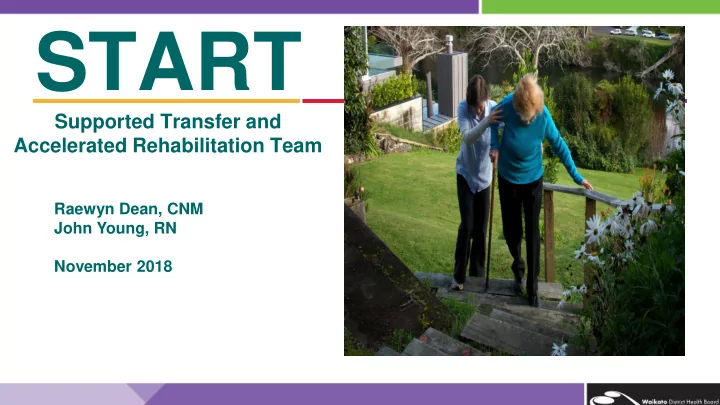
START Supported Transfer and Accelerated Rehabilitation Team - - PowerPoint PPT Presentation
START Supported Transfer and Accelerated Rehabilitation Team Raewyn Dean, CNM John Young, RN November 2018 So what is START? Community-based, intensive rehabilitation program for the over 65 year old (except stroke) With the service for up
Supported Transfer and Accelerated Rehabilitation Team
Raewyn Dean, CNM John Young, RN November 2018
So what is START?
Community-based, intensive rehabilitation program for the over 65 year old (except stroke) With the service for up to 6 weeks (usually 4 weeks) Provides an interdisciplinary approach with a team of: Health Care Assistants Physiotherapists Registered Nurses Occupational Therapists Geriatrician Administrator
Waikato Hospital Tokoroa Hospital Taumarunui Hospital Thames Hospital Te Kuiti Hospital
Criteria
Service Delivery Models
The aim of START is to:
Service Delivery Models
Hamilton Team - 62 patients Cambridge Team - 40 patients Thames Team - 25 patients Tokoroa - 10 patients Taumarunui - 10 patients
What can START provide?
health disciplines
‘What is important to you?’
Discharge
ACC, Acute Home Support
Types of Rehabilitation
endurance, breathing and individual plans)
BGL/insulin, daily weighs, COPD)
The Role of the START Health Care Assistant
An IDT Approach
Case Study 1: Mr J
Ongoing ataxia requiring assist x 2, dysarthria and expressive aphasia.
Case Study 1
What is important?
What is important whilst with START
Aimed completion date Outcome: Achieved/ Not achieved Sign/ date
Mr J will shower independently A Mr J will improve his mobility A Mr J will make his lunch daily A Mr J will improve his communication A
Case Study 1
Goal: Hygiene Task Healthcare assistant to assist with shower on Monday, Tuesday, Wednesday, Thursday, and Friday and to assist with dressing. To tidy the bathroom afterwards Task For Occupational Therapist review of safety and independence in shower Goal: Exercise Task Healthcare assistant to coach/supervise exercises daily Task Physiotherapist to review, advise on aids and amend exercises as needed Goal: Meals Task Healthcare assistant to assist client to make lunch at their morning visit Task Healthcare assistant to assist client to make hot drink (with thickener) at their morning visit Task Occupational Therapist to conduct kitchen assessment and recommend appropriate strategies Goal: Cognition/memory/speech Task Occupational Therapist to conduct appropriate cognitive assessments and develop, review and update cognitive training programmes as appropriate Task Healthcare assistant to supervise speech-language exercises as prescribed by ward or outpatient Speech Language Therapist
Alerts: Needs fluids thickened, soft foods No weekend visits AM visit to be around 10 AM PM visit to be around 2 PM
Case Study 2 Mrs N
decline
Case Study 2
Case Study 2
Questions
Flexigran