SLIDE 1
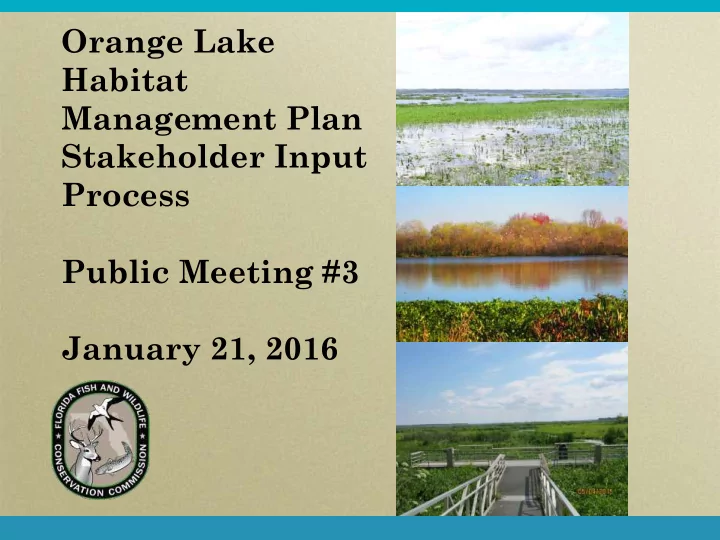
Orange Lake Habitat Management Plan Stakeholder Input Process Public Meeting #3 January 21, 2016
SLIDE 2
Welcome and Introductions
SLIDE 3 Orange Creek Basin Community Working Groups
Orange Lake Habitat Management – Florida Fish and Wildlife Conservation Commission
Other CWGs:
- Herbicide Workshop (March 2015) –
Florida Fish and Wildlife Conservation Commission
- Hydrology/Geology Workshop (November 2015)-
OCB Interagency Working Group
Alachua County
Department of Environmental Protection
OCB Interagency Working Group
SLIDE 4 Orange Lake Habitat Management Plan (HMP) Community Working Group
- FWC is the lead agency
- Stakeholders have been involved from the
beginning and throughout the process of creating the Plan
- Process is facilitated by Normandeau
Associates, who are also writing the plan
- Began in February 2015 and is anticipated
to be complete in mid-2016
SLIDE 5
Normandeau Team
Christine Denny Fay Baird Karen Hill
SLIDE 6
SLIDE 7 Ground Rules
Please:
- Allow others to express their opinions, even if
they are different from your own.
- Respect time limits.
- Listen, and allow others the opportunity to
speak when it is their turn.
- Silence cell phones when in the meeting
room.
- Remember that everyone is here because
they care about Orange Lake.
SLIDE 8 Promise to Stakeholders
The Normandeau project team promises to provide
- pportunities for stakeholders to offer input into development
- f the FWC Orange Lake HMP. We promise to consider all
stakeholder input and recommendations for lake management goals, objectives, and action strategies. We promise to address and balance, where feasible, the needs of stakeholder groups along with FWC habitat management guidelines for the lake. FWC is committed to an HMP that consists of stakeholder supported management actions that are within FWC’s
- jurisdiction. FWC will make the final decisions on content of the
plan.
SLIDE 9 FWC
HABITAT MANAGEMENT GUIDELINES DOCUMENT
STAKEHOLDER INPUT HABITAT MANAGEMENT PLAN (HMP)
SLIDE 10 FWC
HABITAT MANAGEMENT GUIDELINES FOR THE AQUATIC RESOURCES OF THE ORANGE CREEK BASIN (“Guidelines document”)
STAKEHOLDER INPUT
HABITAT MANAGEMENT PLAN (HMP)
Meeting 1 Collecting input
Held July 14, 2015
Meeting 2 Goals and Objectives
Held October 13, 2015 Meeti eting ng 3 Action
Strat rategies egies Today
Meeting 4 Review and Comment on HMP April 2016
SLIDE 11 Status: Writing the Plan
- Draft 1 Completed July 2015: Outline
- Draft 2 Submitted for FWC review September 2015:
Sections 1–3, Introduction, Background, Vision and Guiding Principles
- Draft 3 Submitted for FWC review January 2016:
Revisions to Sections 1-3; Section 4, Management Goals and Objectives. Drafts and other HMP documents are posted on the Orange Creek Basin website: https
tps:// ://orangecree rangecreekbasin.w kbasin.word
ress.co s.com m
SLIDE 12 Next Steps: Writing the Plan
- Draft 4 (Final) Public Review version scheduled for
submittal to FWC in March 2016
- Stakeholder comments on Draft 4 will be solicited at
Public Meeting 4
- Final Plan including revisions and stakeholder
comment resolution section scheduled for completion by May 28, 2016.
SLIDE 13 How we used your input from the first 2 public meetings
From input at Meeting 1, FWC determined what issues are of concern to various stakeholders and used these to set broad goals for the HMP At Meeting 2, FWC
- presented draft objectives to accomplish HMP goals;
- solicited input on draft objectives;
- solicited additional objectives from stakeholders.
SLIDE 14 Input has been incorporated into
- 1. Draft 3 of the HMP;
- 2. Guidelines that are being used by FWC to
generate action strategies. How we used your input from the first 2 public meetings, continued
SLIDE 15
Tonight FWC will present information on action strategies that are being considered for the Orange Lake Habitat Management Plan.
SLIDE 16 What is an action strategy?
Focus cus for Pu Publ blic c Me Meetin ting g #3
- An action strategy says HOW YOU WILL get
the objective accomplished.
GOAL AL
What t does es success cess look like?
OBJEC ECTIV TIVE
What t will it take? e?
ACTION ION STRATEG TEGY
How will you do it?
#2 #2 #1 #1 #3 #3
SLIDE 17 What t NO a O age gency ncy or pr privat ate e en enti tity ty can n do
- Control wind
- Control rainfall
- Provide unlimited funds
- Take action in areas in which it has no jurisdiction
- Simultaneously meet the needs of all possible users of
Orange Lake at all times in a system with a wide range of fluctuations in water levels, lake area and fish/wildlife habitats
SLIDE 18 Wh What t FW FWC can an pr provide vide th through
this s Plan an
- Address the needs of most stakeholder groups
- Commit to limitations on use of management techniques
that are unpopular with many stakeholders
- Use the HMP to create annual work plans that meet FWC
mandates, habitat management guidelines, and balance stakeholder interests
- Make the best use of available funding
- Provide recommendations on future collaboration between
agencies
SLIDE 19
Handout: Possible management tools
SLIDE 20 Communications
In addition to action strategies for access, habitat and invasives, FWC is drafting actions to promote effective public communications. Actions under discussion include:
- Twice yearly meetings to inform the public
about upcoming work
- A new website with information on current
conditions and FWC activities
SLIDE 21
Anticipated Methods and Control of Plants on Orange Lake
SLIDE 22
- Floating plants (hyacinth/lettuce)
- Plants blocking access & navigation
- Control other noxious plants
- Create open areas in large hydrilla mats
Funding Priorities on Orange Lake
SLIDE 23
Floating Plant Management
Water lettuce Water hyacinth
SLIDE 24 Maintenance Control
Crisis management Control when populations are small
SLIDE 25 74 75 76 77 78 79 80 81 82 83 84 85 86 87 88 89 90 91 92 93 94 95 96 97 98 99 00 01 02 03 04 05 06 2 4 6 8 10 12
Units in Thousands
Year
Hyacinth Acres Acres Controlled Tons of Organics Pounds of 2,4-D
Maintenance Control Suwannee River 1974 - 2006
SLIDE 26 Frog’s Bit – Limnobium spongia
- Acts like Hyacinth
- Does not have an
- bvious flower
- Can form dense mats
- Displaces native
plants
SLIDE 27 Cuban bulrush – Oxycaryum cubense
rooted
- Can form dense mats
- Displaces native
plants
SLIDE 28 Access & Navigation
Two components of managing for Access and Navigation on Orange Lake
management
Management
SLIDE 29 Submerged Vegetation/Hydrilla Management
Two types of treatments utilizing herbicide
- Trails using contact herbicide
- Small block (5-50 acres) at critical
navigation points
SLIDE 30 Anticipated Use of Herbicides
- There have been no hydrilla
treatments in the last 5 years
“tussock” control
exotic/noxious plants
- Growing conditions can be
variable
50 100 150 200 250 300 350 400 450 500
2010 2011 2012 2013 2014 2015 2016
Acres of Plants Controlled with Herbicide
?
SLIDE 31 Floating Tussock Management
Combination of mechanical shredding and herbicide
and vegetation
vegetation
SLIDE 32 Anticipated Use of Mechanical
- Scale is a factor
- Shredder $875-
$1,250/Acre
variable
10 20 30 40 50 60 70 80 90 100
2012 2013 2014 2015 2016
Acres of Tussock Material Mechanically Controlled
SLIDE 33 Example of area calculation for treatment: ~ 44 miles of trails, 10ft. wide To Treat ½ = About 27 acres
Orange Lake Trails Maintained in the Past
SLIDE 34
daniel.dorosheff@myfwc.com 386-758-0525
SLIDE 35 Online Survey
Options:
- Fill out a print copy tonight and leave it with
us.
- Visit the link shown on the agenda and fill the
survey out online.
- Take the print copy home, fill it out and mail
it to us at the address on the print copy. You’ll
have to pay for the postage stamp. FWC will email the online survey link to the Orange Lake stakeholder list tomorrow. You must respond by February 7th for your input to be included.
SLIDE 36
Why should we do this?
SLIDE 37 Observed meanings for “Restoration” used in pr pres esen entati tions
e ShORE RE Symposium mposium on t the e Indi dian Riv iver er Lago goon, , Novem ember ber 2015
Stormwater system retrofit Causeway removal Septic tank removal and connection to sewage treatment plant Muck removal to reduce internal nutrient loading Canal dredging Navigation channel dredging Pollutant source removal Increasing flushing rates
SLIDE 38
Anticipated Methods for Fish & Wildlife Habitat Management
SLIDE 39 Environmental Considerations
- Water Levels
- Manage habitat composition when water levels are normal/high.
- Pro active management and preventive maintenance to minimize
impacts of low water during extreme drought.
SLIDE 40 2001-2002 Sediment excavation and rotovating 1998-1999 Tussock removal
SLIDE 41 Normal or High Water Active Management
- Actively manage vegetation
communities to achieve balanced proportions.
Target range Target range 2013 Habitat type % acres %
ac
Tree island 0.5–7.5% 64 - 953 2.30%
291
Shrub swamp 2.5–7.5% 318 - 953 16.90% 2137 Shallow marsh 20.0–30.0% 2541 - 3812 17.10% 2159 Floating marsh 5.0–22.5% 635 - 2859 49.10% 6212 Deep marsh 7.5–20.0% 953 - 2541 5.20% 657 Floating island 0.8–5.0% 102 - 635 0.40% 52 Open water 30.0–50.0% 3812 - 6353 9.00% 1136 SAV 20.0–57.5% 2541 - 7306 0.20% 20
SLIDE 42 Mechanical Harvesting
- Used for reclamation, enhancement
and maintenance of Shallow Marsh, Deep Marsh and Open Water habitats.
- Used in locations where nearby
upland disposal is available and removal of material is necessary to achieve desired habitat conditions.
SLIDE 43
Capable of removing light weight floating vegetation, heavy mud tussocks and small floating islands.
Harvesting
SLIDE 44
Wide variety of equipment types, capabilities and associated costs.
Harvesting
SLIDE 45 Mechanical Shredding
enhancement and maintenance of Shallow Marsh, Deep Marsh, Shrub Swamp and Open Water habitats.
lightweight mats of floating vegetation, heavy mud tussocks and thickets of small trees and shrubs.
SLIDE 46
Shredding
SLIDE 47 Herbicide
Used for reclamation, enhancement and maintenance of Shallow Marsh, Deep Marsh, Shrub Swamp, SAV and Open Water habitats.
2 days Post Treatment 4 wks PT
SLIDE 48 Herbicide
6 wks PT
SLIDE 49
May be applied by a variety of methods depending scope and scale.
Herbicide
SLIDE 50 Multiple products with a variety of use patterns and selectivity Condition and site specific application methods
+ =
Accurate and precise use of herbicide required to achieve habitat management
Herbicide
SLIDE 51 Fire
Vegetation management under flooded conditions.
SLIDE 52 2001-2002 Sediment excavation and rotovating 1998-1999 Tussock removal Harvesting Shredding Herbicide Roller Chopping Mowing Tilling Scraping
SLIDE 53 Low Water Preventive Maintenance
- Inhibit encroachment of woody
species into herbaceous marsh communities.
- Reduce or eliminate organic
sediment accumulation.
- Manipulate exposed sediments to
inhibit tussock formation.
SLIDE 54
Moist Soil Management
SLIDE 55
Roller Chopping
SLIDE 56
Mechanical and Chemical Vegetation Control
SLIDE 57
Organic Sediment Removal “Scraping”
SLIDE 58
Sportsmen’s Cove
SLIDE 59
Richardson’s
SLIDE 60
Lightpole/MKR
SLIDE 61
Planting
SLIDE 62 Cost Considerations
– $100-130/ac – 870 acres*
– $750-$1,500/ac – ~90 acres*
– $4,000-$10,000/ac – ~15 acres*
* Hypothetical budget of $100,000
Herbicide Mowing Till/Disc Roller Chop Scrape
SLIDE 63 Setting Limits
- Total Area for Habitat Management
– Establish annual maximum area to be targeted for lake-wide habitat management (all methods combined).
– Establish annual limits for each individual habitat type to be targeted for management in any given year (i.e. no more than 25%
- f recommended range).
- Develop a Process for Extreme Circumstances
– Stakeholder involvement required prior to FWC action to address extreme situations.
SLIDE 64
Questions?
SLIDE 65
Public Comment
SLIDE 66 Thank You For Attending
Next xt Publ blic ic Meeting ting: : Review view Fina nal l Draf aft t HMP P - Date and location TBA
r draf afts ts an and other ther infor
mation ion: :
https://orangecreekbasin.wordpress.com
https://www.surveymonkey.com/r/K69H3NT