16. Recursion 2 Output: 103 Input: (3 + 5) * 20 Output: 160 Input: - - PowerPoint PPT Presentation

16 recursion 2
SMART_READER_LITE
LIVE PREVIEW

16. Recursion 2 Output: 103 Input: (3 + 5) * 20 Output: 160 Input: - - PowerPoint PPT Presentation

Motivation: Calculator Goal: we build a command line calculator Example Input: 3 + 5 Output: 8 Input: 3 / 5 Output: 0.6 Input: 3 + 5 * 20 16. Recursion 2 Output: 103 Input: (3 + 5) * 20 Output: 160 Input: -(3 + 5) + 20 Output: 12 Building a


slide-1
SLIDE 1
  • 16. Recursion 2

Building a Calculator, Streams, Formal Grammars, Extended Backus Naur Form (EBNF), Parsing Expressions

535

Motivation: Calculator

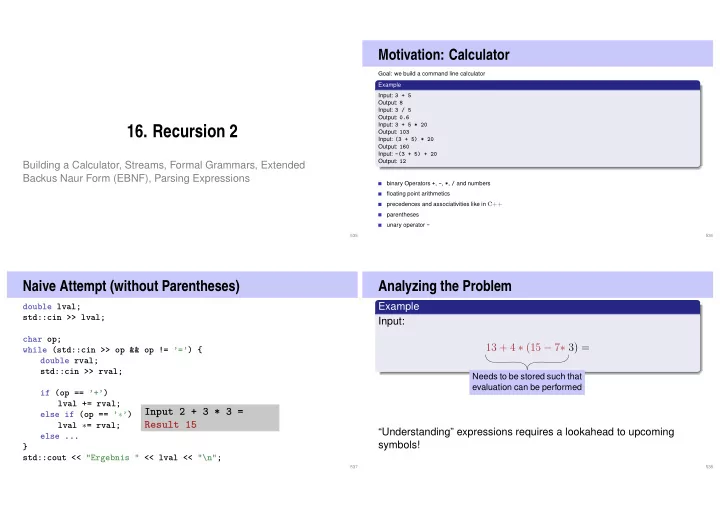
Goal: we build a command line calculator Example Input: 3 + 5 Output: 8 Input: 3 / 5 Output: 0.6 Input: 3 + 5 * 20 Output: 103 Input: (3 + 5) * 20 Output: 160 Input: -(3 + 5) + 20 Output: 12 binary Operators +, -, *, / and numbers floating point arithmetics precedences and associativities like in C++ parentheses unary operator -

536

Naive Attempt (without Parentheses)

double lval; std::cin >> lval; char op; while (std::cin >> op && op != ’=’) { double rval; std::cin >> rval; if (op == ’+’) lval += rval; else if (op == ’∗’) lval ∗= rval; else ... } std::cout << "Ergebnis " << lval << "\n";

Input 2 + 3 * 3 = Result 15

537

Analyzing the Problem

Example Input:

13 + 4 ∗ (15 − 7∗ 3) =

Needs to be stored such that evaluation can be performed

“Understanding” expressions requires a lookahead to upcoming symbols!

538

slide-2
SLIDE 2

Preparational Parenthesis: Streams

A program takes inputs from a conceptually infinite input stream. So far: command line input stream std::cin

while (std::cin >> op && op != ’=’) { ... }

Consume

  • p

from

std::cin,

reading position advances.

In future we want to be able to read from files.

539

Example: BSD 16-bit Checksum

#include <iostream> int main () { char c; int checksum = 0; while (std::cin >> c) { checksum = checksum / 2 + checksum % 2 ∗ 0x8000 + c; checksum %= 0x10000; } std::cout << "checksum = " << std::hex << checksum << "\n"; }

Input:

Lorem ipsum dolor sit amet, consectetur adipiscing elit, sed do eiusmod tempor incididunt ut labore et dolore magna aliqua. Ut enim ad minim veniam, quis nostrud exercitation ullamco laboris nisi ut aliquip ex ea commodo

  • consequat. Duis aute irure dolor in reprehenderit in voluptate velit esse cillum

dolore eu fugiat nulla pariatur. Excepteur sint occaecat cupidatat non proident, sunt in culpa qui officia deserunt mollit anim id est laborum.

Output: 67fd

Requires a manual termination of the input at the console

7

7Ctrl-D(Unix) / Ctrl-Z(Windows) at the beginning of a line that is concluded with ENTER 540

Example: BSD 16-bit Checksum with a File

#include <iostream> #include <fstream> int main () { std::ifstream fileStream ("loremispum.txt"); char c; int checksum = 0; while (fileStream >> c) { checksum = checksum / 2 + checksum % 2 ∗ 0x8000 + c; checksum %= 0x10000; } std::cout << "checksum = " << std::hex << checksum << "\n"; }

returns false when file end is reached.

  • utput: 67fd

541

Example: BSD 16-bit Checksum

Reuse of common functionality? Correct: with a function. But how?

542

slide-3
SLIDE 3

Example: BSD 16-bit Checksum Generic!

#include <iostream> #include <fstream> int checksum (std::istream& is) { char c; int checksum = 0; while (is >> c) { checksum = checksum / 2 + checksum % 2 ∗ 0x8000 + c; checksum %= 0x10000; } return checksum; }

Reference required: we modify the stream.

543

Equal Rights for All!

#include <iostream> #include <fstream> int checksum (std::istream& is) { ... } int main () { std::ifstream fileStream("loremipsum.txt"); if (checksum (fileStream) == checksum (std::cin)) std::cout << "checksums match.\n"; else std::cout << "checksums differ.\n"; }

input: Lorem Yps with Gimmick

  • utput: checksums differ

544

Why does that work?

std::cin is a variable of type std::istream. It represents an

input stream. Our variable fileStream is of type std::ifstream. It represents an input stream on a file. A std::ifstream is also a std::istream, with more features. Therefore fileStream can be used wherever a std::istream is required.

545

Again: Equal Rights for All!

#include <iostream> #include <fstream> #include <sstream> int checksum (std::istream& is) { ... } int main () { std::ifstream fileStream ("loremipsum.txt"); std::stringstream stringStream ("Lorem Yps mit Gimmick"); if (checksum (fileStream) == checksum (stringStream)) std::cout << "checksums match.\n"; else std::cout << "checksums differ.\n"; }

input from stringStream

  • utput: checksums differ

546

slide-4
SLIDE 4

Back to Expressions

13 + 4 ∗ (15 − 7 ∗ 3)

“Understanding an expression requires lookahead to upcoming symbols! We will store symbols elegantly using recursion. We need a new formal tool (that is independent of C++).

547

Formal Grammars

Alphabet: finite set of symbols Σ Strings: finite sequences of symbols Σ∗ A formal grammar defines which strings are valid.

548

Mountains

Alphabet: {/, \} Mountains M ⊂ {/, \}∗ (valid strings)

m′ = //\\///\\\

/\ /\ / \ / \/ \

549

Forbidden Mountains

Alphabet: {/, \} Mountains: M⊂{/, \}∗ (valid strings)

m′′′ = /\\//\ / ∈ M

/\ /\ \/

Both sides should have the same height. A mountain cannot fall below its starting height.

550

slide-5
SLIDE 5

Berge in Backus-Naur-Form (BNF)

mountain = "/\" | "/" mountain "\" | mountain mountain. Possible Mountains

1 /\ 2

/\/\ / \ ⇒ /\/\ / \ / \

3

/\/\ / \ /\ /\ / \ / \/ \ ⇒ /\ /\/\ /\ / \ / \/ \/ \

Rules alternatives nonterminal terminal

It is possible to prove that this BNF describes “our” mountains, which is not completely clear a priori.

551

Expressions

  • (3-(4-5))*(3+4*5)/6

What do we need in the BNF? Number , ( Expression )

  • Number, -( Expression )

Factor * Factor, Factor Factor * Factor / Factor , ... Term + Term, Term Term - Term, ... Factor Term Expression

552

The BNF for Expressions

A factor is a number, an expression in parentheses or a negated factor.

factor = unsigned_number | "(" expression ")" | "−" factor.

553

The BNF for Expressions

A term is factor, factor * factor, factor / factor, factor * factor * factor, factor / factor * factor, ... ... We need a repetition!

554

slide-6
SLIDE 6

EBNF

Extended Backus Naur Form: extends the BNF by

  • ption [] und
  • ptional repetition {}

term = factor { "∗" factor | "/" factor }.

Remark: the EBNF is not more powerful than the BNF . But it allows a more compact representation. The construct from above can be written as follows:

term = factor | factor T. T = "∗" term | "+" term.

555

The EBNF for Expressions

factor = unsigned_number | "(" expression ")" | "−" factor. term = factor { "∗" factor | "/" factor }. expression = term { "+" term | "−" term }.

556

Parsing

Parsing: Check if a string is valid according to the (E)BNF . Parser: A program for parsing. Useful: From the (E)BNF we can (nearly) automatically generate a parser:

Rules become functions Alternatives and options become if–statements. Nonterminial symbols on the right hand side become function calls Optional repetitions become while–statements

557

Functions (Parser with Evaluation)

Expression is read from an input stream.

// POST: extracts a factor from is // and returns its value double factor (std::istream& is); // POST: extracts a term from is // and returns its value double term (std::istream& is); // POST: extracts an expression from is // and returns its value double expression (std::istream& is);

558

slide-7
SLIDE 7

One Character Lookahead...

. . . to find the right alternative.

// POST: leading whitespace characters are extracted // from is , and the first non−whitespace character // is returned (0 if there is no such character) char lookahead (std::istream& is) { if ( is .eof()) return 0; is >> std :: ws; // skip whitespaces if ( is .eof()) return 0; // end of stream return is .peek(); // next character in is }

559

Cherry-Picking

. . . to extract the wanted character.

// POST: if ch matches the next lookahead then consume it // and return true. return false otherwise bool consume (std::istream& is, char ch) { if (lookahead(is) == ch){ is >> ch; return true; } return false ; }

560

Evaluating Factors

double factor (std::istream& is) { double v; if (consume(is, ’(’)){ v = expression (is); consume(is, ’)’); } else if (consume(is, ’−’)) v = −factor (is); else is >> v; return v; }

factor = "(" expression ")" | "−" factor | unsigned_number.

561

Evaluating Terms

double term (std::istream& is) { double value = factor (is); while(true){ if (consume(is, ’∗’)) value ∗= factor (is); else if (consume(is, ’/’)) value /= factor(is) else return value; } }

term = factor { "∗" factor | "/" factor }

562

slide-8
SLIDE 8

Evaluating Expressions

double expression (std::istream& is) { double value = term(is); while(true){ if (consume(is, ’+’)) value += term (is); else if (consume(is, ’−’)) value −= term(is) else return value; } }

expression = term { "+" term | "−" term }

563

Recursion!

Factor Term Expression

564

EBNF — and it works!

EBNF (calculator.cpp, Evaluation from left to right):

factor = unsigned_number | "(" expression ")" | "−" factor. term = factor { "∗" factor | "/" factor }. expression = term { "+" term | "−" term }.

std::stringstream input ("1−2−3"); std::cout << expression (input) << "\n"; // −4

565

BNF — and it does not work!

BNF (calculator_r.cpp, Evaluation from right to left):

factor = unsigned_number | "(" expression ")" | "−" factor. term = factor | factor "∗" term | factor "/" term. expression = term | term "+" expression | term "−" expression.

std::stringstream input ("1−2−3"); std::cout << expression (input) << "\n"; // 2

566

slide-9
SLIDE 9

Analysis: Repetition vs. Recursion

Simplification: sum and difference of numbers Beispiele

3, 3 − 5, 3 − 7 − 1

EBNF:

sum = value {"−" value | "+" value}.

BNF:

sum = value | value "−" sum | value "+" sum.

Both grammars permit the same kind of expressions.

567

value

double value (std::istream& is){ double val; is >> val; return val; }

568

EBNF Variant

// sum = value {"−" value | "+" value}. double sum(std::istream& is) { double v = value(is); while(true){ if (consume(is, ’−’)) v −= value(is); else if (consume(is, ’+’)) v += value(is); else return v; } }

569

We test: EBNF Variant

input: 1-2

  • utput: -1

input: 1-2-3

  • utput: -4

570

slide-10
SLIDE 10

BNF Variant

// sum = value | value "−" sum | value "+" sum. double sum(std::istream& is){ double v = value(is); if (consume(is, ’−’)) return v − sum(is); else if(consume(is, ’+’)) return v + sum(is); return v; }

571

We test: BNF Variant

input: 1-2

  • utput: -1

input: 1-2-3

  • utput: 2

572

We Test

Is the BNF wrong?

sum = value | value "−" sum | value "+" sum.

No, it does only determine the validity of expressions, not over their values! The evaluation we have put on top naively.

573

Getting to the Bottom of Things

double sum (std::istream& is){ double v = value (is); if (consume (is,’−’)) v -= sum (is); else if (consume (is,’+’)) v += sum(is); return v; } ... std::stringstream input ("1−2−3"); std::cout << sum (input) << "\n"; // 4

"1 - 2 - 3" 1 - "2 - 3" 2 - "3" 3 3

  • 1

2 2

574

slide-11
SLIDE 11

What has gone wrong?

The BNF does officially not talk about values but it still suggests the wrong kind of evaluation order.

sum = value | value "−" sum | value "+" sum.

naturally leads to

1 − 2 − 3 = 1 − (2 − 3)

575

A Solution: Left-Recursion

sum = value | sum "−" value | sum "+" value.

Implementation pattern from before does not work any more. Left-recursion must be resolved to right-recursion. This is what it looks like:

sum = value | value s. s = "−" sum | "+" sum.

  • Cf. calculator_l.cpp

576