Objectives Basic Recursion Your goal for this lecture is to - - PowerPoint PPT Presentation

objectives basic recursion
SMART_READER_LITE
LIVE PREVIEW

Objectives Basic Recursion Your goal for this lecture is to - - PowerPoint PPT Presentation

1 in aa + a aa 1 a in aa + a let aa = a * a let aa = a * a Objectives Function Calls Iterative Recursion Recursion and Lists Objectives Function Calls Iterative Recursion Recursion and Lists Objectives Basic Recursion Your goal for


slide-1
SLIDE 1

Objectives Function Calls Iterative Recursion Recursion and Lists

Basic Recursion

  • Dr. Mattox Beckman

University of Illinois at Urbana-Champaign Department of Computer Science

Objectives Function Calls Iterative Recursion Recursion and Lists

Objectives

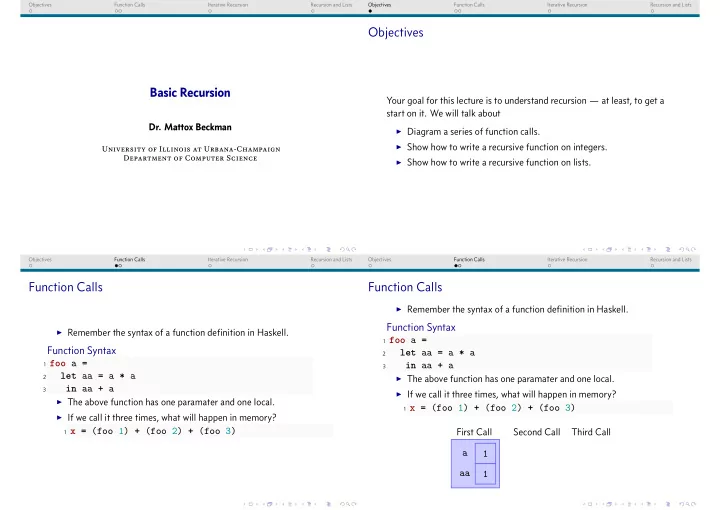
Your goal for this lecture is to understand recursion — at least, to get a start on it. We will talk about

◮ Diagram a series of function calls. ◮ Show how to write a recursive function on integers. ◮ Show how to write a recursive function on lists.

Objectives Function Calls Iterative Recursion Recursion and Lists

Function Calls

◮ Remember the syntax of a function definition in Haskell.

Function Syntax

1 foo a = 2

let aa = a * a

3

in aa + a

◮ The above function has one paramater and one local. ◮ If we call it three times, what will happen in memory?

1 x = (foo 1) + (foo 2) + (foo 3) Objectives Function Calls Iterative Recursion Recursion and Lists

Function Calls

◮ Remember the syntax of a function definition in Haskell.

Function Syntax

1 foo a = 2

let aa = a * a

3

in aa + a

◮ The above function has one paramater and one local. ◮ If we call it three times, what will happen in memory?

1 x = (foo 1) + (foo 2) + (foo 3)

First Call Second Call Third Call a 1 aa 1

slide-2
SLIDE 2

Objectives Function Calls Iterative Recursion Recursion and Lists

Function Calls

◮ Remember the syntax of a function definition in Haskell.

Function Syntax

1 foo a = 2

let aa = a * a

3

in aa + a

◮ The above function has one paramater and one local. ◮ If we call it three times, what will happen in memory?

1 x = (foo 1) + (foo 2) + (foo 3)

First Call Second Call Third Call a 1 aa 1 a 2 aa 4

Objectives Function Calls Iterative Recursion Recursion and Lists

Function Calls

◮ Remember the syntax of a function definition in Haskell.

Function Syntax

1 foo a = 2

let aa = a * a

3

in aa + a

◮ The above function has one paramater and one local. ◮ If we call it three times, what will happen in memory?

1 x = (foo 1) + (foo 2) + (foo 3)

First Call Second Call Third Call a 1 aa 1 a 2 aa 4 a 3 aa 9

Objectives Function Calls Iterative Recursion Recursion and Lists

Functions Calling Functions

◮ If one function calls another, both activation records exist

simultaneously.

1 foo x = x + bar (x+1) 2 bar y = y + baz (y+1) 3 baz z = z * 10

◮ What happens when we call foo 1?

Objectives Function Calls Iterative Recursion Recursion and Lists

Functions Calling Functions

◮ If one function calls another, both activation records exist

simultaneously.

1 foo x = x + bar (x+1) 2 bar y = y + baz (y+1) 3 baz z = z * 10

◮ What happens when we call foo 1?

x 1 ret

slide-3
SLIDE 3

Objectives Function Calls Iterative Recursion Recursion and Lists

Functions Calling Functions

◮ If one function calls another, both activation records exist

simultaneously.

1 foo x = x + bar (x+1) 2 bar y = y + baz (y+1) 3 baz z = z * 10

◮ What happens when we call foo 1?

x 1 ret y 2 ret

Objectives Function Calls Iterative Recursion Recursion and Lists

Functions Calling Functions

◮ If one function calls another, both activation records exist

simultaneously.

1 foo x = x + bar (x+1) 2 bar y = y + baz (y+1) 3 baz z = z * 10

◮ What happens when we call foo 1?

x 1 ret y 2 ret z 3 ret

Objectives Function Calls Iterative Recursion Recursion and Lists

Functions Calling Functions

◮ If one function calls another, both activation records exist

simultaneously.

1 foo x = x + bar (x+1) 2 bar y = y + baz (y+1) 3 baz z = z * 10

◮ What happens when we call foo 1?

x 1 ret y 2 ret z 3 ret 30

Objectives Function Calls Iterative Recursion Recursion and Lists

Functions Calling Functions

◮ If one function calls another, both activation records exist

simultaneously.

1 foo x = x + bar (x+1) 2 bar y = y + baz (y+1) 3 baz z = z * 10

◮ What happens when we call foo 1?

x 1 ret y 2 30 ret z 3 ret 30

slide-4
SLIDE 4

Objectives Function Calls Iterative Recursion Recursion and Lists

Functions Calling Functions

◮ If one function calls another, both activation records exist

simultaneously.

1 foo x = x + bar (x+1) 2 bar y = y + baz (y+1) 3 baz z = z * 10

◮ What happens when we call foo 1?

x 1 ret y 2 30 ret 32 z 3 ret 30

Objectives Function Calls Iterative Recursion Recursion and Lists

Functions Calling Functions

◮ If one function calls another, both activation records exist

simultaneously.

1 foo x = x + bar (x+1) 2 bar y = y + baz (y+1) 3 baz z = z * 10

◮ What happens when we call foo 1?

x 1 32 ret y 2 30 ret 32 z 3 ret 30

Objectives Function Calls Iterative Recursion Recursion and Lists

Functions Calling Functions

◮ If one function calls another, both activation records exist

simultaneously.

1 foo x = x + bar (x+1) 2 bar y = y + baz (y+1) 3 baz z = z * 10

◮ What happens when we call foo 1?

x 1 32 ret 33 y 2 30 ret 32 z 3 ret 30

Objectives Function Calls Iterative Recursion Recursion and Lists

Factorial

◮ This works if the function calls itself.

Factorial

1 fact 0 = 1 2 fact 1 = 1 3 fact n = n * fact (n-1)

◮ fact 4 ...

n 4 6 ret 24 n 3 2 ret 6 n 2 1 ret 2 n 1 ret 1

slide-5
SLIDE 5

Objectives Function Calls Iterative Recursion Recursion and Lists

Lists

Because lists are recursive, functions that deal with lists tend to be recursive.

Length

1 mylength :: [a] -> Int 2 mylength [] = 0 3 mylength (x:xs) = 1 + mylength xs 4 5 mylength s -- would return 3

◮ The base case stops the computation. ◮ Your recursive case calls itself with a smaller argument than the

  • riginal call.