SLIDE 1
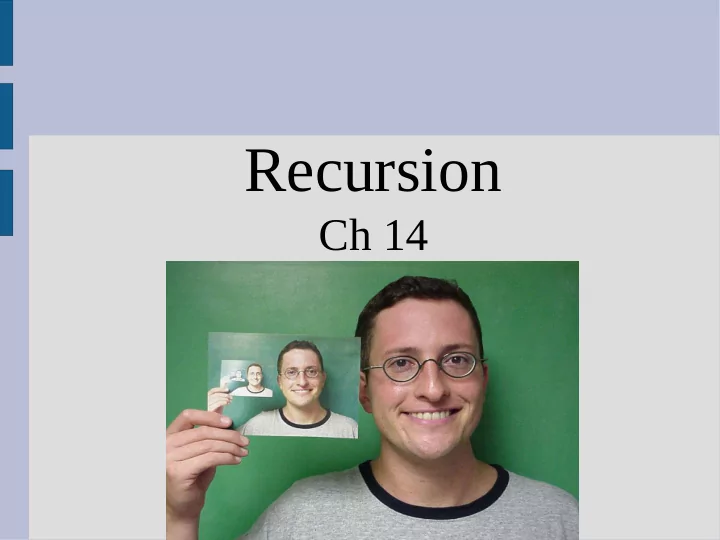
Recursion
Ch 14
SLIDE 2
Announcements
Midterm graded on gradescope
SLIDE 4
Recursion
No fancy blue words or classes this chapter Recursion is simply calling a method from inside itself This copy will re-run the method on any new arguments or information (See: badRecursion.cpp)
SLIDE 5
SLIDE 6
Recursion
If you forget your stopping case, you will not get an infinite loop but crash the program This is because every function call takes up more memory, so you constantly ask for more memory Eventually the memory (stack) cannot store anymore
SLIDE 7
Recursion
SLIDE 8 Recursion basics
Good recursion must have 2 parts:
- A recursive call on a smaller problem
- An ending case
(see: https://www.youtube.com/watch?v=-xMYvVr9fd4)
In order to use recursion, you must be able to identify a subproblem that is very similar to the original problem Each step must get you closer to the solution
SLIDE 9
Recursion basics
For recursion, you can basically assume your function works as you want it to (even though you have not written it) If you have the ending case and reduction step correct, then it will!
SLIDE 10
Recursion: Family tree
Person Descendant
SLIDE 11
Recursion: In words
A child couldn't sleep, so her mother told a story about a little frog, who couldn't sleep, so the frog's mother told a story about a little bear, who couldn't sleep, so bear's mother told a story about a little weasel ...who fell asleep. ...and the little bear fell asleep; ...and the little frog fell asleep; ...and the child fell asleep. (See: story.cpp)
SLIDE 12
Recursion: Basic example
Remember, code starts in main and runs from top to bottom in sequence (normally) When you call a function you go execute all the function's code is run before going back to the original code Code order is important in recursion! (See: stringRecursion.cpp)
SLIDE 13
Recursion
What if I wanted to just count down to zero? countdown(5) would show: 5 4 3 2 1 0! (see: countdown.cpp)
SLIDE 14 Recursion
There are two important parts of recursion:
- A stopping case that ends the recursion
- A reduction case that reduces the problem
What are the base and stopping cases for the Fibonacci numbers? (sum of the previous two numbers) (see last time: fibonacciRecursion.cpp)
SLIDE 15 Recursion: Root finding
Find a root of: (see: rootFind.cpp) Method:
y and 1 neg. y
(of x values)
SLIDE 16
SLIDE 17
Recursion
How would you sum the numbers 1 to n using recursion (not a loop)? For example sumToN(5) = 15, as 1+2+3+4+5 = 15 What is the stopping case? How do you reduce the problem? (see: sumToN.cpp)
SLIDE 18
Recursion
What if we defined tangent recursively as: Assume we take an input for how many times to do this recursion What is the pattern? What is the stopping case? How do we move towards the stopping case (see: tangent.cpp)
SLIDE 19 Recursion: Dictionary search
(See: dictionarySearch.cpp) Open the dictionary to the middle
- If the word is not on that page, reopen
in the middle of the unsearched side
SLIDE 20
Recursion: Tower or Hanoi
https://www.youtube.com/watch?v=2SUvWfNJSsM
SLIDE 21 Recursion: Tower or Hanoi
The tower of Hanoi is played by:
- 1. Moving a single ring to another stack
- 2. Smaller rings cannot have larger rings on
top of them (see: towerHanoi.cpp)
SLIDE 22 Recursion
How would you solve a sudoku problem? Rules:
- 1. Every row has numbers 1-9
- 2. Every column has numbers 1-9
- 3. The nine 3x3 boxes have numbers 1-9
Reduce problem? Stopping case? (see: sudokuSolver.cpp)
SLIDE 23
Recursion
Do not try to solve chess in this manner! You will segfault (you will also not finish computing before the sun burns the earth to a crisp)
SLIDE 24
Miscellaneous notes
Try googling “recursion” and click on the spelling suggestion Recursion is very powerful and used in many advanced algorithms It will give you a headache for a while... =(