
SLIDE 1
1
Introduction to Astronomical Introduction to Astronomical Imaging Systems Imaging Systems Goal of Imaging Systems Goal of Imaging Systems
- Create an “image” of a scene that may be
measured to calculate some parameter (some “quantitative information) about the scene
- Examples:
– Diagnostic X ray – Digital Photograph – “CAT” Scan (computed tomography) – “MRI” (magnetic resonance imaging)
Imaging Imaging “ “Chain Chain” ”
“ “Stages Stages” ” of Imaging Systems
- f Imaging Systems
One Possible Classification:
1.
Object
2.
Source
3.
Collector (lens and/or mirror)
4.
Sensor
5.
Image Processing (computer or eye-brain)
6.
Display
7.
Analysis
(often one and the same!)
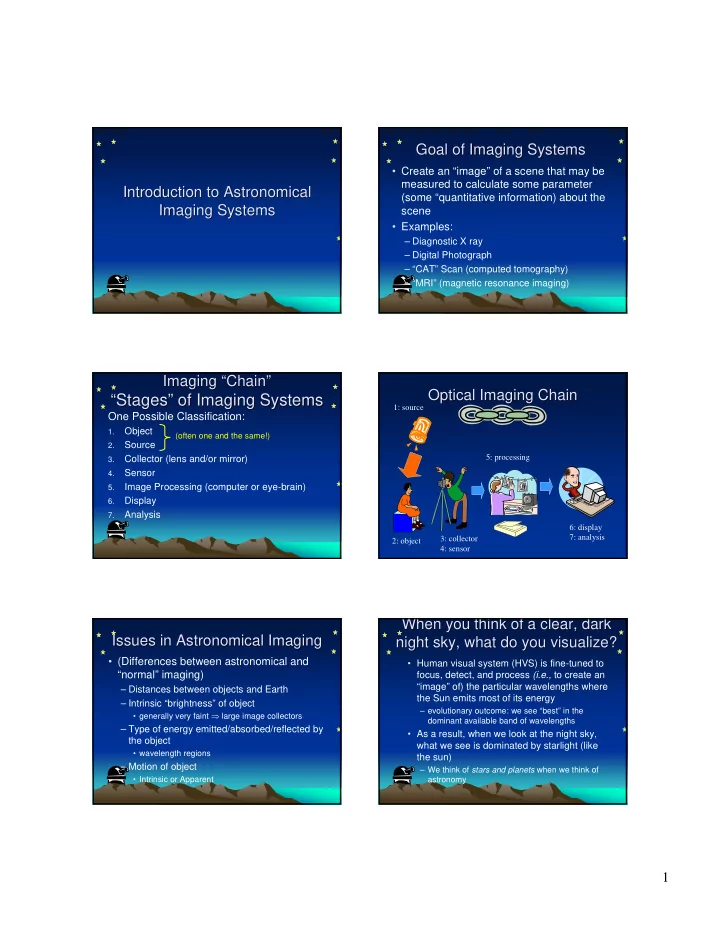
Optical Imaging Chain Optical Imaging Chain
1: source 2: object 3: collector 4: sensor 5: processing 6: display 7: analysis
Issues in Astronomical Imaging Issues in Astronomical Imaging
- (Differences between astronomical and
“normal” imaging)
– Distances between objects and Earth – Intrinsic “brightness” of object
- generally very faint ⇒ large image collectors
– Type of energy emitted/absorbed/reflected by the object
- wavelength regions
– Motion of object
- Intrinsic or Apparent
- Human visual system (HVS) is fine-tuned to
focus, detect, and process (i.e., to create an “image” of) the particular wavelengths where the Sun emits most of its energy
– evolutionary outcome: we see “best” in the dominant available band of wavelengths
- As a result, when we look at the night sky,
what we see is dominated by starlight (like the sun)
– We think of stars and planets when we think of astronomy