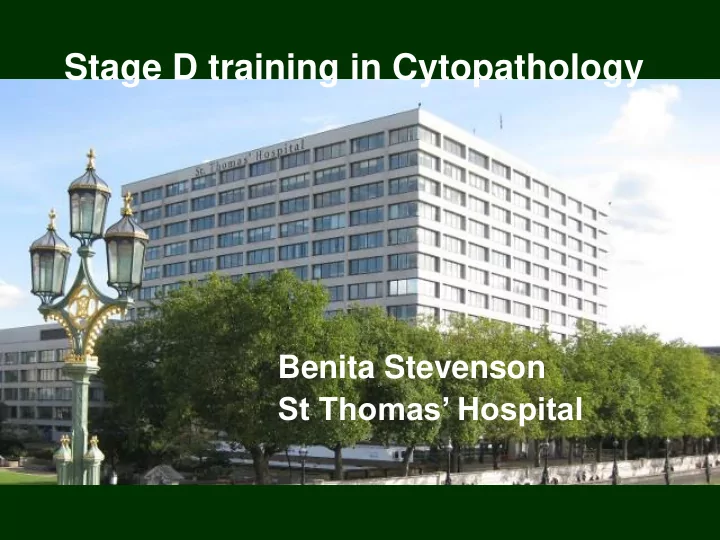
Stage D training in Cytopathology Benita Stevenson St Thomas - - PowerPoint PPT Presentation

stage d training in cytopathology
SMART_READER_LITE
LIVE PREVIEW

Stage D training in Cytopathology Benita Stevenson St Thomas - - PowerPoint PPT Presentation

Stage D training in Cytopathology Benita Stevenson St Thomas Hospital Background Current training 60-66 months depending on additional modules Stages A D ST1/stage A [12mths] (500 surgicals, 150 cervical and 150 diagnostic)


slide-1
SLIDE 1

Stage D training in Cytopathology

Benita Stevenson St Thomas’ Hospital

slide-2
SLIDE 2

Background

  • Current training 60-66 months depending on additional

modules

  • Stages A – D

– ST1/stage A [12mths] (500 surgicals, 150 cervical and 150 diagnostic) – ST2/stage B [12mths] (750 surgicals, 200 cervical and 200 diagnostic) – ST3/stage C [24mths] (1000 surgicals, 300 diagnostic) – ST4/stage C (1000 surgicals, 300 diagnostic) – ST5/stage D [12 mths] (1500 surgicals, 300 diagnostic)

  • Stage D

– post-exam – 12 months

slide-3
SLIDE 3
slide-4
SLIDE 4

Advanced cytopathology training

  • Cytology component of standard stage D:

– 300 cases

  • Subspecialty training in Cytopathology

– Introduced in 2007 curriculum – Replaced diploma in cytopathology – Poor uptake

slide-5
SLIDE 5

Subspeciality training in Cytopathology

  • Competency-based training

– no formal final examination

  • Assessment

– summative portfolio – WBPAs

slide-6
SLIDE 6

Aims (1)

  • Competencies of a specialised cytopathologist
  • Act as local lead

– Advise clinical colleagues on sampling taking and submission – Knowledge of ancillary testing – Teaching experience in workplace and formal settings – Function in a MDM setting

  • Diagnose majority of cytology samples independently

– Manage non-correlation between cytology and other investigations including histology and colposcopy

slide-7
SLIDE 7

Aims (2)

  • Report in a ‘rapid diagnosis’ one-stop clinic setting
  • Perform fine needle aspirates (FNAs)
  • Detailed knowledge of NHSCSP

– Interpret quality assurance data – Interpret performance indicators

slide-8
SLIDE 8

Entry to programme

  • Satisfactory completion stages A-C with FRCPath Parts

1 and 2 in histopathology

Cervical cytopathology

3 months equivalent (stage C or D) 500 cervical cytology cases, majority new screening cases 4 x WBPA (all directed) CHCCT exam

slide-9
SLIDE 9

Subspecialty training in Cytopathology

  • Structured educational programme
  • Stage D entirely within cytopathology

– whilst continuing to accumulate the histopathology competencies for completion of Stage D

  • Broad scope
slide-10
SLIDE 10

Components

Reporting Technical skills

12 months equivalent 1000 gynae cytology cases, majority new screening cases 15 x FNA clinics 1000 diagnostic cytology cases, appropriate mix of specimen sites and types 15 x endoscopic US-FNA clinics

slide-11
SLIDE 11

Assessment

18 WBPA 12 directed Training portfolio Structured case-log FNA experience Endoscopic US-FNA experience EQA performance Colposcopy MDM experience Personal performance monitoring data Cervical cancer audit case Histopathology/cytopathology correlation cases Critical review of errors Educational supervisor’s report ARCP outcome 6

slide-12
SLIDE 12

WBPAs (1)

DOPS Perform FNA using an aspiration technique Perform FNA using a non-aspiration technique Spread and stain a direct smear from an FNA Assess adequacy of a targeted aspirate from a deep lesion CBDs Provide second opinion/review on a case previously reported Discuss a case where morphology and ancillary studies give inconclusive results Discuss a case assessed in a rapid diagnosis clinic where an immediate report was not appropriate Discuss a case where ancillary studies were essential to the diagnosis

slide-13
SLIDE 13

WBPAs (2)

ECEs Present a non-cervical case at an MDT where there are discordant cytological findings Discuss statistical data prepared for KC61 returns Audit and present cytology performance in an area of specialist practice Explain procedure and take consent for a fine needle aspirate

slide-14
SLIDE 14

Our experience

  • Based at St

Thomas’ Hospital

  • 35000 gynae

cases/yr

  • 6500 non-

gynae cases/yr

slide-15
SLIDE 15

Cytology service at St Thomas’

  • Eight consultants
  • Daily ‘on-call’ rota

– Same day service for urgent samples – Wet preparation

  • cross-polarisation
  • phase contrast

microscopy

– Immunofluorescence – Triage of needle washings for ancillary testing

slide-16
SLIDE 16

My role

  • Clinical service duties

– Review and interpret most specimens – Progressive responsibility for caseload – Performing FNAs of palpable lesions – Performing ROSA for FNAs – Selection and interpretation of ancillary studies – On-call responsibility – Supervising consultant available at all times

slide-17
SLIDE 17

FNA experience

  • Utilising both aspiration and non-aspiration techniques
  • Experience of multiple environments:

– Wards – ITU – Theatres – Dedicated ‘palpable lump’ clinic

  • Impact of imaging

– Difficulty gaining numbers – Opportunity to collaborate

slide-18
SLIDE 18

ROSA (1)

  • Rapid on site assessment

– urgent ward FNAs – U/S guided H+N clinics – EBUS clinics

slide-19
SLIDE 19

ROSA (2)

  • Adequacy

– Time vs risk of false -ve

  • Communication
  • Ancillary testing

– Small samples

slide-20
SLIDE 20

Other responsibilities (1)

  • Multidisciplinary meetings

– lead colposcopy MDMs – presented at other relevant MDMs (thyroid, H+N)

  • Teaching

– Attend and assist in weekly FNA teaching – Formal teaching slot

  • departmental teaching/blackbox rota
  • ST1 teaching week
slide-21
SLIDE 21

Other responsibilities (2)

  • EQAs

– Continuing participation in gynae cytology EQA

  • Management

– First port of call for technical and clinical questions from BMS, screeners and clinical staff – Monthly consultants cytology meeting

slide-22
SLIDE 22

Subspecialty training in Cytopathology

Pros Cons

Wide spectrum of caseload Double the assessments ‘Hands on’ practical experience Gaining FNA numbers Different preparations and techniques Maintaining histopathology skills Managing small volume samples No peer group support to compare progress Exposure to different work practices

slide-23
SLIDE 23

Stage D assessment pathways

Histopathology Cytopathology

1500 surgicals (dependent on specialist interest/complexity)

  • 300 diagnostic cytology (suggested)

1000 diagnostic cytology 1000 gynae cytology 12 x WBPA 18 x WBPA 1 audit 1 audit Multisource feedback Training Logbook CCT in Histopathology CCT in Histopathology & Cytopathology

slide-24
SLIDE 24

What could be improved?

  • Collaboration with radiology for FNAs

– Difficulty of FNA experience – Training of ultrasound-guided FNAs

  • more controversial
  • not on curriculum
  • Access to molecular attachment

– Now on new curriculum

slide-25
SLIDE 25

Conclusion

  • Excellent opportunity

– Technical skills – Diagnostic proficiency

  • Managing cytological-histological discordance
  • Recognising sampling and diagnostic limitations
  • Correlating clinical & imaging data with ancillary testing to

provide a robust diagnosis

  • Seeking senior consultation from others
  • ….but a lot of work!
slide-26
SLIDE 26

References

1. Curriculum for specialty training in histopathology. Royal College of Pathologists, June 2015 https://www.rcpath.org/resourceLibrary/histopathology- curriculum--2015-.html 2. Curriculum for specialty training in histopathology. Royal College of Pathologists, June 2010 https://www.rcpath.org/resourceLibrary/histopathology- curriculum---2010-.html