SLIDE 1
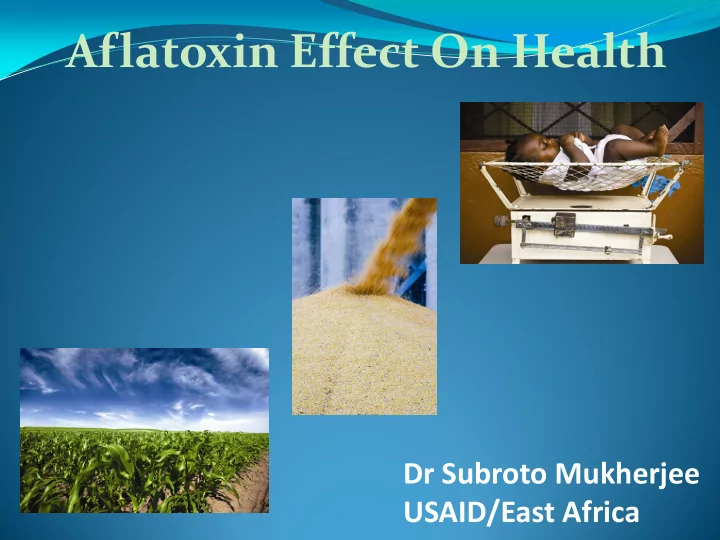
Aflatoxin Effect On Health
Dr Subroto Mukherjee USAID/East Africa
SLIDE 2 What is ‘Toxin’
A toxin (from Ancient Greek: toxikon) is
a poisonous substance produced within living cells or organisms
It simply means, it is a biologically
produced poison.
SLIDE 3
Aflatoxins are naturally occurring toxins that are produced by species of a fungus called Aspergillus
Types Aspergillus flavus and Aspergillus parasiticus
SLIDE 4 The Fungus - Aspergillus
- Survive temperatures ranging from 12°C to 48°C
- Surves on many organic nutrient sources like plant
debris, tree leaves, decaying wood, animal fodder, cotton, compost piles, dead insects and animal carcasses, stored grains, and even immunocompromised humans and animals.
- At latitudes between 40°N and 40°S of the equator
- Contaminate 25% of crops worldwide
SLIDE 5
When Is The Toxin Produced
The toxins are produced as secondary metabolites by the fungi in temperatures range between 24 and 35°C, within many commodities whenever the moisture content exceeds 7% (10% with ventilation)
SLIDE 6 Aflatoxin Prone African Dietary Staples
Maize Rice Corn Cassava Nuts Peanuts Chilies Spices
SLIDE 7
One form of the toxin is also released in milk
SLIDE 8
Exposure
Primarily through contaminated
food
Some evidence exists through
respiration
SLIDE 9
Who Gets Exposed
Everybody & Anybody Both humans and live-stocks living in region where the fungus grows uncontrolled But most are those in the lower socio- economic section and much of the live-stock in the unorganised sectors
SLIDE 10
Apoptosis (programed cell death) Inhibits of nucleic acid (DNA – RNA) synthesis Decrease protein synthesis Effects membrane stability leading cell damage
How Dose The Toxin Act?
SLIDE 11
How Dose The Toxin Act?
Apoptosis Cell death Inhibits of nucleic acid (DNA – RNA)
synthesis Mutation Cancer
Decrease protein synthesis Stunting Effects membrane stability cell
damage
SLIDE 12
Aflatoxin Effect on Human Health
Organs/ Systems Effects Pathological changes Liver, kidney, and spleen enlargement, fatty liver syndrome Urinary System Kidney inflammation leading to kidney failure Digestive system Decreased protein and fats digestion and absorptions, impaired carbohydrate breakdown, decreased motility, diarrhea
SLIDE 13
Aflatoxin Effect on Human Health
Organs/ Systems Effects Nervous system Abnormal Behavior, depression Reproductive System Reduced sperm count and infertility; neonatal outcomes-low birth weight Growth Recent human research confirms that dietary Aflatoxin reduces the rate of growth
SLIDE 14 Aflatoxin Effect on Human Health
Organs/Systems Effects Gene and Gene Expression Teratogenic effect (birth defect) Gene and Gene Suppression Carcinogenic effect—higher incidence of cancer Immunosuppression Decreased resistance and susceptibility to, HIV, TB, and
- ther opportunistic infections
SLIDE 15
The Principal Target Organ For Aflatoxins Is The Liver.
SLIDE 16
Aflatoxicosis Aflatoxicosis is the poisoning that results from ingesting aflatoxins
SLIDE 17
Aflatoxicosis Is Exposure related
1) large doses lead to acute illness and death, usually through liver cirrhosis; 2) Chronic low doses have nutritional and immunologic consequences; and 3) All doses have a cumulative effect on the risk of cancer
SLIDE 18
Chronic Aflatoxicosis
Acute Aflatoxicosis
Chronic Aflatoxin Exposure
SLIDE 19 Acute Aflatoxicosis
Acute poisoning is characterized by an acute
hepatotoxic disease that manifests itself with
- Depression
- Anorexia
- Jaundice
- Hemorrhages
- Edema of the lower extremities
- Abdominal pain and vomiting
Adult humans usually have a high tolerance of aflatoxin, and, in the reported acute poisonings, it is usually the children who die
SLIDE 20 Chronic Exposure
4.5 billion people worldwide are at risk
- Liver cancer: causative role in 5 – 28% of liver
cancer cases
- Impaired immune function
- Childhood stunting
- Possible neural tube defects
Both acute and chronic aflatoxin exposures are preventable
SLIDE 21
Aflatoxin and Cancer
Aflatoxin (B1) is regarded as a class I carcinogen by the World Health Organization
SLIDE 22
As per one estimate, 40% of the hepatocellular carcinoma (liver cancer) in Africa can be attributed to aflatoxin
SLIDE 23 Aflatoxin: Hepatitis B and Cancer
Hepatitis B virus (HBV) infection contributes to liver damage that is potentiated by chronic AF exposure leading to cancer
- The presence of the virus may interfere with
AF metabolism and detoxification process
- Predisposition of HBV-infected hepatocytes
to aflatoxin induced DNA damage;
- Viral replication and chronic inflammation
in liver cell, may contribute to the mutation potentiated by AF
SLIDE 24 Aflatoxin and HIV
HIV increases the toxic effect of Aflatoxin (AF) by
decreasing the levels of anti-oxidant nutrients that helps detoxify AF in the body
For HIV virus to penetrate a cell it has to overcome
the barrier of cell membrane & secretory IgA. AF reduces the level of secretory IgA thereby easing
In a large number of HIV cases there is a co-
infection of HBV causing liver damages thereby potentiating the effects of AF
SLIDE 25
Aflatoxin and Growth Stunting
Several studies have indicated
the effect of Aflatoxin on growth leading to stunting
The patho-biochemical mode of
action of Aflatoxin indicates it can have direct effect on growth
SLIDE 26
Under-nutrition Can Potentiate All These Effects Of Aflatoxin
SLIDE 27 Animal Health and Aflatoxin
Animals have similar (& potentiated)
pathological effect as found in Humans
In general animals have greater
pathological effect at lower concentrations
In animals, the affects of aflatoxin on
the liver is greater at a much lower concentration than that for humans
SLIDE 28
Impacts of Aflatoxin on Livestock and Livestock Products
Direct Impacts on Animals:
Acute Toxicity Reduced growth
rates and weight
Immunosuppression
at low doses Product Contamination:
Meat Dairy, eggs, and
cheese
Farm fish Organ meats
SLIDE 29 Diagnosis
The diagnosis of aflatoxicosis is often difficult because of
Variation in clinical signs, Gross pathological conditions Presence of infectious diseases due to the
suppression of the immune system.
No consistent diagnostic changes in
hematocrit, hemoglobin, and differential cell counts
SLIDE 30
Treatment
The source should be eliminated
immediately.
Levels of protein and vitamins A,D,E,K
and B should be increased.
Secondary
infections must receive immediate attention and treatment.
Good
management practices to alleviate stress
Address specific system diseases
SLIDE 31
Treatment
The source should be eliminated
immediately.
Levels of protein and vitamins A,D,E,K
and B should be increased.
Secondary
infections must receive immediate attention and treatment.
Good
management practices to alleviate stress
Address specific system diseases
SLIDE 32
PREVENTION
Remove the sources Promotes better agricultural and storage
techniques
Have good resources for testing and early
diagnosis
Strict food quality standards General awareness and personal
protection.
Better livestock feeding & management
SLIDE 33 Permissible Limits United States Food and Drug Administration
Parts Per Billion Criterion 20
- Food for human consumption
- Feed corn, grains, and cottonseed meal for
immature animals 100
- Feed corn and grains for breeding beef cattle,
breeding swine, or mature poultry 200
- Feed corn and grains intended for finishing
swine of 100 pounds or greater 300
- Feed corns and grains and for finishing (feedlot)
beef cattle
SLIDE 34 Aflatoxin Abatement Measures
Protection is Required throughout the value chain from “field to fork”
- 1. Pre-harvest
- Bio Control
- Improved Plant Varieties
- Integrated Pest Management
- 2. Post-harvest
- Post-Harvest Handling
- Improved Storage
- Quality Assurance of the Food Chain
SLIDE 35
Stop The Silent Killer And Disabler Before It Gets To Us
SLIDE 36
THANKS