St. Teresas Primary School Primary 1 and 2 Parents Information - - PowerPoint PPT Presentation

st teresa s primary school
SMART_READER_LITE
LIVE PREVIEW

St. Teresas Primary School Primary 1 and 2 Parents Information - - PowerPoint PPT Presentation

St. Teresas Primary School Primary 1 and 2 Parents Information Evening Wednesday 3 rd February 2016 Language & Literacy Shared and Modelled Reading in P1 & 2 Mrs Branniffs Class Mrs Walshs Class Mrs Finchs Class Mrs


slide-1
SLIDE 1

Primary 1 and 2 Parents’ Information Evening Wednesday 3rd February 2016

Language & Literacy

  • St. Teresa’s Primary School
slide-2
SLIDE 2

Mrs Finch’s Class Mrs Walsh’s Class Mrs Conlon’s Class Mrs Keane’s Class Mrs Kelly-Bogue’s Class Miss Campbell’s Class Mrs Branniff’s Class

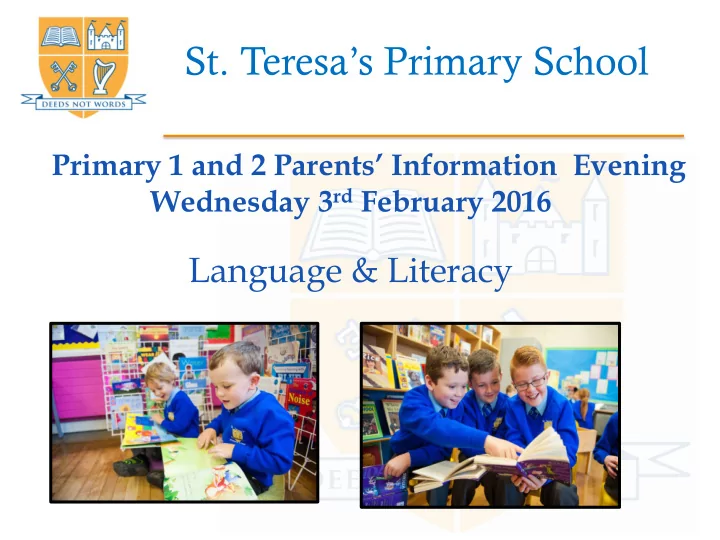
Shared and Modelled Reading in P1 & 2

slide-3
SLIDE 3

Supporting Reading at Home

  • Read stories to your children daily

Story Telling booklet with prompts

  • Homework activities with your child
  • Online stories e.g. Starfall
  • Audio story tapes
  • Visit your local library
  • Tablet/smart phone Apps
slide-4
SLIDE 4

What is Phonics?

  • Developing listening skills.
  • Teaching the sounds of the letters and the

names.

  • A practical approach to learning.
slide-5
SLIDE 5

How do we do this?

  • By the end of each week,

your child will have met some new sounds.

  • Each sound has its own

action, story and song

  • The children listen for

the sound.

  • Letter formation

See Action Booklet

slide-6
SLIDE 6

Learning the Letter Sounds

slide-7
SLIDE 7

Learning the Basic Sounds

  • s – so
  • a – at
  • t – to
  • i – in
  • p – pig
  • n – no
  • c/k – key
  • e – egg
  • h – hop
  • r – red
  • m – my
  • d – day
  • g – go
  • o – on
  • u – up
  • l – lip
  • f – fan
  • b - bee
slide-8
SLIDE 8

Moving on to the next stages...

  • ai - day
  • j – jug
  • a – oat
  • ie – tie
  • ee – tee
  • r – or
  • z – zoo
  • w – we
  • ng – rang
  • v – van
  • o – boot
  • o – zoo
  • y – you
  • x – fox (ks)
  • ch – chair
  • sh – shoe
  • th – the

These are harder to learn: The old saying ‘When two vowels go walking

the first sound does the talking’ may help you remember. (ai, oa, ie. ee,

ue)

slide-9
SLIDE 9

And finally – two letters-one sound

  • qu – quack
  • ou – ouch
  • oi – oil
  • ue – queue
  • er – mixer
  • ar – car
slide-10
SLIDE 10

Segmenting

Now that we know our sounds .... Segmenting We call the dots sound buttons. Every time we touch the button we say the sound. This is Segmenting

slide-11
SLIDE 11

Blending

  • After Segmenting we put the sounds

back together called Blending.

  • Blending is the more difficult skill.
  • Some children take longer than others

to develop this skill – it improves with practice.

  • Say the first sound more loudly and

repeat the sounds getting faster

  • Once children have developed the skills
  • f segmenting and blending to help

them to read words. They can progress to identifying the sounds in words which will ultimately help them both READ and WRITE

View Video

slide-12
SLIDE 12

Hearing the Sounds in Words

Sound Talk Games

  • I spy a d-o-g.
  • Dress the teddy with a c-oa-t.
  • Give the robot a p-e-g.
  • Simon says, “Put you hands on your h-ea-d.”
  • Magnetic letters or squares of paper
  • Play ‘Show Me’ Sounds
  • Robot arms/ sound buttons
  • Letter/ sound Hunts
  • Alphablocks ( cbeebies)
slide-13
SLIDE 13

Tricky Words

  • Words that do not follow the rules-

the was here

These are High Frequency Words Learn as look and Say words

slide-14
SLIDE 14

Jolly Phonics at home with the Website and Apps

  • Jolly Phonics Website

http://www.jollylearning.co.uk/overview-about- jolly-phonics https://www.youtube.com/watch?v=eCjJYB07a SU

  • Jolly Phonics App

1. Letter and Sounds- £4.99 through app store for apple or Google play store for android 1. Jolly Phonics Games Bundle- £5.99 2. Pirate phonics 1- £2.29 3. Phonics puzzles-Free 4. Phonics Match-Free

slide-15
SLIDE 15

How Writing Develops

  • Developing control of

large movements.

  • Mastering control of co-
  • rdination and small

movements.

  • Sorting, matching and

identifying shapes and patterns.

  • Beginning to form letters.
slide-16
SLIDE 16

St Teresa’s Letter Formation

slide-17
SLIDE 17

Writing in Primary 2

slide-18
SLIDE 18

Supporting Writing at Home

  • Model and share writing experiences with your

child.

  • Encourage the development of skills that support

writing (large/small movements).

  • Praise your child for ‘having a go’.
  • Talk about your child’s writing or mark making.