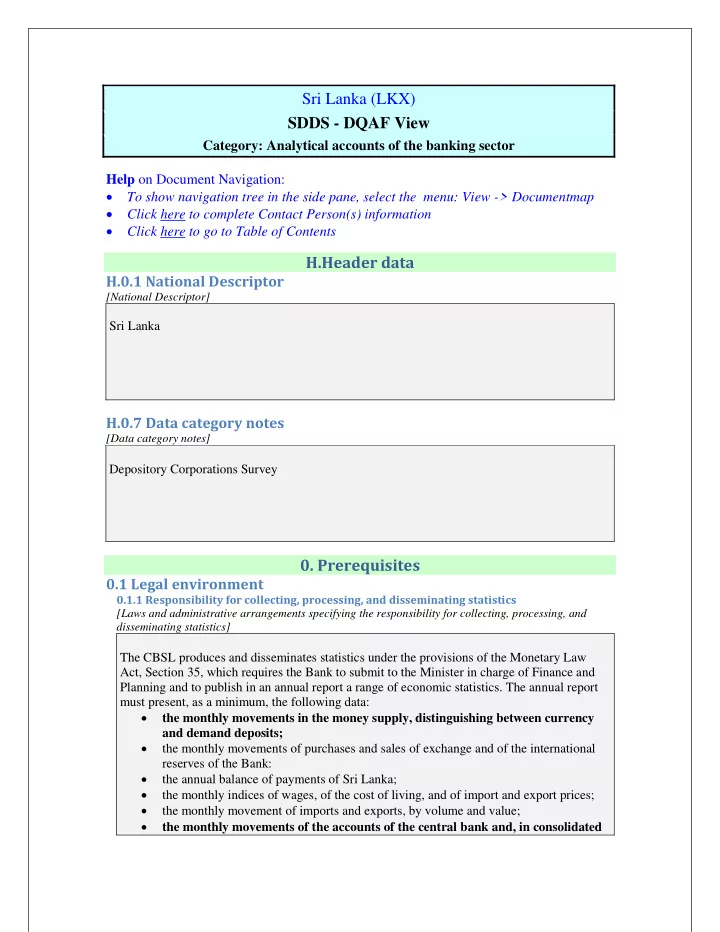
SLIDE 1 Sri Lanka (LKX) SDDS - DQAF View
Category: Analytical accounts of the banking sector
SDDSKey
Help on Document Navigation: To show navigation tree in the side pane, select the menu: View -> Documentmap Click here to complete Contact Person(s) information Click here to go to Table of Contents
H.Header data
H.0.1 National Descriptor
[National Descriptor]
Sri Lanka
H.0.7 Data category notes
[Data category notes]
Depository Corporations Survey
0.1 Legal environment
0.1.1 Responsibility for collecting, processing, and disseminating statistics [Laws and administrative arrangements specifying the responsibility for collecting, processing, and disseminating statistics]
The CBSL produces and disseminates statistics under the provisions of the Monetary Law Act, Section 35, which requires the Bank to submit to the Minister in charge of Finance and Planning and to publish in an annual report a range of economic statistics. The annual report must present, as a minimum, the following data: the monthly movements in the money supply, distinguishing between currency and demand deposits; the monthly movements of purchases and sales of exchange and of the international reserves of the Bank: the annual balance of payments of Sri Lanka; the monthly indices of wages, of the cost of living, and of import and export prices; the monthly movement of imports and exports, by volume and value; the monthly movements of the accounts of the central bank and, in consolidated
SLIDE 2 form, of the commercial banks; and the principal data on government receipts and expenditures and on the state of the public debt, both domestic and foreign. Additional data are produced for the analytical and policy needs of the CBSL and are disseminated as a public service in a variety of publications of various frequencies, including the "Selected Weekly Economic Indicators," the monthly "Selected Economic Indicators," and the "Monthly Bulletin." These are available at the Central bank’s web; http://www.cbsl.gov.lk/
0.1.2 Data sharing and coordination among data producing agencies [Data sharing and coordination among data producing agencies are adequate.]
Economic Research Department of the CBSL ensures satisfactory coordination with data providing licensed banks and licensed finance companies.
0.1.3 Confidentiality of individual reporters' data [Measures ensuring individual reporters’ data are kept confidential and used for statistical purposes
Confidentiality of reporting data is ensured by Section 45 of the Monetary Law Act, which states that “...every officer of the Central Bank shall preserve and aid in preserving secrecy with regard to all matters relating to the affairs of any banking institution or of any client of such institution...”
0.1.4 Ensuring statistical reporting [Legal mandates and/or measures to require or encourage statistical reporting.]
Monetary Law Act, Section 35, requires the CBSL to publish specified statistical data including monetary aggregates.
0.2 Resources
0.2.1 Staff, facilities, computing resources, and financing [Staff, facilities, computing resources, and financing for statistical programs currently available as well as what would be required for programmed statistical outputs.]
Adequate resources are available and the prevailing computing system of monetary aggregates is being updated with the support of IMF. No specific software packages are available.
0.2.2 Ensuring efficient use of resources [Measures implemented to ensure efficient use of resources.]
SLIDE 3 Current resources are utilised at its maximum through appropriate monitoring
0.3 Relevance
0.3.1 Monitoring user requirements [How the relevance and practical utility of existing statistics in meeting users’ needs are monitored.]
0.4 Quality management
0.4.1 Quality policy [Processes in place to focus on quality.] 0.4.2 Quality monitoring [Processes in place to monitor the quality of the statistical program. 0.4.3 Quality planning [Processes in place to deal with quality considerations in planning the statistical program.]
1.1 Professionalism
1.1.1 Impartiality of statistics [Measures to promote impartiality in production of statistics.]
SLIDE 4 Impartiality is ensured as statistics are compiled and analysed by professional central bankers.
1.1.2 Selection of sources, methodology, and modes of dissemination [Selection of sources, methodology, and modes of dissemination.]
The CBSL has independence with regard to release of data and methodology for compiling
- data. Methodology and models which are used to conduct Depository Corporations survey
coherent with international practices.
1.1.3 Commenting on erroneous interpretation and misuse of statistics [Entitlement to, opportunity for, and historical frequency of, comment on erroneous interpretation and misuse of statistics by the appropriate statistical entity.]
In order to avoid the erroneous interpretation detailed explanation on statistics are given in the CBSL Annual Report. (Chapter 07)
1.2 Transparency
1.2.1 Disclosure of terms and conditions for statistical collection, processing, and dissemination [Disclosure of terms and conditions for statistical collection, processing, and dissemination.]
Monetary Law Act No.58 of 1949, under which CBSL was established, requires it to publish specified statistical data.
1.2.2 Internal governmental access to statistics prior to release [Disclosure of Internal governmental access to statistics prior to their release.]
There is no access to data before they are released to the public. In a number of cases (e.g. national accounts) other agencies cooperate in the production of the data.
1.2.3 Attribution of statistical products [Identification of statistical agencies/units producing disseminated statistics.]
SLIDE 5 There is no commentary by senior government officials on the release of any data by the
- CBSL. In many cases, the data release contains a detailed technical commentary.
1.2.4 Advance notice of major changes in methodology, source data, and statistical techniques. [Advance notice of major changes in methodology, source data, and statistical techniques.]
Major changes in methodology are usually introduced in the CBSL "Annual Report" and these changes are accompanied by detailed methodological commentary.
1.3 Ethical standards
1.3.1 Guidelines for staff behavior [Measures implementing and enforcing guidelines for staff behavior.]
Staffs are highly trained to handle confidential data. Relevant guidelines are given in CBSL manual.
2.1 Concepts and definitions
2.1.1 Concepts and definitions [Degree to which the overall structure of concepts and definitions follows internationally accepted standards, guidelines, or good practices.]
The definition is broadly consistent with the recommendations of the ‘Monetary and Financial Statistical Manual’. A monthly Monetary Survey is compiled and disseminated as stock data in millions of Sri Lanka rupees. The Monetary Survey (M2b) is a consolidation of (1) the accounts of the monetary authorities, which includes the balance sheet of the Central Bank of Sri Lanka (CBSL), (2) Commercial banks Domestic Banking Units (DBUs), and (3) Commercial banks
- ffshore banking units (OBUs).
The M2b monetary survey is not a broad money survey in that it excludes a number of financial institutions that accept deposits. The monetary survey is a balance sheet presentation based on the identity of money equal to net foreign assets plus net domestic assets. A separate monetary survey (M2) that consolidates the accounts of the CBSL and commercial banks (DBUs) and treats the OBUs as nonresident units, is also disseminated to facilitate comparisons with earlier presentations of monetary data. Narrow money is defined to include currency outside banks and demand deposits, which are
SLIDE 6
- nly accepted by commercial banks. Quasi-money consists of time, saving, and fixed deposits
denominated in rupees, as well as foreign currency deposit accounts of Sri Lanka residents. There are no foreign currency demand deposits.
2.2 Scope
2.2.1 Scope 2.2.1.1 Scope of the data [Scope of the data.]
The Monetary Survey (M2b) covers the accounts of the CBSL, DBUs and OBUs of commercial banks. Only commercial banks are permitted to accept demand deposits. As
- f end 2014, the commercial bank sector consisted of 25 institutions, including 2 state
- wned banks, 11 local private banks, and 12 foreign banks. OBUs are separate
institutional units of commercial banks that transact primarily with nonresidents. Excluded from the M2b monetary survey are two groups of financial institutions that accept deposits that are included in broader measures of money. These groups are (1) Licensed Specialized Banks (LSBs), which include 9 long and medium-term lending
- rganizations (including the National Savings Bank), and (2) Licensed Finance
Companies (LFCs); 47 LFCs as at end 2014. The coverage of monetary statistics has been expanded to include the accounts of the Licensed Specialized Banks and Licensed Finance
- Companies. This permits construction of a broad money survey that includes all
depository corporations, denoted as M4. The coverage of monetary statistics now includes the accounts of the Licensed Specialized Banks and Licensed Finance Companies. This permits construction of a broad money survey that includes all depository corporations and therefore a complete M4 measure.
2.2.1.2 Exceptions to coverage [Exceptions to coverage.] 2.2.1.3 Unrecorded activity [Unrecorded activity.]
2.3 Classification/sectorization
2.3.1 Classification/sectorization [Broad consistency of classification/sectorization systems used with internationally accepted standards, guidelines, or good practices.]
SLIDE 7 The classification is broadly consistent with the recommendations of the ‘Monetary and Financial Statistical Manual’.
2.4 Basis for recording
2.4.1 Valuation [Types of prices (market, historical, administrative, basic, purchasers’, producer, etc.) used to value flows and stocks.]
Valuation of foreign-currency-denominated positions: Foreign currency positions are revalued at relevant end-period exchange rates. Monetary gold is valued at market rates.
2.4.2 Recording basis [Degree to which recording meets requirements for accrual accounting.]
The accounting records of all institutions covered by the monetary survey are maintained on an accrual basis. Provisions: Banks’ provisions are classified as other liabilities, a component
- f other items (net). Provisions are not netted against domestic credit.
2.4.3 Grossing/netting procedures [Broad consistency of grossing/netting procedures with internationally accepted standards, guidelines,
The grossing/netting procedures are broadly consistent with the recommendations of the ‘Monetary and Financial Statistical Manual’
- 3. Accuracy and reliability
3.1 Source data
3.1.1 Source data collection programs [Comprehensiveness of source data from administrative and survey data collection programs, and appropriateness of the collection modality for country-specific conditions.]
SLIDE 8 Data in the Monetary Survey for the CBSL are based on an analytical presentation of the CBSL’s balance sheet. Data for commercial banks and OBUs are obtained from balance sheet report forms (which include substantial sectoral detail) provided by the banks under instructions from the CBSL. The monetary survey is based on the actual administrative records of the CBSL supplemented by Treasury records, the commercial banks, and OBUs. A “monetary authorities” concept is applied, which aggregates the balance sheet of the CBSL with Treasury holdings of reserve
- assets. No sampling or estimations are applied. The CBSL is required by the Monetary Law
Act to produce its end month balance sheet within 30 days of the subsequent month. The commercial banks are required to submit their end-month report forms to the CBSL by the 15th of the subsequent month. A few institutions with extensive branch operations have difficulty meeting the deadline but reporting is completed to permit the monetary survey to be compiled and disseminated within 1 month of the end of the reference month.
3.1.2 Source data definitions, scope, classifications, valuation, and time of recording [Degree to which source data approximate the definitions, scope, classifications, valuation, and time of recording required (as described in 2.1.1-2.4.3).] 3.1.3 Source data timeliness [Source data timeliness relative to what is required for producing statistical outputs whose timeliness meets applicable data standard (SDDS requirements or GDDS recommendations).]
3.2 Assessment of source data
3.2.1 Source data assessment [Routine assessment of source data—including censuses, sample surveys, and administrative records (e.g., for coverage, sample error, response error, and nonsampling error); whether assessment results are monitored; how results are used to guide statistical processes.]
3.3 Statistical techniques
SLIDE 9 3.3.1 Source data statistical techniques [Statistical techniques in data compilation to deal with data sources (e.g., to align them with target concepts from 2.1.1).] 3.3.2 Other statistical procedures [Statistical techniques employed in other statistical procedures (e.g., data adjustments and transformations, and statistical analysis).]
3.4 Data validation
3.4.1 Validation of intermediate results [Assessment and investigation of statistical discrepancies in intermediate data.] 3.4.2 Assessment of intermediate data [Assessment and investigation of statistical discrepancies in intermediate data.] 3.4.3 Assessment of discrepancies and other problems in statistical outputs [Investigation of statistical discrepancies and other potential indicators of problems in statistical
SLIDE 10 3.5 Revision studies
3.5.1 Revision studies and analyses [Periodicity with which studies and analyses of revisions are carried out; whether and how they are used internally to inform statistical processes (see also 4.3.3).]
4.1 Periodicity and timeliness
4.1.1 Periodicity [Periodicity of statistical outputs relative to applicable dissemination standard (SDDS requirement or GDDS recommendation).]
Monthly.
4.1.2 Timeliness [Timeliness of statistical outputs relative to applicable dissemination standard (SDDS requirement or GDDS recommendation).]
One month.
4.2 Consistency
4.2.1 Internal consistency [Consistency of statistics within the dataset.]
The monthly monetary data present details on foreign positions, credit to domestic sectors, and monetary aggregates and components and substantial detail is also presented for the accounts of the CBSL, and commercial banks. This facilitates comparisons with fiscal and balance of payments data and permits cross-checking of data.
4.2.2 Temporal consistency [Consistency or reconcilability of statistics over a reasonable period of time.]
SLIDE 11 Monetary data are not seasonally adjusted.
4.2.3 Intersectoral and cross-domain consistency [Consistency or reconcilability of statistics with those obtained through other data sources and/or statistical frameworks.]
4.3 Revision
4.3.1 Revision schedule [Transparency and regularity of revision schedule.] 4.3.2 Identification of preliminary and/or revised data [Identification of preliminary and/or revised data.] 4.3.3 Dissemination of revision studies and analyses [Dissemination of revision studies and analyses (see also 3.5.1).]
5.1 Data
5.1.1 Statistical presentation
SLIDE 12
[Statistics are presented in a way that facilitates proper interpretation and meaningful comparisons (layout and clarity of text, tables, and charts).]
Data are presented in millions of Sri Lanka rupees. The monthly data are presented as follows: Broad money (M2b) Narrow money (M1) Currency Demand deposits Quasi money Net foreign assets Monetary authorities Commercial banks Net domestic assets Domestic credit Claims on central government Of monetary authorities Of commercial banks Credit to public corporations Credit to the private sector Other items (net) Detailed monthly balance sheet data are also compiled and disseminated for the CBSL (see data category for Central Bank survey), for commercial banks, and for OBUs.
5.1.2 Dissemination media and format 5.1.2.1 Hard copy - New release [Hard copy - New release.] 5.1.2.2 Hard copy - Weekly bulletin [Hard copy - Weekly bulletin.]
"Selected Weekly Economic Indicators," Central Bank of Sri Lanka (monthly data).
SLIDE 13
5.1.2.3 Hard copy - Monthly Bulletin [Hard copy - Monthly Bulletin.]
"Monthly Bulletin," Central Bank of Sri Lanka "Selected Economic Indicators," Central Bank of Sri Lanka
5.1.2.4 Hard copy - Quarterly bulletin [Hard copy - Quarterly bulletin.] 5.1.2.5 Hard copy - Other [Hard copy - Other.]
"Annual Report" Central Bank of Sri Lanka “Recent Economic Development” – Half year report
5.1.2.6 Electronic - On-line bulletin or data [Electronic - On-line bulletin or data.]
Data available at www.cbsl.lk.
5.1.2.7 Electronic - Other [Electronic - Other.]
Central Bank Annual Report.
5.1.3 Advance release calendar [Pre-announcement of the release schedule for statistics.]
SLIDE 14
Quarter-ahead precise release dates are disseminated in the International Monetary Fund’s (IMF’s) Dissemination Standards Bulletin Board.
5.1.3.1 ARC Note [ARC Note.] 5.1.4 Simultaneous release [Degree to which statistics are made available to all users at the same time, and modalities used to achieve this.] 5.1.5 Dissemination on request [Dissemination on request of unpublished but non-confidential statistics.]
5.2 Metadata
5.2.1 Dissemination of documentation on concepts, scope, classifications, basis of recording, data sources, and statistical techniques [Dissemination of documentation on concepts, scope, classifications, basis of recording, data sources, and statistical techniques, including annotation of differences from internationally accepted standards, guidelines.]
There is no published methodology at present.
5.2.2 Disseminated level of detail [Customization of detail and format of tables for the target groups of users.]
SLIDE 15 5.3 Assistance to users
5.3.1 Dissemination of information on contact points [Dissemination of information on contact points for each subject field.] 5.3.2 Availability of documents and services catalogs [Dissemination of catalogs of publications, documents, and other services, including information on any charges.]
Contact Person(s):
[Please provide information below as relevant] Contact 1 Applies To: Base page Summary Page Dissemination Page Prefix/First Name/Last Name: Mr. Vishuddhi Jayawickrama Title: Economist Unit: Division: Money and Banking Division Department: Economic Research Department Agency: Central Bank of Sri Lanka Address1:
Address2: Janadhipathi Mawatha City/State: Colombo 01 Postal Code: Phone: Country Code/City Code/Number +94 112477 203 Fax: Country Code/City Code/Number +94 112387 017 Email: vishuddhi@cbsl.lk
SLIDE 16 Contact 2 Applies To: Base page Summary Page Dissemination Page Prefix/First Name/Last Name: Mrs. Chamani Wijesinghe Title: Economist Unit: Division: Money and Banking Division Department: Economic Research Department Agency: Central Bank of Sri Lanka Address1:
Address2: Janadhipathi Mawatha City/State: Colombo 01 Postal Code: Phone: Country Code/City Code/Number +94 112477 554 Fax: Country Code/City Code/Number +94 112387 017 Email: chamani@cbsl.lk Contact 3 Applies To: Base page Summary Page Dissemination Page Prefix/First Name/Last Name: Title: Unit: Division: Department: Agency: Address1: Address2: City/State: Postal Code: Phone: Country Code/City Code/Number Fax: Country Code/City Code/Number Email:
Go to Top
Table Of Contents
Sri Lanka (LKX) ............................................................................................................................................ 1 H.Header data ................................................................................................................................................. 1 H.0.1 National Descriptor ........................................................................................................................... 1 H.0.7 Data category notes........................................................................................................................... 1
- 0. Prerequisites ............................................................................................................................................... 1
0.1 Legal environment ................................................................................................................................ 1 0.1.1 Responsibility for collecting, processing, and disseminating statistics ......................................... 1 0.1.2 Data sharing and coordination among data producing agencies .................................................... 2 0.1.3 Confidentiality of individual reporters' data .................................................................................. 2 0.1.4 Ensuring statistical reporting ......................................................................................................... 2
SLIDE 17 0.2 Resources .............................................................................................................................................. 2 0.2.1 Staff, facilities, computing resources, and financing .................................................................... 2 0.2.2 Ensuring efficient use of resources ................................................................................................ 2 0.3 Relevance ............................................................................................................................................. 3 0.3.1 Monitoring user requirements........................................................................................................ 3 0.4 Quality management ............................................................................................................................. 3 0.4.1 Quality policy ................................................................................................................................ 3 0.4.2 Quality monitoring ........................................................................................................................ 3 0.4.3 Quality planning ............................................................................................................................ 3
- 1. Integrity ...................................................................................................................................................... 3
1.1 Professionalism ..................................................................................................................................... 3 1.1.1 Impartiality of statistics ................................................................................................................. 3 1.1.2 Selection of sources, methodology, and modes of dissemination ................................................. 4 1.1.3 Commenting on erroneous interpretation and misuse of statistics................................................ 4 1.2 Transparency ........................................................................................................................................ 4 1.2.1 Disclosure of terms and conditions for statistical collection, processing, and dissemination ........ 4 1.2.2 Internal governmental access to statistics prior to release ............................................................. 4 1.2.3 Attribution of statistical products .................................................................................................. 4 1.2.4 Advance notice of major changes in methodology, source data, and statistical techniques. ......... 5 1.3 Ethical standards ................................................................................................................................... 5 1.3.1 Guidelines for staff behavior ......................................................................................................... 5
- 2. Methodology .............................................................................................................................................. 5
2.1 Concepts and definitions ...................................................................................................................... 5 2.1.1 Concepts and definitions ............................................................................................................... 5 2.2 Scope .................................................................................................................................................... 6 2.2.1 Scope ............................................................................................................................................. 6 2.2.1.1 Scope of the data ..................................................................................................................... 6 2.2.1.2 Exceptions to coverage ........................................................................................................... 6 2.2.1.3 Unrecorded activity ................................................................................................................ 6 2.3 Classification/sectorization ................................................................................................................... 6 2.3.1 Classification/sectorization ............................................................................................................ 6 2.4 Basis for recording ............................................................................................................................... 7 2.4.1 Valuation ....................................................................................................................................... 7 2.4.2 Recording basis ............................................................................................................................. 7 2.4.3 Grossing/netting procedures .......................................................................................................... 7
- 3. Accuracy and reliability ............................................................................................................................. 7
3.1 Source data ........................................................................................................................................... 7 3.1.1 Source data collection programs .................................................................................................... 7 3.1.2 Source data definitions, scope, classifications, valuation, and time of recording .......................... 8 3.1.3 Source data timeliness ................................................................................................................... 8 3.2 Assessment of source data .................................................................................................................... 8 3.2.1 Source data assessment .................................................................................................................. 8 3.3 Statistical techniques ............................................................................................................................ 8 3.3.1 Source data statistical techniques .................................................................................................. 9 3.3.2 Other statistical procedures............................................................................................................ 9 3.4 Data validation ...................................................................................................................................... 9 3.4.1 Validation of intermediate results .................................................................................................. 9 3.4.2 Assessment of intermediate data ................................................................................................... 9 3.4.3 Assessment of discrepancies and other problems in statistical outputs ......................................... 9 3.5 Revision studies ...................................................................................................................................10 3.5.1 Revision studies and analyses .......................................................................................................10
.............................................................................................................................................10 4.1 Periodicity and timeliness ....................................................................................................................10 4.1.1 Periodicity.....................................................................................................................................10 4.1.2 Timeliness.....................................................................................................................................10 4.2 Consistency..........................................................................................................................................10
SLIDE 18 4.2.1 Internal consistency ......................................................................................................................10 4.2.2 Temporal consistency ...................................................................................................................10 4.2.3 Intersectoral and cross-domain consistency .................................................................................11 4.3 Revision ...............................................................................................................................................11 4.3.1 Revision schedule .........................................................................................................................11 4.3.2 Identification of preliminary and/or revised data ..........................................................................11 4.3.3 Dissemination of revision studies and analyses ............................................................................11
- 5. Accessibility ..............................................................................................................................................11
5.1 Data .....................................................................................................................................................11 5.1.1 Statistical presentation ..................................................................................................................11 5.1.2 Dissemination media and format ..................................................................................................12 5.1.2.1 Hard copy - New release ........................................................................................................12 5.1.2.2 Hard copy - Weekly bulletin ..................................................................................................12 5.1.2.3 Hard copy - Monthly Bulletin ................................................................................................13 5.1.2.4 Hard copy - Quarterly bulletin ...............................................................................................13 5.1.2.5 Hard copy - Other ..................................................................................................................13 5.1.2.6 Electronic - On-line bulletin or data ......................................................................................13 5.1.2.7 Electronic - Other ..................................................................................................................13 5.1.3 Advance release calendar .............................................................................................................13 5.1.3.1 ARC Note ..............................................................................................................................14 5.1.4 Simultaneous release ....................................................................................................................14 5.1.5 Dissemination on request ..............................................................................................................14 5.2 Metadata ..............................................................................................................................................14 5.2.1 Dissemination of documentation on concepts, scope, classifications, basis of recording, data sources, and statistical techniques .........................................................................................................14 5.2.2 Disseminated level of detail..........................................................................................................14 5.3 Assistance to users ...............................................................................................................................15 5.3.1 Dissemination of information on contact points ...........................................................................15 5.3.2 Availability of documents and services catalogs ..........................................................................15 Contact Person(s): .........................................................................................................................................15