
SLIDE 1
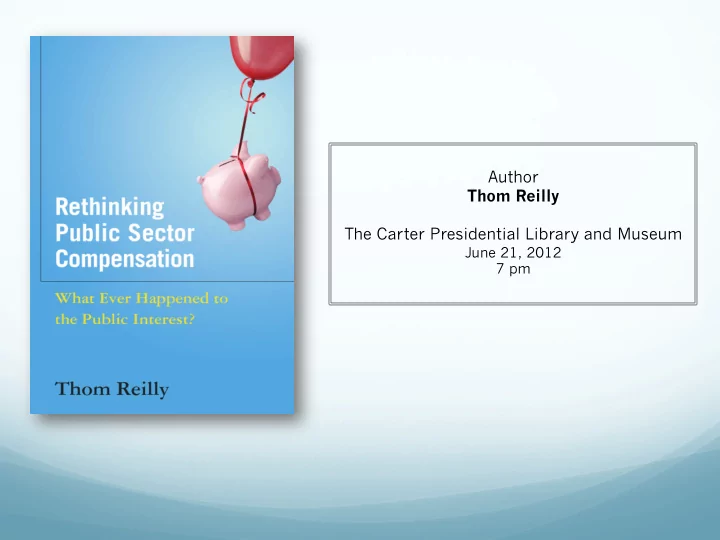
Author Thom Reilly The Carter Presidential Library and Museum
June 21, 2012 7 pm
A Broken System The current way we Retiree Health reward and - - PowerPoint PPT Presentation
Author Thom Reilly The Carter Presidential Library and Museum June 21, 2012 7 pm A Broken System The current way we Retiree Health reward and manage Care employees is skewed too heavily towards pensions and retiree Pensions health
Author Thom Reilly The Carter Presidential Library and Museum
June 21, 2012 7 pm
Public Employees Pensions Retiree Health Care
The current way we reward and manage employees is skewed too heavily towards pensions and retiree health care.
Current system places too much emphasis on:
Job Security Time Served
Rather than:
Performance Innovation Entrepreneurial Thinking
service delivery
efficiency
responsiveness
Deferral of employee compensation Future Generations
Shifts costs to With interest! Results in
Expensive and ethically troublesome personnel system
Estimates place the unfunded liability for pensions and retiree health care between $1 trillion and $3 trillion!
To put this in perspective if you stack a trillion $1 bills on top of each other, you can reach the moon and back, four times!
*According to astrophysicist Neil deGrasse Tyson
The typical public pension plan assumes its investments will earn average annual returns of 8% over the long term
1
Actual experience since 2000 has been much less – 5.7% over the last 10 years
2
1Center for Retirement Research at Boston College 2National Association of State Retirement Administrators
Governments do not use their investment
assumptions to project future asset growth
Governments measure what they will
Private companies have been prohibited
from this doing since 1993
Vallejo, California – inability to pay pension
Prichard, Alabama – inability to pay pensions,
especially state mandated increases (2009)
Central Falls, Rhode Island – inability to pay
State Pension Liability Percent of Pension Funded Kentucky $36 billion 58% Illinois $126 billion 51% New Hampshire $8 billion 58% New Jersey $135 billion 66% Oklahoma $35 billion 57% Kansas $21 billion 64% Massachusetts $61 billion 68% Colorado $55 billion 69% Maryland $53 billion 65%
Elected Politicians Gov’t Bureaucracies Interest Groups
Public sector workers at all levels
(federal, state, and local) earn higher wages and benefits than their private sector counterparts
However, when comparisons of
similar workers are made between the two with regards to education, age, and occupation, most studies show public workers are either modestly over or underpaid.
Most significant factor…
Without college degrees, employees do
better working for governments
Public employees with college degrees
do worse
How much to value deferred benefits such as:
Pensions
Retiree health care Job security
Blue-collar White-collar
Public employees should be
compensated in a manner comparable to their private sector counterparts
This is consistent with economic and
efficiency principles and concepts of fairness and equality
Increased transparency Avoiding conflicts and self-dealing in awarding compensation Pensions and other post-employment benefits (OPEB)
Raising retirement age Eliminating current abuses Increased employee contributions Moving employees to 401k-style or hybrid plans (portability) Moratorium on new benefits until plans are fully funded Fully fund pension and OPEB obligations Independent analysis of benefit costs that outline how the plans will be
funded now and in the future
Voter approvals of OPEB increases Retiree health care reform
Civil service reform
At will employment Broadbanding Move away from time served compensation to
rewarding employees for high performance, innovation and entrepreneurial thinking (bonus structure)
Collective bargaining compensation
Subject collective bargaining to open meeting laws Right to work (prohibit compulsory union
membership/dues)
Prohibit strikes by public workers Do not subject certain deferred compensation
benefits (i.e., pensions and retiree health care) to collective bargaining
Community members/citizens appointed to collective
bargaining teams
In lieu of arbitration and when an impasse occurs,
allow elected officials or the community to decide
For more information, visit
www.rethinkingpublicpay.com
Contact info: thom@thereillygroup.org