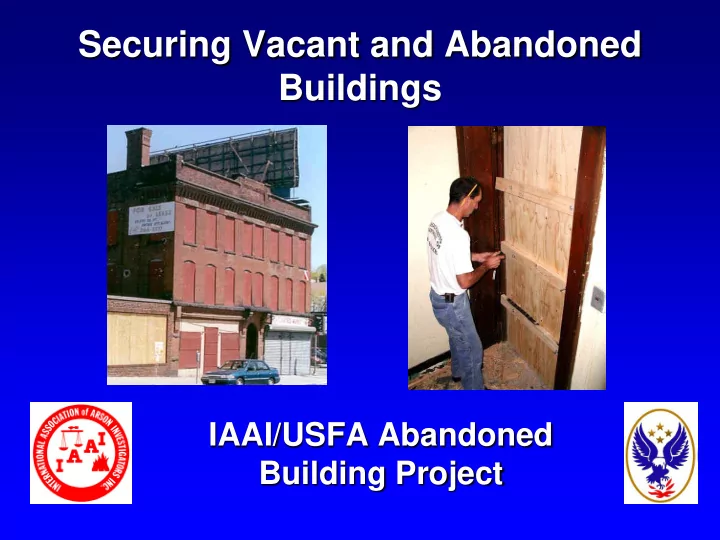
Securing Vacant and Abandoned Buildings IAAI/USFA Abandoned - - PowerPoint PPT Presentation

securing vacant and abandoned buildings
SMART_READER_LITE
LIVE PREVIEW

Securing Vacant and Abandoned Buildings IAAI/USFA Abandoned - - PowerPoint PPT Presentation

Securing Vacant and Abandoned Buildings IAAI/USFA Abandoned Building Project The "Broken Windows" Theory of Social Disorder From one broken window, you can lose a street Target Properties Secure and well maintained properties


slide-1
SLIDE 1

IAAI/USFA Abandoned Building Project

Securing Vacant and Abandoned Buildings

slide-2
SLIDE 2

The "Broken Windows" Theory of Social Disorder

From one broken window, you can lose a street

slide-3
SLIDE 3

Target Properties

  • Secure and well

maintained properties are not the problem

  • Problem properties

 Vacant  No viable owner  Unsecured  Accessible

slide-4
SLIDE 4

Vacant Properties

It is estimated that 18%

  • f urban structures in

the United States are unused The ISO estimates that there are more than 21000 idle properties of over 15000 square feet in the United States

slide-5
SLIDE 5

The Problem

  • Thousands of fires annually
  • Civilian injuries and deaths
  • Fire Fighters are more likely to

be injured fighting fires in vacant properties than any

  • ther property type

 More than 6000 fire fighter injuries every year  From 1990 to 1999 - 23 fire fighters died while operating at fires in vacant/idle properties

slide-6
SLIDE 6

D E T E R IO R A T IO N H azard to P u b lic S afety L east G reatest

O w ner: R esponsive U ninhabited S ecure O w ner: U nresponsive U ninhabited O pen to U nauthorized E ntry O w ner: A bsentee or U nknow n B uilding D eteriorating O pen to U nauthorized E ntry

The Vacancy Progression

slide-7
SLIDE 7

The Impact on the Community

  • Crime
  • Safety
  • Community image

Abandonment is a contagious phenomenon

slide-8
SLIDE 8

Why Building Security is Essential

  • Of the more than 12000 fires in vacant

structures every year

 Nearly 72% are of incendiary or suspicious origin  More than 5% are caused by children playing with matches

slide-9
SLIDE 9

Securing Buildings

  • Prevents unauthorized access
  • Reduces exposure to

elements

  • Must be done well
  • Requires regular monitoring

to make sure security measures are not breached

  • Slowing down deterioration of

the structure from weather and vandalism Security is a temporary measure

slide-10
SLIDE 10

Is This Security?

slide-11
SLIDE 11

Security = Fire Prevention Crime Prevention

slide-12
SLIDE 12

The Process

  • Identification – What buildings in

your jurisdiction are vacant?

  • Evaluation – Determine the potential

hazards to public safety

  • Preparation – What must be done

prior to securing the building and what materials will be needed?

  • Action – Securing the building
slide-13
SLIDE 13

Building Security Methods

  • Normal – Locks on windows and doors
  • Board Up

 Simple  HUD  HUD Reinforced (USFA National Arson Prevention

Initiative method)

  • Fencing
  • Intensive Surveillance
  • Security Guards
  • Intrusion Alarm
slide-14
SLIDE 14

Normal Security

slide-15
SLIDE 15

Simple Board Up

slide-16
SLIDE 16

HUD Board Up

slide-17
SLIDE 17

HUD Reinforced Board Up

slide-18
SLIDE 18

Fencing for Security

slide-19
SLIDE 19

Other Methods

  • Intensive Surveillance by police and fire

department

 Regular building sweeps to remove

  • ccupants
  • Security Guards

 24 hour guard service on premises

  • Intrusion Alarm

 Monitored and supervised alarm system  Police or guard service response to alarms

slide-20
SLIDE 20

Pros and Cons of Board Up

  • Pros

 Provides a high level

  • f security

 Reduces criminal activity  Reduces fires  Is easily monitored

  • Cons

 Expensive materials  Complex installation  Difficult for fire department to gain access

slide-21
SLIDE 21

Building Evaluation

Objectives

 Determine that the building is secure  Identify hazards that require immediate corrective action  Evaluate the fire growth potential

  • Exposure fires
  • Available fuel packages
  • Compromised fire barriers
  • Location and type of hazardous materials on site

 Evaluate the potential for structural collapse  Identify conditions that will be hazardous to fire fighters in the event of a fire

slide-22
SLIDE 22

Is the Building Secure?

  • Secure means not open

to unauthorized access

  • Do the security

measures meet the requirements of the jurisdiction?

Hole in

  • utside

wall

slide-23
SLIDE 23

Signs of Recent Entry

  • Trash/litter
  • Furnishings in an
  • therwise empty

building

  • Signs of recent fires

for heat or cooking

slide-24
SLIDE 24

The building was boarded well on street level. On the 2nd floor, wood was easily pulled away without tools.

slide-25
SLIDE 25

Fix it Now

Are there conditions that should be remedied immediately?

 Significant fire hazards  Lack of security  Trash accumulations  Life safety hazards  Potential for collapse

slide-26
SLIDE 26

Preparation

  • Remove combustibles

and hazardous materials

  • Disconnect utilities
  • Determine what

materials are needed for board-up

slide-27
SLIDE 27

Remove Combustibles

slide-28
SLIDE 28

Utilities

  • Turn off water and drain

plumbing system  Open all faucets  Put anti-freeze in traps

  • Arrange for power company

to disconnect electricity

  • Arrange for natural gas shut
  • ff or disconnect and remove

LPG tanks

  • Empty fuel oil tanks
slide-29
SLIDE 29

What is Needed for Board-Up?

  • Count and measure
  • penings that require

board-up

  • Determine the quantity
  • f materials required

to accomplish the job

  • Order materials
  • Pre-cut and drill if

possible

slide-30
SLIDE 30

Board-Up Materials

USFA National Arson Prevention Initiative Board Up Procedures MATERIALS LIST

IAAI/USFA Abandoned Building Project

DOOR ASSEMBLIES

MATERIALS REQUIRED PER DOOR

1 1/2" CDX PLYWOOD SHEET - CUT TO DIMENSIONS OF DOOR FRAME (WEATHER SIDE) 1 1/2" CDX PLYWOOD SHEET - CUT TO OUTSIDE DIMENSIONS OF DOOR FRAME TRIM (INSIDE) 6 2X4 BRACES - 3 CUT TO WIDTH OF OUTSIDE PLYWOOD, 3 CUT TO WIDTH OF INSIDE PLYWOOD 1 2X4 BOTTOM BRACE - CUT TO WIDTH OF DOOR TRIM (OPTIONAL) 6 CARRIAGE BOLT ASSEMBLIES CARRIAGE BOLT ASSEMBLY 1 12' X 3/8" CARRIAGE BOLT - COURSE THREAD 1 1/2" USS STANDARD FLAT WASHER (WEATHER SIDE) 1 3/8" USS STANDARD FLAT WASHER (INSIDE) 1 3/8" CONSTRUCTION GRADE NUT - COURSE THREAD WINDOW ASSEMBLY

MATERIALS REQUIRED PER WINDOW

1 1/2" CDX PLYWOOD SHEET - CUT TO DIMENSIONS OF WINDOW FRAME (WEATHER SIDE 4 2X4 BRACES - CUT TO WIDTH OF PLYWOOD 4 CARRIAGE BOLT ASSEMBLIES

NUMBER OF WINDOWS TO BE SECURED (NW): NUMBER OF WINDOWS BRACES REQUIRED: (NW X 4) CARRIGE BOLT ASSEMBLIES REQUIRED (BW): (NW X 4) NUMBER OF DOORS TO BE SECURED (ND ): NUMBER OF DOOR BRACES REQUIRED: (ND X 6) CARRIGE BOLT ASSEMBLIES REQUIRED(BD): (ND X 6) TOTAL CARRIGE BOLT ASSEMBLIES REQUIRED:(BW + BD) NUMBER OF BOTTOM BRACES REQUIRED: (ND)

slide-31
SLIDE 31

Which Openings Need Securing?

  • Within 10’ of grade
  • Accessible from

porch, fire escape, roof, or climbing point

slide-32
SLIDE 32

Board Up Materials

  • ½” CDX plywood to cover
  • penings
  • 2” X 4” construction

grade lumber for braces

  • 3/8” X 12” carriage bolts

with nuts and washers

  • Nails or deck screws to

secure plywood covers

slide-33
SLIDE 33

Particle Board Doesn't Work!

slide-34
SLIDE 34

Securing the Building

  • Search Building
  • Remove doors and

storm windows

  • Post the building with

“No Trespassing” signs

  • Install barriers
  • Mark the building for

firefighting operations

slide-35
SLIDE 35

Search Building

slide-36
SLIDE 36

Preparation

  • Remove doors
  • Remove window

screens

  • Position double hung

windows in center of

  • pening to allow

bolts to be passed through

slide-37
SLIDE 37

Interior Crew

slide-38
SLIDE 38

Exterior Crew

Monitor installation and avoid pry points on braces and bolt assemblies

slide-39
SLIDE 39

Reinforced Board-Up

Installation Details

slide-40
SLIDE 40

Carriage Bolt Assembly

1 – 12” X 3/8” Carriage bolt – coarse thread 1 – ½” USS Standard flat washer – weather side 1 – 3/8” USS Standard flat washer – inside 1 – 3/8” Construction grade nut – coarse thread

slide-41
SLIDE 41

NOTES:

  • 1. USE 3/8" X 12" CARRIAGE BOLTS - ROUNDED HEAD ON OUTSIDE OF BUILDING
  • 2. TIGHTEN NUTS FROM INSIDE ENOUGH TO SLIGHTLY COMPRESS WASHER INTO 2X4 BRACE.
  • 3. USE 1/2" WASHER ON WEATHER SIDE TO ACCOMMODATE THE THE WRENCH NECK OF BOLT

AND ELIMINATE PRY POINTS.

USFA National Arson Prevention Initiative Board Up Procedures Bolt Assembly Detail

IAAI/USFA Abandoned Building Project

1/2" USS STANDARD FLAT WASHER ROUNDED HEAD OF 3/8" CARRIAGE BOLT ON WEATHER SIDE OF OPENING 3/8" HOLE IN BRACE AND PLYWOOD -- PRE-DRILLED DURING FABRICATION 3/8" X 12" CARRIAGE BOLT COURSE THREAD ROUNDED HEAD 3/8" USS STANDARD FLAT WASHER 3/8" CONSTRUCTION GRADE NUT COURSE THREAD

BRACE BRACE

1/2" CDX PLYWOOD

slide-42
SLIDE 42
slide-43
SLIDE 43

Window Assembly

Materials Required per Window

1 – ½” CDX Plywood sheet cut to dimensions of window frame installed on weather side 4 – 2 X 4 Braces cut to width of plywood 4 – Carriage bolt assemblies

slide-44
SLIDE 44

NOTES:

  • 1. FOR DOUBLE HUNG WINDOWS, SLIDE SASH TO CENTER OF UNIT AND PASS

BOLTS THROUGH OPENINGS AT TOP AND BOTTOM.

  • 2. STORM WINDOWS SHOULD BE REMOVED AND STORED INSIDE STRUCTURE.
  • 3. OUTSIDE TRIM MAY HAVE TO BE REMOVED TO ACCOMMODATE A FLUSH AND

TIGHT FIT.

  • 4. TIGHTEN NUTS FROM INSIDE ENOUGH TO SLIGHTLY COMPRESS 2X4 BRACE.
  • 5. BRACE LOCATIONS: A = 1/3 B (SEE DIMENSION LOCATIONS ON DRAWING)
  • 6. LOCATION OF BOLT HOLES: C = 1/3D (SEE DIMENSION LOCATIONS ON DRAWING)

USFA National Arson Prevention Initiative Board Up Procedures Window Detail

WINDOW - OUTSIDE VIEW

2 X 4 BRACE CUT TO SIZE OF PLYWOOD 1/2" CDX PLYWOOD CUT TO TO COVER WINDOW OPENING SECURE TO STRUCTURE WITH 1-5/8" (6D) GALVANIZED NAILS 3/8" CARRIAGE BOLT 12" LONG/COURSE THREAD NUT TO MATCH, WASHERS INSTALLED ON BOTH SIDES ROUNDED HEAD OF BOLT ON OUTSIDE 2 X 4 BRACE CUT TO OUTSIDE DIMENSION OF WINDOW TRIM

IAAI/USFA Abandoned Building Project

A A B D C C

slide-45
SLIDE 45

Door Assembly

Materials Required per Door

1 – ½” CDX plywood sheet cut to dimensions of weather side of door frame 1 – ½” CDX plywood sheet cut to

  • utside dimensions of interior

door frame 6 – 2 X 4 Braces – 3 cut to width of plywood of each sheet of plywood 6 – Carriage bolt assemblies 1 – 2 X 4 bottom brace – cut to dimension of interior door frame (Optional)

slide-46
SLIDE 46

1/2" CDX PLYWOOD CUT TO FIT AGAINST DOOR BAND MOLDING OR OUTSIDE OF DOOR FRAME NOTES:

  • 1. DOOR IS REMOVED AND STORED INSIDE BUILDING.
  • 2. USE 3/8" X 12" CARRIAGE BOLTS - ROUNDED HEAD ON OUTSIDE OF BUILDING
  • 3. TIGHTEN NUTS FROM INSIDE ENOUGH TO SLIGHTLY COMPRESS 2X4 BRACE.
  • 4. IF PLYWOOD CAN NOT BE BUTTED AGAINST BAND MOLDING, CUT TO COVER

OUTSIDE EDGE OF DOOR FRAME.

  • 5. BOLT HOLES ARE LOCATED AS THEY ARE FOR WINDOWS (SEE WINDOW DETAIL)
  • 6. CENTER BRACE LOCATED IN CENTER OF DOORWAY OPENING. TOP AND

BOTTOM BRACES ARE POSITIONED WHERE A = 1/2B (SEE DIMENSION LOCATIONS ON DRAWING) TOP BOTTOM

USFA National Arson Prevention Initiative Board Up Procedures Door Detail DOOR - OUTSIDE VIEW

2 X 4 BRACES CUT TO SIZE OF PLYWOOD CENTER

DOOR - INSIDE VIEW

BOTTOM BRACE - OPTIONAL

1/2" CDX PLYWOOD CUT TO COVER DOOR FRAME AND MOLDING

IAAI/USFA Abandoned Building Project

3/8" CARRIAGE BOLT WITH 1/2" WASHER 12" LONG 3/8" CARRIAGE BOLT WITH 1/2" WASHERS ON BOTH SIDES B A A REMOVE TRIM AS NECESSARY TO ELIMINATE PRY POINTS

slide-47
SLIDE 47

Large Openings

slide-48
SLIDE 48
slide-49
SLIDE 49

Allowing Authorized Entry

  • Utilize a solid core

door of wood or metal construction

  • There should be NO
  • penings in the door
  • Secure using padlock

and hasp

  • Hasp should be

installed using bolts that pass through the door

No

  • penings

allowed

slide-50
SLIDE 50

Precautions for Doors

  • Openings in

security doors allow devices to be dropped into the building

  • Flammable liquids

could also be poured through them

slide-51
SLIDE 51

Vacant Building Markings

Exterior operations enter

  • nly for known life hazard

Interior operations with extreme caution Normal stability at time of marking

slide-52
SLIDE 52

Marking Buildings

  • Severe structural or interior

deficiencies

  • Operations should be conducted

from outside except for life safety

  • If interior operations are required

 Approval of Incident Commander  Modification of tactics  Examination before units are committed

  • Time of any interior operations

must be limited

Exterior Operations Only

slide-53
SLIDE 53

Legal Posting on Buildings

slide-54
SLIDE 54

No Trespassing

  • Secured buildings should

be posted with NO TRESSPASSING signs

  • This assists the police in

taking action against individuals who enter buildings without authority

slide-55
SLIDE 55

When Do You Placard?

slide-56
SLIDE 56

Questions

slide-57
SLIDE 57

Activity

  • Assess the assigned building

 Identify all openings that require boarding up using the HUD Reinforced method  Develop a materials list for boarding up the building using the HUD reinforced method

  • Complete a reinforced board-up of the

assigned opening using the materials provided

slide-58
SLIDE 58

The assistance provided by Massachusetts State Fire Marshal Stephen D. Coan and the staff at the Massachusetts Department of Fire Services in the production of this presentation is greatly appreciated.

IAAI/USFA Abandoned Building Project