
SLIDE 1
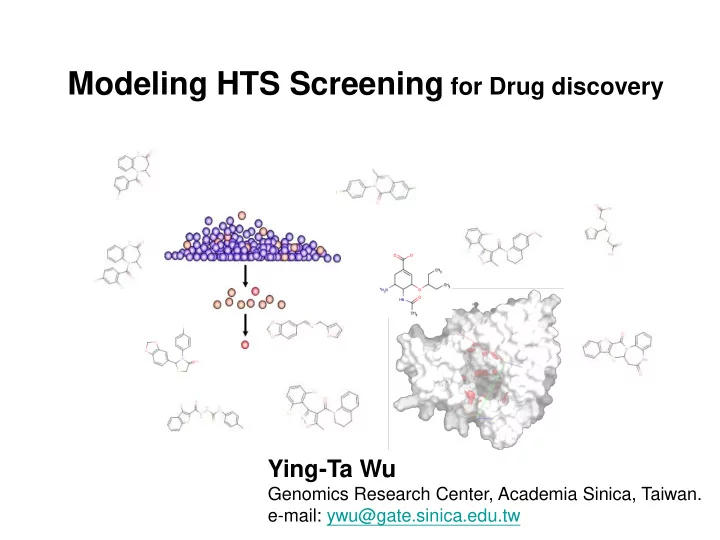
Modeling HTS Screening for Drug discovery
Ying-Ta Wu
Genomics Research Center, Academia Sinica, Taiwan. e-mail: ywu@gate.sinica.edu.tw
Outlines Drug discovery HTS Screening Computational Screening - - PowerPoint PPT Presentation
Modeling HTS Screening for Drug discovery Ying-Ta Wu Genomics Research Center, Academia Sinica, Taiwan. e-mail: ywu@gate.sinica.edu.tw Outlines Drug discovery HTS Screening Computational Screening Structure-based approach
Genomics Research Center, Academia Sinica, Taiwan. e-mail: ywu@gate.sinica.edu.tw
parasites, bacteria, viruses, …
Nature review drug discovery
G.L. Patrick An Introduction to Medicinal Chemistry, Oxford University Press, 1995
slay the dragon ! ax sword armor dagger
N N R3 O R1 R2
(structure Activity relationship)
Target Assay
N N R3 O R1 R2 NH2 O R1 R2 O O H N H2 R3 X R4
Refer to Walters et al. DDT, 3, 160-178 (1998)
Target selected Assay developed HTS HTS hits confirmed Chemistry begins Target structure obtained Development candidate is taken forward Target selected Assay developed HTS HTS hits confirmed Chemistry begins Target structure obtained Development candidate is taken forward Target selected Assay developed HTS HTS hits confirmed Chemistry begins Target structure obtained Development candidate is taken forward Target selected Assay developed HTS HTS hits confirmed Chemistry begins Target structure obtained Development candidate is taken forward
Screen Strategy
Refer to Walters et al. DDT, 3, 160-178 (1998)
Target selected Assay developed HTS HTS hits confirmed Chemistry begins Target structure obtained Development candidate is taken forward Database clustering Similarity analysis/ Virtual screening Homology modeling QSAR Pharmacophores Structure-based design/ lead optimizing 2-4 years library selecting Target selected Assay developed HTS HTS hits confirmed Chemistry begins Target structure obtained Development candidate is taken forward Database clustering Similarity analysis/ Virtual screening Homology modeling QSAR Pharmacophores Structure-based design/ lead optimizing 2-4 years library selecting Target selected Assay developed HTS HTS hits confirmed Chemistry begins Target structure obtained Development candidate is taken forward Database clustering Similarity analysis/ Virtual screening Homology modeling QSAR Pharmacophores Structure-based design/ lead optimizing 2-4 years library selecting Target selected Assay developed HTS HTS hits confirmed Chemistry begins Target structure obtained Development candidate is taken forward Database clustering Similarity analysis/ Virtual screening Homology modeling QSAR Pharmacophores Structure-based design/ lead optimizing 2-4 years library selecting
library HTS primary hits reconfirmation assay confirmed hits cluster/MCS/mode hit series
cpd 1 cpd 2 cpd 3
SAR/ADME/IP prioritized hits selected hits
cluster 2 single cluster 2 single cluster 1 cluster 3
extended hits repository substructure similarity library HTS primary hits reconfirmation assay confirmed hits cluster/MCS/mode hit series
cpd 1 cpd 2 cpd 3 cpd 1 cpd 1 cpd 2 cpd 2 cpd 3 cpd 3
SAR/ADME/IP prioritized hits selected hits
cluster 2 cluster 2 single cluster 2 single cluster 2 single cluster 1 single cluster 1 cluster 3 cluster 3
extended hits repository substructure similarity
Random Screen (> 1,000,000) Focused Screen (~10,000) Sequential Screen (5000~10,000)
may be recruited after other two screen procedures
virtual screening medicinal chemistry HTS data analysis active model new library Initial library lead opt
HD HA Z
Garrett M. Morris David S. Goodsell Ruth Huey William E. Hart Scott Halliday Rik Belew Arthur J. Olson
Morris et al. (1998), J. Computational Chemistry , 19 : 1639-1662.
Docking Engine: AutoDock 3.0.5
S N N HN H NH O HO 26a
3x10^ -10 O
S N N HN H NH O HO 26a
3x10^ -10 O
Cys-145
Glu_166
S N H N COOCH3 40 uM 10 S N H N H N JMF310 10 uM S N H N H N S N JMF311 4 uM S N H N CN JMF312 30 uM S N H N Br JMF313 16 uM S N H N CH3 JMF314 37 uM S N H N CN JMF315 21 uM
S N H N CH3 JMF316 17 uM S N H N OCH3 JMF317 18 uM
S N H N CF3 JMF318 23 uM S N H N CH3 JMF319 > 50 uM
S N H N NO2 JMF320 > 50 uM S N H N JMF321 20 uM S N H N CH3 JMF322 15 uM
S N H N OCH3 JMF323 33 uM S N H N N N N JMF309 > 50 uM
Replication cycle of Flaviviridae
http://en.wikipedia.org/wiki/Aedes Kuhn, R.J.et al. Cell 108, 717−725; 2002
Ying-Ta Wu
e-mail: ywu@gate.sinica.edu.tw
GVSS Summary
Grid-enabled Virtual Screening Service (GVSS), incorporating the docking engine of the Autodock 3.0.5, was developed on Grid Application Platform (GAP).
stability and usability.
allows submitted jobs to be split into multiple independent subtasks and run to complete.
docking parameters, monitor docking jobs and computing resources, visualize and refine docking results, and finally download the final results. GVSS hides the complexity of deploying large-scale molecular docking on Grid while provides users more flexible control over their works on Grid
docking processes on production Grids. Large-scale compound library can therefore be effectively enriched by executing docking tasks on Grid.
DIANE/AutoDock framework
jobs
– ~16 % failures related to middleware errors – ~12 % failures related to application errors
DIANE utilized ~ 95% of the healthy resources
stable throughput
Efficiency and throughput Applications: 1) Anti-Influenza: Data Challenges 2) EUAsiaGrid fight Dengue virus
Supports from Genomics Research Center, Academia Sinica, Taiwan National Science Council, Taiwan and LCG-ARDA, CERN Jakub Moscicki Massimo Lamanna
Kuhn, R.J.et al. Cell 108, 717−725; 2002 http://en.wikipedia.org/wiki/AedesNS3 protease
cleave polypeptide help virus replication
a high-level grid application framework developed by ASGC
Grid Application Platform (GAP)
Local System Agent (LSA) Virtual Queuing System (VQS)
Post-Screening Data Analysis
applications in master-worker model.
communication, and workflow management details on behalf of applications. DIANE, Distributed Analysis Environment
User Application InterfaceGRID environments
User Application InterfaceGRID environments
job reassigned a DIANE/Autodock task
– Need extra works to manage the efficient job handling and result gathering – Need efforts to handle transient network or site problems – Need application oriented GUI to hide Grid complexities from end users.
– Grid only benefit to those jobs with long computing time. – not suitable for pilot jobs (required for decision making).
storage space increases proportional to the number of compounds (N) and target proteins (M). Number of docking tasks = N x M
– difficult to apply trivial domain decomposition method in splitting the tasks
Molecular docking method is commonly used to predict potential interacting complexes of a small molecule and a target protein. Using molecular docking method for compound screening purpose, however, is restricted by the availability of computing resources. In this work, Grid Application Platform (GAP) and GAP Virtual Screening Service (GVSS) were developed to enable users to get access to the Grid technology and worldwide-scale computing resources seamlessly. Working with production e-infrastructures (such as EGEE and EUAsiaGrid), GVSS presents intensive computing power and effective data management, which provides opportunities for in-silico drug discovery on the neglected and emerging diseases, for instance, Avian Influenza and Dengue Fever. References
Autodock: Morris, G.M., et al., J. Computational Chemistry, 19, 1639-1662 (1998). GAP/GVSS: Lee, H.-C., et al., IEEE Transaction on Nanobioscience, 5, 288-295 (2006) WISDOM: Jacq, N., et al., Parallel Computing, 33, 289-301 (2007) DIANE: Moscicki, J.T., et al., Computer Physics Communications, 180, 2303-2316 (2009) AMGA: Koblitz, B., et al., J. Grid Computing, 6, 61-76 (2008)
GVSS
good load balance
Pitfalls Acknowledgements
ASGC, Taiwan His-Kai Wang Mason Hsung* Li-Yung Ho* Hurng-Chun Lee* Wei-Long Ueng Hsing-Yen Chen Eric Yen Simon Lin
Peach and Nicklaus Journal of Cheminformatics 2009, 1:6
2qwf (G20) 2qwe (GNA) 1f8b (DAN) 1f8c (4AM) 1f8e (49A) 2qwh (G39)
Applied to validate screening quality and decide the hit rate
1,5-dihydro-2H-pyrrol-2-one
Shie et al. J. AM. CHEM. SOC. 2007, 129, 11892-11893
Genomics Research Center, Academia Sinica National Science Council, Taiwan