SLIDE 1 Specker’s Proof of Infinity in NF
Sergei Tupailo Centro de Matem´ atica e Aplica¸ c˜
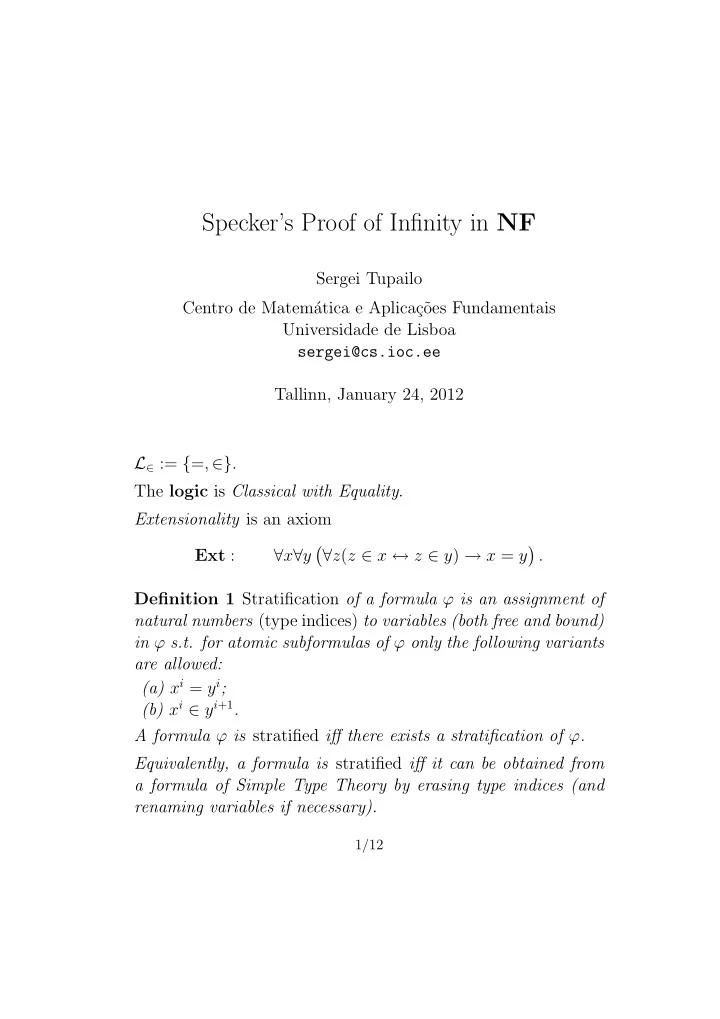
Universidade de Lisboa sergei@cs.ioc.ee Tallinn, January 24, 2012 L∈ := {=, ∈}. The logic is Classical with Equality. Extensionality is an axiom Ext : ∀x∀y
- ∀z(z ∈ x ↔ z ∈ y) → x = y
- .
Definition 1 Stratification of a formula ϕ is an assignment of natural numbers (type indices) to variables (both free and bound) in ϕ s.t. for atomic subformulas of ϕ only the following variants are allowed: (a) xi = yi; (b) xi ∈ yi+1. A formula ϕ is stratified iff there exists a stratification of ϕ. Equivalently, a formula is stratified iff it can be obtained from a formula of Simple Type Theory by erasing type indices (and renaming variables if necessary).
1/12
SLIDE 2
- Examples. The formula x ∈ y ∧ y ∈ z is stratified, but the
formula x ∈ y ∧ y ∈ x is not. Stratified Comprehension is an axiom scheme SCA : ∃y∀x
for every stratified formula ϕ with y not free in ϕ. NF := SCA + Ext. Known facts:
- Consis(NF + . . .) → Consis(ZF + . . .);
- NF ⊢ ¬AC;
- NF ⊢ Inf;
- PA ⊢ Consis(NF3);
- NF = NF4;
- Consis(NFU) ⇔ Consis(I∆0 + Exp);
- . . .
Main unknown question (since 1937):
- Consis(ZF + . . .) → Consis(NF) ?
Russell’s Paradox is not derivable in NF, for M := {x | x / ∈ x} cannot claimed to be a set. Nor any other known ”paradox” goes through. Axioms of ZF: 1908: Extensionality, Pair, Union, Infinity, Sep- aration, Powerset, 1917: Foundation, 1922: Replacement
2/12
SLIDE 3 Which ZFC axioms are provable in NF?
- Extensionality: ⊢.
- Pair: ⊢, ∀a(0) ∀b(0) ∃z(1) ∀x(0) (x ∈ z ↔ x = a ∨ x = b).
- Union: ⊢, ∀a(2) ∃z(1) ∀x(0) (x ∈ z ↔ ∃u(1)∈a x ∈ u).
- Powerset: ⊢, ∀a(1) ∃z(2) ∀x(1) (x ∈ z ↔ ∀u(0)∈x u ∈ a).
- Infinity: ⊢, very non-trivial proof, [Specker53].
- Separation: ⊢ strat., ∀a(1) ∃z(1) ∀x(0) (x ∈ z ↔ x ∈ a∧ϕ[x]) (small trick
if a ∈ FV(ϕ)). Non-strat.: Let V := {x | x = x}. Then ∃z∀x (x ∈ z ↔ x ∈ V ∧ x / ∈ x) yields Russell’s Paradox. Therefore ⊢ ¬non-strat..
∀a
- ∀x∈a ∃!yϕ[x, y] → ∃z(1) ∀y(0) (y ∈ z ↔ ∃x(∗)∈a(∗+1) ϕ[x, y])
- (the same
small trick if a ∈ FV(ϕ)). ⊢ ¬non-strat., requires work.
- Foundation: ⊢ ¬, since V ∈ V. Requires work.
- Choice: ⊢ ¬, [Specker53]. All ”reasonable” forms of AC are OK.
So, much mathematics can be developed. Much ”elementary” set theory can be developed in NF in a reasonably standard
- way. ”Later”, however, there are substantial differences.
Λ(1) := {x(0) | x = x}. Thus, ∀x x / ∈ Λ. V(1) := {x(0) | x = x}. Thus, ∀x x ∈ V.
3/12
SLIDE 4 Theorem 2 ([Specker 62])
- 1. NF is consistent iff there is a model of TNT [TST is fine]
with a type-shifting automorphism [=: tsau] σ.
- 2. NF is equiconsistent with the Theory of Types, TNTA
[TSTA is fine] with the Ambiguity scheme, Amb, ϕ ↔ ϕ+, for all sentences ϕ. [ϕ+ is the result of raising all type indices in ϕ by 1.]
- 3. When ψ is a stratified sentence, then NF+ψ is equiconsis-
tent with TNTA+ψmin. [ψmin is the minimal stratification
- f ψ.]
- Proof. See [6]. (1) If Ui, =i, ∈ii∈Z is a model of TNT with a
tsau σ, then U, =, ∈ with U := U0, x = y :⇔ x =0 y, x ∈ y :⇔ x ∈0 σ(y) is a model of NF. Conversely, if U, =, ∈ is a model of NF, then U, =, ∈i∈Z is a model of TNT with a tsau σ := id. ✷ Theorem 3 ([Grishin 69]) There is a model of NF3. Theorem 4 ([Grishin 73]) NF = NF4. Thus, Consis(NF) is equivalent to Consis(TSTA4), the Type Theory with Ambigu- ity using types 0, 1, 2 and 3 only. Equivalently, one can try to build a model for TST4, with (=, ∈)-isomorphisms between type domains... For TST3 it was done by [Grishin 73].
4/12
SLIDE 5 (Frege) natural numbers in NF 0(2) := {x(1) | ∀y(0) y / ∈ x}(2) = {Λ}. S(n(2)) := {x(1) ∪ {y(0)} | x ∈ n ∧ y / ∈ x}(2). Thus, 1 = {x ∪ {y}|x ∈ 0 ∧ y / ∈ x} = {Λ ∪ {y}|y / ∈ Λ} = {{y}}; (1) 2 = {x ∪ {y} | x ∈ 1 ∧ y / ∈ x} = {x ∪ {y} | ∃z (x = {z}) ∧ y / ∈ x} = {x ∪ {y} | ∃z (x = {z} ∧ y = z)} = {{z, y} | z = y}; (2) 3 = {{z, y, x} | z = y ∧ y = x ∧ x = z}; (3) etc. — n is ”the set of all sets with exactly n elements”. We can also define I N(3) :=
- {X(3)|0(2) ∈ X ∧ ∀n(2) (n ∈ X → S(n) ∈ X)}(4). (4)
From the Definition (4) we immediately have a Theorem (Mathematical Induction) If X ⊆ I N, 0 ∈ X and ∀n (n ∈ X → S(n) ∈ X), then X = I N. It looks like we’ve already implemented the whole of PA in NF, I N being the ”infinite” set. Is it true??
5/12
SLIDE 6
But how do we know that there are ”infinitely many” distinct elements in V (to make all natural numbers not Λ)? Have we checked all Peano axioms? Assume that V is ”small”, e.g. V ∈ 2. Then, by (2), ∃z∃y (z = y ∧ V = {z, y}). But then, by (3), 3 = {{z, y, x} | z = y ∧ y = x ∧ x = z} = Λ! Also, we have S(Λ) = {x ∪ {y} | x ∈ Λ ∧ y / ∈ x} = Λ. So, we have Λ = 3 = 4 = 5 = . . ., while 3 = Λ = 2. This situation clearly breaks injectivity of S! All of the following theorems either follow immediately from the Definitions, or are proved by Mathematical Induction. See Holmes [3, pp. 84–85]. Theorem 0 ∈ I N. Theorem If n ∈ I N, then S(n) ∈ I N. Theorem If n ∈ I N, then S(n) = 0. Theorem If n ∈ I N and n = 0, then n = S(m) for some m ∈ I N. Theorem If ∀k ∈ I N k = Λ, n, m ∈ I N and S(n) = S(m), then n = m.
6/12
SLIDE 7 Also, observe Lemma A If n = Λ for some n ∈ I N, then V ∈ m for some m ∈ I N.
- Proof. Assume that n = Λ. Since 0 = {Λ} = Λ, by Mathemat-
ical Induction ∃m ∈ I N (m = Λ ∧ S(m) = Λ). Fix such an m. Since m = Λ, ∃x0 x0 ∈ m. Fix such an x0. We also have S(m) = {x ∪ {y} | x ∈ m ∧ y / ∈ x} = Λ. This only can be if ∀y y ∈ x0. By Extensionality, then, x0 = V, yielding V ∈ m. ✷ Contrapositioning Lemma A, we obtain Lemma B If ∀m∈I N V / ∈ m, then ∀n∈I N n = Λ. Thus, in order to obtain a faithful representation of PA in NF, it remains to prove ∀m∈I N V / ∈ m (”V / ∈ Fin” in NF terminol-
- gy). In the remainder we will do it by showing that V cannot
be well-ordered.
7/12
SLIDE 8 Wiener-Kuratowski ordered pair is defined in the standard way: x, y(2) := {{x(0)}, {x(0), y(0)}}, as well as relations, functions, etc. Also, ”X is a well-ordering” is defined as usual, by a stratified formula WO(X): X is a set of ordered pairs ∧ LO(X) ∧ ∀Y ⊂dom(X)
- Y = Λ → ∃y∈Y ∀x∈Y y, x ∈ X
- .
Ordinal is a set of well-orderings s.t. btw domains of any two of them there is an order-preserving bijection. Ordinal arithmetic is developed in the standard way. There is a set Ω of all well-orderings, ordered by ≤, which is also a w.o. So, there is the greatest ordinal. (Burali-Forti paradox is avoided due to the stratification problems.) Cardinal is an equivalence class under equinumerosity (expressed by bijections). Elementary cardinal arithmetic can be developed as usual (avoiding AC). WO∗(X, Y ) :⇔ WO(Y ) ∧ dom(Y ) = X. Provable by Math. Induction: Theorem ∀n∈I N∀x∈n∃X WO∗(x, X).
8/12
SLIDE 9 BIG Theorem [Specker 53] ¬∃X WO∗(V, X). Corollary 1 ∀n∈I N V / ∈ n; ∀n∈I N n = Λ. Corollary 2 PA can be faithfully embedded in NF. Corollary 3 TST+Inf and Z∆0 can be faithfully embedded in NF. Proof (Solovay). We have to derive a contradiction in ”NF + V can be well-ordered”. By the Theorem 2.3, we will derive a contradiction in ”TNTA + V1 can be well-ordered”. Very briefly: in the context of TNT, with its facts P(Vi) = Vi+1 and Vi+1 = 2Vi, the assumption ”V1 can be well-ordered” contradicts Amb. Solovay exhibits the proof in the context of ZFC, to better communicate the main construction. In the end, everything should be done inside Type Theory (which can be done, is a lot of technical details, and was done so by [Specker 53] (inside NF)). As usual, cardinal means the least ordinal of that cardinality. Define a function G (a proper class) which maps the class OR
- f ordinals into the class of cardinals:
1) G(0) = 0; 2) G(α + 1) = 2G(α) (cardinal exponentiation); 3) if λ is a limit ordinal, then G(λ) is sup{G(α) | α < λ}. Thus G restricted to the finite ordinals is the usual ”stack of twos” function. And G(ω + α) = α.
9/12
SLIDE 10 To each cardinal κ (which could be finite or infinite), we are going to assign the Specker invariant Sp(κ) which will be an integer in the set {0, 1, 2}. Let then κ be a cardinal. Let λ be the least ordinal such that G(λ) ≥ κ. Write λ = λ1 + n where λ1 is a limit ordinal and n ∈ ω. Then Sp(κ) is the residue of n mod 3. The key fact is the following: Proposition Let κ be a cardinal. Let κ1 = 2κ and let κ2 = 2κ1. Then Sp(κ2) is unequal to Sp(κ). /- Let λ be least such that G(λ) ≥ κ. So G(λ + 1) ≥ κ1 and G(λ + 2) ≥ κ2. We claim that G(λ) < κ2. It follows that the least ordinal, λ2, such that G(λ2) ≥ κ2 is either λ + 1 or λ + 2 from which the proposition follows. In proving our claim there are three cases to consider: Case 1: λ = 0. Then G(λ) = 0 = κ < κ2. Case 2: λ is limit. From the way G is defined at limits and ∀α<λ G(α) < κ, G(λ) ≤ κ. So G(λ) = κ < κ2. Case 3: λ = β + 1 for some β. Then G(β) < κ. So G(λ) ≤ κ1 < κ2.
Compressing the definition into Type Theory: It is easy to find a sentence of the language of Type Theory that expresses ”Sp(V0) = j” (where j ∈ {0, 1, 2}). The amount of choice we need is at most ”V1 is well-orderable”. Specker’s result that AC contradicts ”typical ambiguity” now follows immediately from the proposition. Namely, in TNT + ”V1 is well-orderable” we have derived the sentence ¬
- Sp(V0) = 00 ↔ Sp(V2) = 02
- ,
10/12
SLIDE 11
contradicting Amb. ✷ ... As a result of all this, PA can be embedded in NF ... Question (asked by T. Forster, R. Holmes, M. Rathjen, . . . ) Specker’s proof very essentially uses classical logic. Does INF derive Infinity? Could Consis(INF) be easy to prove? – Unknown.
11/12
SLIDE 12 References
[1] T. Forster. Set Theory with a Universal Set, second edi-
- tion. Clarendon Press, Oxford, 1995
[2] R. Jensen. On the consistency of a slight(?) modification
- f Quine’s NF. Synthese 19, pp. 250–263, 1969
[3] R. Holmes. Elementary Set Theory with a Universal Set,
- vol. 10 of the Cahiers du Centre de logique, Academia,
Louvain-la-Neuve (Belgium), 242 p., 1998 [4] R. Solovay. Email message of 24.04.2008 [5] E. Specker. The axiom of choice in Quine’s new founda- tions for mathematical logic. Proceedings of the National Academy of Sciences of the USA 39, pp. 972–975, 1953 [6] E. Specker. Typical ambiguity. In: E. Nagel (ed.), Logic, methodology and philosophy of science, Stanford Univer- sity Press, pp. 116–123, 1962
12/12