SPECIES LISTED UNDER CITES APPENDIX II AFTER CoP 17 Decision for - - PowerPoint PPT Presentation

species listed under cites appendix ii after cop 17
SMART_READER_LITE
LIVE PREVIEW

SPECIES LISTED UNDER CITES APPENDIX II AFTER CoP 17 Decision for - - PowerPoint PPT Presentation

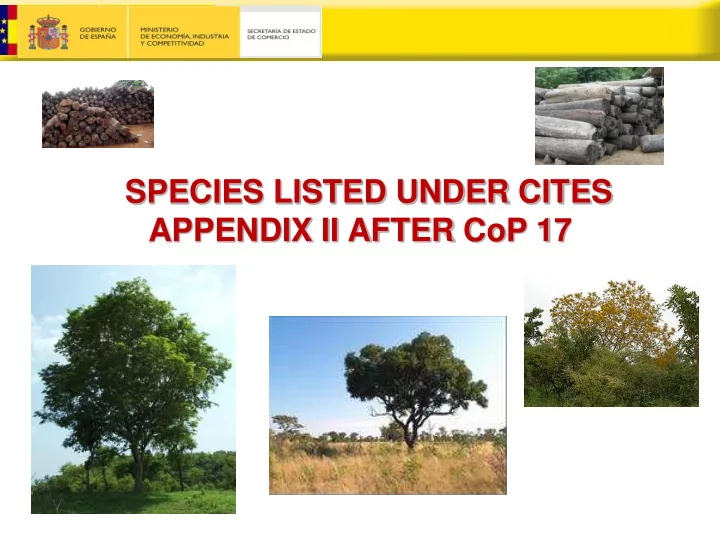
SPECIES LISTED UNDER CITES APPENDIX II AFTER CoP 17 Decision for wood species Inclusion of all Dalbergia spp in Cites Appendix II, except Brazilian Rosewood ( Dalbergia nigra ), which is in Appendix I). Inclusion of three Bubinga species


slide-1
SLIDE 1

SPECIES LISTED UNDER CITES APPENDIX II AFTER CoP 17

slide-2
SLIDE 2

Decision for wood species

  • Inclusion of all Dalbergia spp in Cites Appendix II, except

Brazilian Rosewood (Dalbergia nigra), which is in Appendix I).

  • Inclusion of three Bubinga species (Guibourtia demeusei,

Guibourtia pellegriniana y Guibourtia tessmannii) in Appendix II.

  • Inclusion of the Pterocarpus erinaceus in Appenix II.
slide-3
SLIDE 3

Annotation for Dalbergia spp and the three Guibourtia species #15: All parts and derivates are included, except:

a) Leaves, flowers, pollen, fruits and sedes (are excluded) b) No commercial exports of a máximum weight of 10 kilos (are excluded) c) Parts and derivates of Dalbergia cochinchinensis included with note # 4. d) Parts and derivates of Dalbergia spp. From Mexican origin or exported from Mexico included with note # 6.

slide-4
SLIDE 4

Aplication of the annotación for Dalbergia c) For Dalbergia cochinchinensis Annotation #4 is applied:

#4: Parts and derivates except:

a) Seeds, spores and pollen (including pollinia). b) Plant cultivation and tissues produced in vitro, in solid or liquid way, transported in sterile packaging. c) Cut flowers from plants produced artificially

d) Annotation #6 is applied for Dalbergia spp from Mexican

  • rigin

#6: Logs, Sawn wood, veneer and laminated veneer.

slide-5
SLIDE 5

Non commercial shippings

  • Article 2 Regulation (CE) 338/97
  • Trade:

The inclusion in the European Community, included the inclusion by sea, as well as export and reexport from it, and also the use, the transport and the shift of possesion inside of the EU, even the ones inside a EU member, from species subject to the provisions of the Regulation 338/97.

  • Non comercial trade is any activity whose goal can not be

consider as primarily commercial

slide-6
SLIDE 6

Procedure from the 2nd of January 2017

  • Imports of Dalbergia spp., Guibourtia demeusei, Guibourtia

pellegriniana, Guibourtia tessmannii and Pterocarpus erinaceus in the EU:

 Export permit or re-Export certificate expired by the country of

  • rigin or source country

 Import permit expired by the…. el EM  For imports in Spain:

Inspection services from SOIVRE local offices http://www.cites.es/es-ES/Paginas/contactenos.aspx

slide-7
SLIDE 7

Particular Cases

  • Goods that have come out the country of origin before the

2nd of January 2017:

– To prove properly that the shipment left before that date with the commercial attached documents.

slide-8
SLIDE 8

Stock Declaration

  • You have one calendar year to declare the stock of these species.
  • You have to declare it at your CITES office regional / provincial or at

your local SOIVRE office.(If you are in Spain).

  • You will have to present an inventory or complete declaration of your

stock stating:

– Specie (botanic name). – Number of pieces. – Volume (m3) and weight (Kg)

  • For certain items, like musical instruments , furniture or manufactures,

the quantity to declare will be done by number of pieces.

slide-9
SLIDE 9

Stock Declaration

  • This inventory will be inspected personally by your local SOIVRE office

(if you are in Spain).

  • Once inventory is done and declared, they will give you a document

with your complete inventory and one register number will be assigned to you.

  • When you apply for a CITES certificate to re-Export the wood logs, you

will have to provide the updated inventory.

  • Commercial sales inside the EU of any of the Dalbergias, Guibourtias y

Pterocarpus do not requiered a CITES certificate. You only have to document it to prove legal origin and legal purchase.

slide-10
SLIDE 10

Undeclared Inventory

  • For the inventory that has not been declared within one year, if you want to

sell it or re-Export it, you will have to document it to prove legal origin and legal purchase.

  • To document legal origin and legal purchase for the undeclared inventory:
  • Provide documentation that proves that the wood was legally purchased.
  • In case of pre-Convention wood: Provide documentation that proves the wood was

purchased before the inclusion in Cites.

  • Samples of documents
  • Copies of CITES documents/customs documents used for the import of the wood.
  • Receipt or invoice of purchases or sales.
  • Inventory Register.
slide-11
SLIDE 11

Plan of action from the EU against the Trade of Endangered Species

Ilegal arms Wildlife trafficking De 8 a 20 Billions of Euros yearly

slide-12
SLIDE 12

EU Action Plan

  • Approved the 26th of February 2016
  • It is an initiative that came out because of the increase of

illegal wildlife trade which is approximately from 8 to 20 billions annually.

  • Many species are affected by the illegal trading, for

example shark, big apes, big felines, pangolins, coral, turtle, lizards, cactuses, orchids, reptile skins, tropical timbers and other woods.

slide-13
SLIDE 13

Impact of the illegal wildlife trade

  • Damaging effects on the economy.
  • Negative impact on security issues.

Financing of militia groups recognized by the United Nations Security Council. Links with terrorism recognized by the G7 leaders.

slide-14
SLIDE 14

EU Action Plan

  • EU is an important market of legal wildlife products.
  • The total trade of wildlife products of UE (incluiding

wood, fishes, animals and wild plants) is estimated around 100.000 millions of Euros.

  • EU represents almost the 20% of the global wood market
slide-15
SLIDE 15

The objective of the EU action plan

  • To establish the illegal trade of wildlife as a priority on the

politic agenda of the EU and its EM.

  • To fulfill important commitments against the wildlife trade

with terms and follow-up mechanisms.

  • Strengthening action at the EU against the illegal trade of

wildlife inside of the EU and worldwide.

slide-16
SLIDE 16

Priorities of the EU action plan

  • Limit ivory trade.
  • Deal with the corporate sector involved with wildlife

trade.

  • Fighting against corruption of the wildfile illegal trade