Special Report 8/2016 Rail freight transport in the EU: still not - - PowerPoint PPT Presentation

special report 8 2016 rail freight transport in the eu
SMART_READER_LITE
LIVE PREVIEW

Special Report 8/2016 Rail freight transport in the EU: still not - - PowerPoint PPT Presentation

7 December 2016 Special Report 8/2016 Rail freight transport in the EU: still not on the right track Table of contents Why the subject matters The questions we asked What we found What we recommend Other Special Reports and


slide-1
SLIDE 1

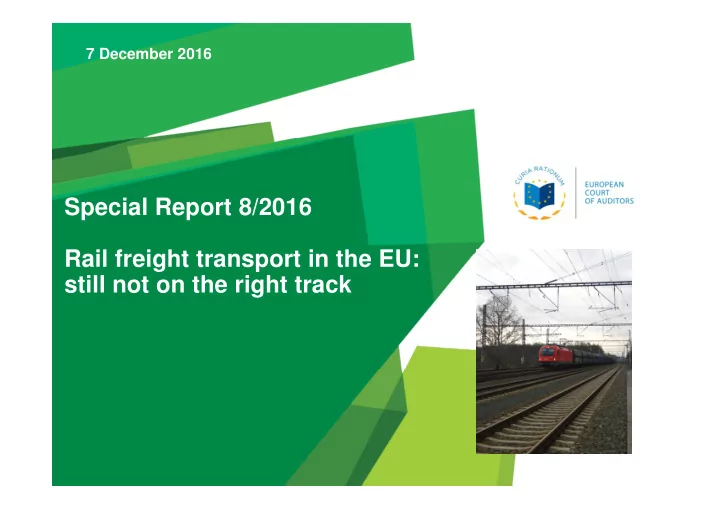
Special Report 8/2016 Rail freight transport in the EU: still not on the right track

7 December 2016

slide-2
SLIDE 2

Table of contents

Why the subject matters The questions we asked What we found What we recommend Other Special Reports and Opinion

Page 2

slide-3
SLIDE 3

Why the subject matters (1/2)

Source: ECA based on European Environment Agency 2012 data for the EU

Page 3

slide-4
SLIDE 4

Why the subject matters (2/2)

The mobility of goods is essential for the EU internal market, growth and jobs creation BUT can have negative impacts on environment and quality of life of EU citizens Increasing rail freight would contribute to reducing pollution and congestion: Shifting freight from road to rail is an EU transport policy objective Funding for rail infrastructure: €28bn allocated during the period 2007-2013

Page 4

slide-5
SLIDE 5

Page 5

The questions we asked

Are EU actions effective in enhancing rail freight transport?

  • Has the performance improved since 2000?
  • Strategic and regulatory framework?
  • EU funds properly targeted?

Five Member States: Spain, France, Germany, Czech Republic and Poland 18 rail infrastructure projects selected accounting for a total EU contribution of €2bn

slide-6
SLIDE 6

What we found

Rail freight transport performance (1/2)

The performance of rail freight transport remains unsatisfactory overall: the objective of shifting goods from road to rail not reached Road remains the leading mode of freight transport in the EU Poor performance of rail freight transport not helped by low speed of trains

Page 6

slide-7
SLIDE 7

Rail freight transport performance (2/2)

BUT, some Member States have managed to increase the proportion of goods transported by rail, including one

  • f the Member States we visited - Germany, due to:

its central location and high level of industry the early liberalisation of its rail freight market the introduction of a road toll for heavy vehicles its relatively strong and independent regulatory body

Page 7

slide-8
SLIDE 8
  • Many strategic and regulatory factors prevent rail

freight from being more competitive Some efforts by the Commission, BUT: A single European railway area is still far from being achieved – system of 26 separate national networks, interoperability issues (ERTMS) Uneven progress of rail freight market liberalisation in Member States – still significant market share of incumbent freight operators

Page 8

Strategic and regulatory framework (1/2)

slide-9
SLIDE 9

Traffic management procedures are not adapted to rail freight needs (path allocation) Unlike rail, road infrastructure is not always subject to charges for every kilometre used Administrative and technical constraints hamper the competitiveness of rail freight (4th railway package) Lack of transparency on the performance of the sector has not stimulated improvements in customer service

Page 9

Strategic and regulatory framework (2/2)

slide-10
SLIDE 10
  • EU funding has not properly targeted the needs of

the rail freight sector: Overall more EU funds were allocated to roads than to rail… …when allocated to rail, EU funds did not specifically target rail freight needs Co-financed projects: outputs delivered, but no general improvement in rail freight performance Poor maintenance of lines used mainly by freight trains affects performance of EU-funded infrastructure

Page 10

EU financial support

slide-11
SLIDE 11

What we recommend (1/3)

EC and the MS should make the rail freight more competitive and attractive by:

Addressing the strategic and regulatory issues (Recommendations 1 to 5) 1: Ensure that national regulatory bodies have the power and independence they need, in particular to prevent anti-competitive practices 2: Adapt the traffic management rules to the needs of the rail freight sector

Page 11

slide-12
SLIDE 12

What we recommend (2/3)

3: Simplify and harmonise procedures for vehicle approval and for safety certificates, and simplify the language requirements for train drivers 4: Monitor progress and evaluate user satisfaction to promote good quality service 5: Promote a level playing field between the different methods of transport

Page 12

slide-13
SLIDE 13

What we recommend (3/3)

Better targeting the available EU funding (Recommendations 6 to 8) 6: Allocate EU funding in line with EU transport policy objectives and monitor how much EU funding is actually invested into rail freight 7: Improve the coordination of rail investments to maximise their effectiveness and avoid development in a piecemeal fashion 8: Ensure proper maintenance of the rail network, in particular rail freight corridors

Page 13

slide-14
SLIDE 14

Other Special Reports and Opinion (1/2)

SR 31/2016 Spending at least one euro in every five from the EU budget on climate action: ambitious work underway, but at serious risk of falling short SR 23/2016 Maritime transport in the EU: in troubled waters - much ineffective and unsustainable investment SR 1/2015 Inland Waterway Transport in Europe: No significant improvements in modal share and navigability conditions since 2001 SR 21/2014 EU-funded airport infrastructures: poor value for money

Page 14

slide-15
SLIDE 15

Other Special Reports and Opinion (2/2)

SR 1/2014 Effectiveness of EU-supported public urban transport projects SR 5/2013 Are EU Cohesion Policy funds well spent on roads? SR 1/2013 Have the Marco Polo programmes been effective in shifting traffic off the road? Opinion 2/2016 EFSI: an early proposal to extend and expand

Page 15

slide-16
SLIDE 16

Thank you