Special Relativity Jan is a railway worker working for South African - - PDF document

special relativity
SMART_READER_LITE
LIVE PREVIEW

Special Relativity Jan is a railway worker working for South African - - PDF document

12/17/19 Test your understanding of simultaneity Te Special Relativity Jan is a railway worker working for South African Railways. He has ingeniously synchronised the clocks on all South Africas Presentation to UCT Summer School January 2020


slide-1
SLIDE 1

12/17/19 1 Special Relativity

Presentation to UCT Summer School January 2020 (Part 2 of 3)

By Rob Louw roblouw47@gmail.com

1

1 Te Test your understanding of simultaneity

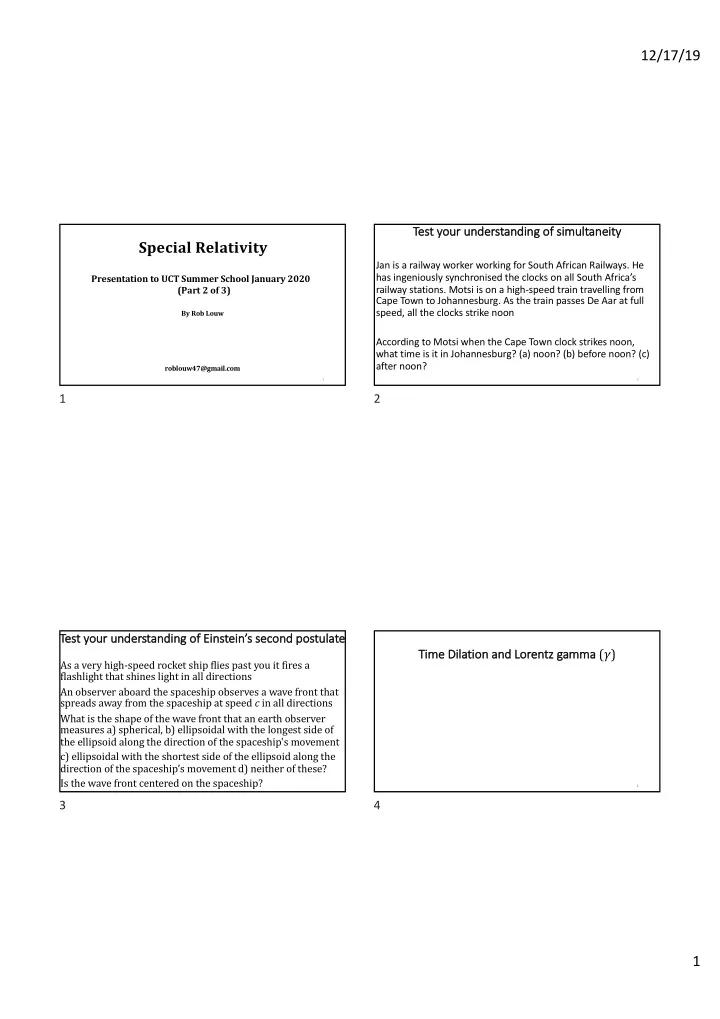
Jan is a railway worker working for South African Railways. He has ingeniously synchronised the clocks on all South Africa’s railway stations. Motsi is on a high-speed train travelling from Cape Town to Johannesburg. As the train passes De Aar at full speed, all the clocks strike noon According to Motsi when the Cape Town clock strikes noon, what time is it in Johannesburg? (a) noon? (b) before noon? (c) after noon?

2

2 Te Test your understanding of Einstein’s second postulate

As a very high-speed rocket ship flies past you it fires a flashlight that shines light in all directions An observer aboard the spaceship observes a wave front that spreads away from the spaceship at speed c in all directions What is the shape of the wave front that an earth observer measures a) spherical, b) ellipsoidal with the longest side of the ellipsoid along the direction of the spaceship's movement c) ellipsoidal with the shortest side of the ellipsoid along the direction of the spaceship’s movement d) neither of these? Is the wave front centered on the spaceship?

3 Ti Time e Dilation and Loren entz gamma (𝛿)

4

4

slide-2
SLIDE 2

12/17/19 2

5

In order to gain a better understanding of what is happening, we clearly need to derive a quantitative relationship that allows us to compare time intervals in different frames of reference This will be done using another thought experiment

5 Ti Time e Dilation Th Though ght Ex Exper erimen ent

The objective of the experiment is to demonstrate: That observers measure any clock to run slow if it moves relative to them and as the relative speed approaches the speed of light, the moving clock’s change in time tends to zero

6

6

7

Imagine we have a train moving close to the speed of light along a straight stretch of railway track Sarah, sitting in a coach, is riding in frame S’ where she measures the time interval between two events that occur at the same point in space (a) on her ‘light clock’ between two events that occur at the same point in space (a)

7

8

Peter Sarah Sarah Reference frame S’

8

slide-3
SLIDE 3

12/17/19 3

9

Sarah Mirror Light source d S’ O’ (Event 1 occurs here)

9

10

Sarah Mirror Light source d S’ O’ (Event 2 also occurs here)

10

11

Sarah d Sarah measures a round trip time of ∆t0 for the light beam O’ (Events 1 and 2 occur here) Mirror Light source S’

11

12

The light beam travels a total distance of 2d in a time of ∆t0 and since the speed of light = c, d = c∆t0/2 Sarah Mirror Light source d O’ (Events 1 and 2 occur here) S’ Sarah measures a round trip time of ∆t0 for the light beam

12

slide-4
SLIDE 4

12/17/19 4

13

Sarah Source moves from here to here Event 1 occurs here

Peter who is stationary observes the same light pulse following a diagonal path

13

14

Sarah Source moves from here to here Event 1 occurs here Event 2 occurs here

14

15

Peter measures the round-trip time to be ∆t Sarah Source moves from here to here Event 1 occurs here Event 2 occurs here

15

16

Peter measures the round-trip time to be ∆t Sarah Source moves from here to here (Distance travelled) Event 1 occurs here Event 2 occurs here

16

slide-5
SLIDE 5

12/17/19 5

17

Peter measures the round-trip time to be ∆t Sarah Source moves from here to here (Distance travelled) The round-trip distance for the light beam in reference frame S is 2ℓ Event 1 occurs here Event 2 occurs here

17 Py Pythagorean theorem

18

The Pythagorean theorem states that for a right-angle triangle, the square of the hypotenuse (c) is equal to the sum

  • f the squares of the remaining two shorter perpendicular

sides (a & b) a b c Thus c2 = a2 + b2 ∴ c = 𝑏$ + 𝑐$

18

d

19

Peter Sarah

19

u∆t/2 d

20

Peter Sarah

20

slide-6
SLIDE 6

12/17/19 6

Using the Pythagorean theorem we can calculate ℓ ℓ = 𝑒$ + (𝑣∆t/2)$ The speed of light is the same for both observers so the round-trip time measured in S is ∆t where ∆t = 2ℓ/c = 2/c 𝑒$ + (𝑣∆t/2)$

21

21

We would like to have a relationship between ∆t and ∆t0 that is independent of d (but is dependent on u and c) Remembering that d = 𝑑∆t0/2, then by substitution we get ∆t = 2/c (𝑑∆t0/2)$+(𝑣∆t/2)$ Squaring this equation and then solving for ∆t we finally get ∆t = ∆t0 / 1 − 𝑣$/𝑑2

22

22

Since the quantity 1 − 𝑣$/𝑑2 is less than 1, ∆t is always greater than ∆t0 Thus Peter measures a longer round-trip time for the light pulse than does Sarah The quantity 1/ 1 − 𝑣$/𝑑2 appears so often in relativity that it has its own symbol 𝛿 and is referred to as Lorentz gamma 𝛿 = 1/ 1 − 𝑣$/𝑑2 Lorentz gamma factor

23

23

Note that 𝛿 is always ≥ 1 and 1/𝛿 is always ≤ 1 ! If 𝛿 appears in the numerator of any relativistic equation, it will tend towards infinity as velocity, approaches c Conversely if 𝛿 appears in the denominator of any relativistic equation, it will tend towards zero as velocity, u approaches c

24

24

slide-7
SLIDE 7

12/17/19 7

∆t0 is called the proper time and is equal to the time interval between two events that occur at the same position Only one inertial frame (S’) measures the proper time and it does so with a single clock that is present at both events An inertial reference frame moving with velocity u relative to the proper time frame must use two clocks to measure the time interval: One at the position of the first event and one at the position of the second event By rearranging our earlier equations, the time interval in the frame where two clocks are required is as follows

25

25

∆t = ∆t0 / 1 − 𝑣$/𝑑2 = 𝛿 ∆t0 and thus ∆t ≥ ∆t0 The stretching out of time of the time interval is called time dilation The equation Above tells two things: Firstly, if it were possible to travel faster than the speed of light then 1 – u2/c2 would be negative and 1 − 𝑣$/𝑑2 would be an imaginary number. We don’t have imaginary time! Secondly, a time dilation plot of ∆t/∆t0 as a function of relative velocity, u will tend to infinity as u approaches c (or in other words as u/c approaches one) This is illustrated graphically in the following slide

26

26

1 2 3 4 5 6 7 8 0.1 0.2 0.3 0.4 0.5 0.6 0.7 0.8 0.9 1

∆t/∆t0 = 𝜹 = 1/√(1− u2/c2) Speed u relative to the speed of light (u/c)

Ti Time e dilation

  • n

As u approaches c, 𝜹 approaches infinity

∆t/∆t0 = 𝛿

27

27

sometimes described by saying that moving clocks run slow. This must be interpreted carefully Time dilation is sometimes described by saying that moving clocks run slow. This must be interpreted carefully The whole point of relativity is that all inertial frames are equally valid so there is no absolute sense in which a clock is moving or at rest

28

28

slide-8
SLIDE 8

12/17/19 8

29

To illustrate this point, this image shows two firecracker explosions i.e. two events that occur at different positions in the ground frame Assistants on the ground need two clocks to measure the time interval ∆t In the train reference frame however a single clock is present at both events, hence the time interval measured in the train reference is the proper time ∆t0

29

30

In this sense the moving clock (the

  • ne that is present at both events)

‘runs slower’ than the the clocks that are stationary with respect to both events More generally, the time interval between two events is smallest in the reference frame in which the two events occur at the same position

30

In deriving the time dilation equation we made use of a light clock which made our analysis clear and easy The conclusion is about time itself Any clock, regardless of how it operates (e.g. a grandfather clock, a wind-up wristwatch, digital watch, alarm clock or a super accurate quartz clock) behaves in the same way!

31

31 Fa Faster than the speed of light? 32

slide-9
SLIDE 9

12/17/19 9

Space is expanding faster than the speed of light. This is because spacetime itself is expanding and is denying us the

  • pportunity to see further than 14 billion light years

In water, muons can travel faster then the speed of light. This is known as Cherenkov light which has a distinct blue hue. It can be observed in nuclear reactors. Although this is true nothing can travel faster than the speed of light in a vacuum Neutrinos from super nova explosions arrive at earth before photons do. This is because the photons take a significant amount of time to escape from the exploding star while neutrinos (with near zero mass)escape unhindered We are constantly moving through spacetime at the speed of light in a vacuum. We either experience space or time or a mixture of both

33

33

Hubble ultra deep field image Galaxies as old as 13 billion years are visible

34

34

35

An example of Cherenkov radiation inside a nuclear reactor where muons (heavy electrons) travel faster than photons of light in water

35

Space is expanding faster than the speed of light. This is because spacetime itself is expanding and is denying us the

  • pportunity to see further than 14 billion light years

In water, muons can travel faster than the speed of light. This is known as Cherenkov light which has a distinct blue hue. It can be observed in nuclear reactors. Although this is true, nothing can travel faster than the speed of light in a vacuum Neutrinos from super nova explosions arrive at earth before photons do. This is because the photons take a significant amount of time to escape from the exploding star while neutrinos (with near zero mass)escape unhindered We are constantly moving through spacetime at the speed of light in a vacuum. We either experience space or time or a mixture of both

36

36

slide-10
SLIDE 10

12/17/19 10

Ti Time e Dilation in nature

37

37

38

Image of an exploding supernova in a distant

  • galaxy. Its brightness

decays at a certain rate but because it is moving away from us at a substantial fraction of the speed of light, it decays more slowly as seen from earth. The super nova is a ‘moving clock that runs slow.’

38

High energy cosmic ray protons entering our upper atmosphere interact with the nuclei of N2 and O2 generating pions which then decay into muons (heavy electrons) which move off at a speed of 0.994c The half life of a muon is 2.2 microseconds After 660 meters half the muons would have decayed but at a speed of 0.994c the half life is 20 microseconds About 25% of the muons created reach the ground If there was no time dilation only 1/220 muons would reach the earth

39

39 Wh Why don’t we experience time dilation in our ev everyday lives?

40

40

slide-11
SLIDE 11

12/17/19 11

The sun with the earth in tow is travelling around the milky way at a speed of 217 261 m/s At this speed 𝜹 for the earth is only 1.000 000 3 as it moves around the centre of our galaxy At such a low value of 𝜹, the surface of the earth is to all intents and purposes an inertial reference frame A high velocity rifle bullet has a 𝜹 of only 1.000 000 000 001 When bloodhound finally reaches its target speed of 1000 mph, its 𝜹 will only be 1.000 000 000 000 6

41

41 Ti Time e Dilation in Practice

42

42

43

Cathode ray tube in which electrons reach 30% of the speed of light

43

44

44

slide-12
SLIDE 12

12/17/19 12

Le Length th contr tracti ction 47 Re Relativity of length

48

We also need to derive a quantitative relationship between lengths in different coordinate systems (i.e. different reference frames) using another thought experiment Once again, we have a train travelling near to the speed of light along a stretch of straight railway track Sarah is travelling in the carriage in reference frame S’ Next to her on the seat is a ruler, a light source and a mirror as illustrated

48

49

Sarah

49

50

Sarah Peter

50

slide-13
SLIDE 13

12/17/19 13

By using logic like the derivation of time dilation we get In special relativity a length ℓ0 measured in the frame in which the body is at rest is called a proper length Lengths measured perpendicular to the direction of travel are not contracted (the velocity in the y and z direction is zero)

55

ℓ = ℓ0 /𝛿 Length contraction formula

55

Rearranging the previous equation we get What this tells us is that observers measure any ruler to contract in length if it moves relative to them To the traveler her ruler will continue to show the proper length ℓ0 as she is at rest in her reference frame What the equation also tells us is that as a traveler approaches the speed of light her ruler will contract to zero as observed by a stationary observer as shown in the next slide

56

ℓ/ℓ0 = 1/𝛿

56

0.1 0.2 0.3 0.4 0.5 0.6 0.7 0.8 0.9 1 0.1 0.2 0.3 0.4 0.5 0.6 0.7 0.8 0.9 1

𝓶/𝓶0 = 1/𝛅 = √(1− u2/c2) Speed u relative to the speed of light c (u/c)

Le Length contract ction

As u approaches c, 1/𝛅 approaches zero

ℓ/ℓ0 = 1/𝛿

57

57

Tarring roads reduces the distance! An advert seen in Johannesburg international airport

58

slide-14
SLIDE 14

12/17/19 14

Length th con

  • ntr

traction action of

  • f a

a cu cube as as it it wou

  • uld

ld ap appear ar at t var ariou ious s rela lativ tive velocitie locities

Measured length Visual Appearance 0.0 c 0.5 c 0.99 c Measured length Visual Appearance Measured length Visual Appearance

59 Le Length th Contr tracti ction in Practi ctice ce

60

60

61

Electrons reach a speed of just 1 cm/s less than c in the 3 km beam line of the SLAC national accelerator As measured by the electron the beam line which stretches from the top towards the bottom of the photo is only 15cm long!

61 Ex Expe perimental pr proof of time di dilation n and nd le length contractio ion 62

slide-15
SLIDE 15

12/17/19 15

Ricard Feynman once said that no matter how beautiful your theory, no matter how clever you are or what your name is, if it disagrees with experiment, it’s wrong! Let's see if this applies to time dilation and length contraction A muon (heavy electron) has a half life of 2.2 microseconds when at rest Scientists have accelerated a beam of muons circulating around a 14m diameter ring to 99.94% of the speed of light at the AGS Synchrotron in New York Without time dilation the muons would only last for 15 laps

  • f the ring

In practice they lasted for 400 laps!

63

63

This means that their lifetime had been increased by a factor

  • f 29 to just over 60 microseconds

This result agrees exactly with theory (𝛿 = 29) If you joined the muon you would of course circulate the ring 400 times as well The problem here is that your watch would only measure 2.2 microseconds because you would be standing still in the muon’s reference frame

64

64

You could not circulate the ring 400 times in 2.2 microseconds! The circumference of the ring must have shrunk from the viewpoint of the muon The length of the of the ring as determined by the muon shrinks by the same amount that the muon’s life increases (29 times) Both space and time have become malleable! The effects are real!

65

65 Re Relativistic paradox

  • xes

66

slide-16
SLIDE 16

12/17/19 16

Given a pair of twins where one travels into space at near the speed of light for say ten years, when the travelling twin returns can they still be the same age? A train travelling near the speed of light approaches a tunnel which measures 80% of its length when they are stationery relative to each other. Can the train fit into the tunnel? To answer these questions we need to use two important relativistic equations called the Lorentz transforms named after the Dutch physicist Hendrik Lorentz who developed them The Lorentz transforms are also required to resolve simultaneity issues and are the most useful set of equations used in relativistic problem solving

67

67 Lo Lorentz tz coordinate tr transformati tions 68

When an event occurs at point (x, y, z) at time t as

  • bserved in a frame of

reference S, what are the coordinates (x’, y’, z’) and time t’ of the event as

  • bserved in a second

frame S’ moving relative to S with a velocity of u in the + x direction?

69

69

Without performing a detailed derivation, the transformation

  • f an event with spacetime coordinates x, y, z and t in frame S

and x’, y’, z’ and t’ in frame S’ is done by via the following Lorentz coordinate transformations x’ = 𝛿 (x-ut) Lorentz coordinate transformations t’ = 𝛿 (t-ux/c2) y’ = y and z’ = z since they are perpendicular to x

70

70

slide-17
SLIDE 17

12/17/19 17

Space and time have become intertwined and we can no longer say that length and time have absolute meanings independent of the frame of reference Time and the three dimensions of space collectively form a four-dimensional entity called spacetime and we call x, y, z and t together the spacetime coordinates of an event Using the Lorentz coordinate transformations we can derive a set of Lorentz velocity transformations The result (without derivation) is shown in the next slide

71

71 Te Test your understanding of time dilation

Peter, who is standing on the ground, starts his stopwatch the moment that Sarah flies overhead in a spaceship at a speed of 0.6c At the same instant Sarah starts her stopwatch As measured in Peter’s frame of reference, what is the reading

  • n Sarah’s stopwatch at the instant peter’s stopwatch reads

10s? a) 10s, b) less than 10s or c) more than 10s? As measured in Sarah’s frame of reference, what is the reading

  • n Peter’s stopwatch at the instant that Sarah’s stopwatch

reads 10s? a) 10s, b) less than 10s or c) more than 10s? Whose stopwatch is reading proper time in the above two examples?

72 Te Test your understanding of length contraction

A 10m long spaceship flies past you horizontally at 0.99c At a certain instant you observe that that the nose and tail of the spaceship align exactly with the two ends of a meter stick that you hold in your hand Rank the following distances in order from longest to shortest: a) the rest length of the spaceship, b) the proper length of the meter stick, c) the proper length of the spaceship d) the length of the spaceship measured in your reference frame e) the length of the meter stick measured in the spaceship’s frame of reference?

73 74