Special Relativity Peter, who is standing on the ground, starts his - - PDF document

special relativity
SMART_READER_LITE
LIVE PREVIEW

Special Relativity Peter, who is standing on the ground, starts his - - PDF document

12/17/19 Te Test your understanding of time dilation Special Relativity Peter, who is standing on the ground, starts his stopwatch the moment that Sarah flies overhead in a spaceship at a speed of 0.6c Presentation to UCT Summer School January


slide-1
SLIDE 1

12/17/19 1 Special Relativity

Presentation to UCT Summer School January 2020 (Part 3 of 3)

By Rob Louw roblouw47@gmail.com

1

1 Te Test your understanding of time dilation

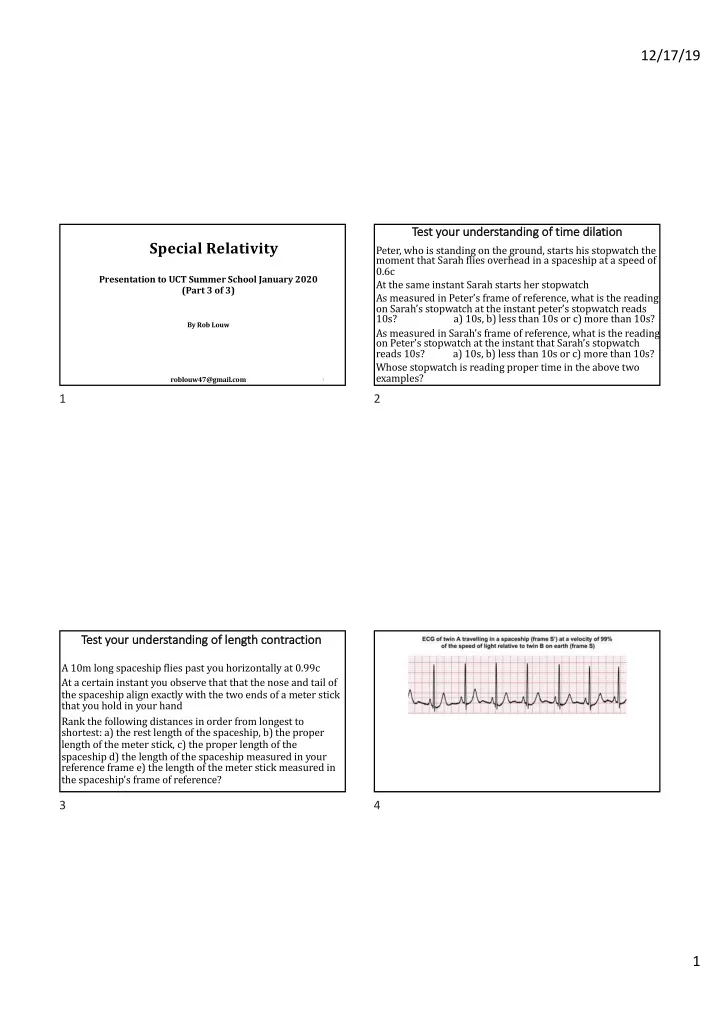
Peter, who is standing on the ground, starts his stopwatch the moment that Sarah flies overhead in a spaceship at a speed of 0.6c At the same instant Sarah starts her stopwatch As measured in Peter’s frame of reference, what is the reading

  • n Sarah’s stopwatch at the instant peter’s stopwatch reads

10s? a) 10s, b) less than 10s or c) more than 10s? As measured in Sarah’s frame of reference, what is the reading

  • n Peter’s stopwatch at the instant that Sarah’s stopwatch

reads 10s? a) 10s, b) less than 10s or c) more than 10s? Whose stopwatch is reading proper time in the above two examples?

2 Te Test your understanding of length contraction

A 10m long spaceship flies past you horizontally at 0.99c At a certain instant you observe that that the nose and tail of the spaceship align exactly with the two ends of a meter stick that you hold in your hand Rank the following distances in order from longest to shortest: a) the rest length of the spaceship, b) the proper length of the meter stick, c) the proper length of the spaceship d) the length of the spaceship measured in your reference frame e) the length of the meter stick measured in the spaceship’s frame of reference?

3 4

slide-2
SLIDE 2

12/17/19 2

5

As we saw yesterday, space and time have become intertwined and we can no longer say that length and time have absolute meanings independent of the frame of reference Time and the three dimensions of space collectively for a four-dimensional entity called spacetime and we call x,y,z and t together the spacetime coordinates of an event Using the Lorentz coordinate transformations we can derive a set of Lorentz velocity transformations The result (without derivation) is shown in the next slide6

6

In the extreme case where vx = c we get vx’ = (c-u)/(1-uc/c2) = c(1-u/c)/(1-u/c) = c This means that anything moving at c measured in S is also travelling at c when measured in S’ despite the relative motion of the two frames

7

vx’ = (vx – u)/(1- uvx/c2) Lorentz velocity transformation

7

The Lorentz velocity transformation shows that a body with a speed less than c in one frame of reference always has a speed less than c in every other frame of reference This is one reason for concluding that no material body may travel with a speed greater than or equal to the speed of light in a vacuum, relative to any inertial reference frame

10

10

slide-3
SLIDE 3

12/17/19 3

Let's consider an example of the velocity limit which any

  • bserver can reach relative to some other observer

If we had a set of five spaceships stacked like Russian dolls where each ship could launch the remaining ships at a velocity equal to the relative velocity of the launching ship as

  • bserved from earth what relative velocities could the

various ships achieve relative to the earth observer? The following slide shows the velocity profiles of the five spaceships relative to an earth observer

11

11

0 .1 0 .2 0 .3 0 .4 0 .5 0 .6 0 .7 0 .8 0 .9 1 0 .1 0 .2 0 .3 0 .4 0 .5 0 .6 0 .7 0 .8 0 .9 1

Rocket speeds relative to speed of light c as as observed on earth Rocket speeds relative to speed of light c observed by successive ship

  • bservers when u=v

Re Relative rocket ship speeds

Mot her sh ip Ro cket 1 Ro cket 2 Ro cket 3 Ro cket 4 Ro cket 5

12

12

0 .1 0 .2 0 .3 0 .4 0 .5 0 .6 0 .7 0 .8 0 .9 1 0 .1 0 .2 0 .3 0 .4 0 .5 0 .6 0 .7 0 .8 0 .9 1

Rocket speeds relative to speed of light c as as observed on earth Rocket speeds relative to speed of light c observed by successive ship

  • bservers when u=v

Re Relative rocket ship speeds

Mot her sh ip Ro cket 1 Ro cket 2 Ro cket 3 Ro cket 4 Ro cket 5

13

13

0 .1 0 .2 0 .3 0 .4 0 .5 0 .6 0 .7 0 .8 0 .9 1 0 .1 0 .2 0 .3 0 .4 0 .5 0 .6 0 .7 0 .8 0 .9 1

Rocket speeds relative to speed of light c as as observed on earth Rocket speeds relative to speed of light c observed by successive ship

  • bservers when u=v

Re Relative rocket ship speeds

Mot her sh ip Ro cket 1 Ro cket 2 Ro cket 3 Ro cket 4 Ro cket 5

14

14

slide-4
SLIDE 4

12/17/19 4

0 .1 0 .2 0 .3 0 .4 0 .5 0 .6 0 .7 0 .8 0 .9 1 0 .1 0 .2 0 .3 0 .4 0 .5 0 .6 0 .7 0 .8 0 .9 1

Rocket speeds relative to speed of light c as as observed on earth Rocket speeds relative to speed of light c observed by successive ship

  • bservers when u=v

Re Relative rocket ship speeds

Mot her sh ip Ro cket 1 Ro cket 2 Ro cket 3 Ro cket 4 Ro cket 5

15

15

0 .1 0 .2 0 .3 0 .4 0 .5 0 .6 0 .7 0 .8 0 .9 1 0 .1 0 .2 0 .3 0 .4 0 .5 0 .6 0 .7 0 .8 0 .9 1

Rocket speeds relative to speed of light c as as observed on earth Rocket speeds relative to speed of light c observed by successive ship

  • bservers when u=v

Re Relative rocket ship speeds

Mot her sh ip Ro cket 1 Ro cket 2 Ro cket 3 Ro cket 4 Ro cket 5

16

16

0 .1 0 .2 0 .3 0 .4 0 .5 0 .6 0 .7 0 .8 0 .9 1 0 .1 0 .2 0 .3 0 .4 0 .5 0 .6 0 .7 0 .8 0 .9 1

Rocket speeds relative to speed of light c as as observed on earth Rocket speeds relative to speed of light c observed by successive ship

  • bservers when u=v

Re Relative rocket ship speeds

Mot her sh ip Ro cket 1 Ro cket 2 Ro cket 3 Ro cket 4 Ro cket 5

17

17

0 .1 0 .2 0 .3 0 .4 0 .5 0 .6 0 .7 0 .8 0 .9 1 0 .1 0 .2 0 .3 0 .4 0 .5 0 .6 0 .7 0 .8 0 .9 1

Rocket speeds relative to speed of light c as as observed on earth Rocket speeds relative to speed of light c observed by successive ship

  • bservers when u=v

Re Relative rocket ship speeds

Mot her sh ip Ro cket 1 Ro cket 2 Ro cket 3 Ro cket 4 Ro cket 5

No matter how many successive rockets are launched their velocity will never exceed c !

18

18

slide-5
SLIDE 5

12/17/19 5

Re Relativistic kinematics and the Doppler ef effect for electromagnetic wave ves

33

Here we go with another thought experiment involving the use of a high-speed train A source of light is moving towards Stanley with constant speed u who is in a stationery inertial reference frame S The source emits light emits light waves of frequency f0 as Measured in its rest frame Stanley receives light waves of frequency f as shown below

34

34

36

36

Here we go with another thought experiment involving the use of a high-speed train A source of light is moving towards Stanley with constant speed u who is in a stationery inertial reference frame S The source emits light waves of frequency f0 as measured in its rest frame Stanley receives light waves of frequency f as shown in the next slide

37

37

slide-6
SLIDE 6

12/17/19 6

With an electromagnetic source approaching an observer, the relativistic blue shift Doppler formula can be derived using the appropriate Lorentz transforms and is

39

The doppler blue shift equation indicates that f increases i.e. the wavelength gets shorter (bluer) as u approaches the speed of light c f = (𝐝 + 𝐯)/(𝐝 − 𝐯) f0 Doppler formula (blue shift)

39

40

With light, unlike sound, there is no distinction between motion of source and motion of observer, only the relative velocity of the two is significant The following slide illustrates the Doppler blue shift effect

40

2 4 6 8 1 0 1 2 1 4 1 6 1 8 2 0 0 .1 0 .2 0 .3 0 .4 0 .5 0 .6 0 .7 0 .8 0 .9 1

42

Speed v relative to the speed of light c (v/c) f/f0 = (𝒅 + 𝒗)/(𝒅 − 𝒗)

Do Doppl ppler effect- so source e ap approac aching obser server er

As the source velocity - u approaches the speed of light, f/f0 approaches infinity (BLUE SHIFT)

f/f0

42

With electromagnetic waves moving away from an observer, the relativistic red shift Doppler formula can be derived using the appropriate Lorentz transforms The doppler red shift equation indicates that f decrease i.e. the wavelength gets longer (redder) as u approaches the speed of light c

43

f = (𝐝 − 𝐯)/(𝐝 + 𝐯) f0 Doppler formula (red shift)

43

slide-7
SLIDE 7

12/17/19 7

Note that in deriving the Doppler equations, 𝛿 has cancelled

  • ut

The Doppler red shift effect is shown in the next few slides

44

44

0 .1 0 .2 0 .3 0 .4 0 .5 0 .6 0 .7 0 .8 0 .9 1 0 .1 0 .2 0 .3 0 .4 0 .5 0 .6 0 .7 0 .8 0 .9 1

46

f/f0 = (𝒅 + 𝒗)/(𝒅 − 𝒗)

As the source velocity u approaches the speed of light, f/f0 approaches zero (red SHIFT)

Do Doppl ppler effect- so source e movi ving away from obser server er

Speed v relative to the speed of light c (v/c) f/f0

46

47

Hubble photograph of a fast moving, Doppler blue shifted jet emanating from a black hole at the centre of Galaxy M87

47

48

Queen Mary 2’s radar antennae

48

slide-8
SLIDE 8

12/17/19 8

49

Radar equipment installation at an airport

49

50

50

51

51

Re Relativistic particle phy hysics

52

slide-9
SLIDE 9

12/17/19 9

Re Relativistic particle momentum p

53

Newton’s laws of of motion have the same form in all inertial frames of reference Using Lorentz transformations to change from one inertial frame to another, the laws should be invariant The principle of the conservation of momentum states that when two bodies interact, the total momentum is constant providing that there is no net external force acting on the bodies in an inertial reference frame Conservation of momentum must therefore be valid in all inertial frames of reference

54

54

This poses us with a problem: Suppose we look at a collision in an inertial coordinate system S and we find that momentum is conserved When we use the Lorentz transformation to obtain velocities in a second inertial system S’ we find that using the Newtonian definition of momentum (p = mv), momentum is not conserved in the second system To solve this problem we need a more generalised definition

  • f momentum

55

55

The equation will not be derived from first principles, but it will simply be stated below Suppose we have a material particle with a rest mass of m, when such a particle has a velocity v, then its relativistic momentum p is

56

p = mv/ 1 − (𝑤/𝑑). = 𝛿 mv Relativistic momentum

56

slide-10
SLIDE 10

12/17/19 10

Relativistic momentum plays a key role in understanding the kinematics of particle physics Particle velocities will be denoted with v for the rest of this presentation We will no longer be making use of u, the relative velocity of reference frames as we will be the stationary observer on earth Relativistic and Newtonian momentum as a function of relative speed v/c are illustrated graphically in the next few slides

57

57

59

0 .2 0 .4 0 .6 0 .8 1 1 .2 1 .4 1 .6

Pa Particle momentum

1 8 mc 1 mc 2 mc

P = 𝜹 mv = mv/ 𝟐 − (𝐰/𝐝)𝟑 Speed v relative to the speed of light c (v/c)

As v approaches c, relativistic momentum approaches infinity

3 mc 4 mc 5 mc 6 mc 7 mc

p = 𝜹 mv

59

61

0 .2 0 .4 0 .6 0 .8 1 1 .2 1 .4 1 .6

Pa Particle momentum

1 8 mc 1 mc 2 mc

P = 𝜹 mv = mv/ 𝟐 − (𝐰/𝐝)𝟑 Speed v relative to the speed of light c (v/c)

Newtonian mechanics incorrectly predicts that momentum

  • nly reaches

infinity if v becomes infinite

3 mc 4 mc 5 mc 6 mc 7 mc

p = 𝜹 mv

61

Fo Force F an and ac acceleration

  • n a

62

slide-11
SLIDE 11

12/17/19 11

The general form of Newton’s second law is F = dp/dt = ma Experiments show this result is still valid in relativistic mechanics provided we use relativistic momentum. Thus the relativistically correct version of Newton’s second law is F = ma/{ 𝟐 − (𝒘/𝒅)𝟑}3 =𝛿 3ma Force formula

63

63

Rearranging the previous equation we can establish what happens to the acceleration a of a particle of rest mass m which is subjected to a constant force a = (F/m 𝟐 − (𝒘/𝒅)𝟑 3 = F/m𝛿 𝟒 Acceleration formula

64

64

In Newtonian mechanics if a constant force F is applied to a particle of rest mass m it will continue to accelerate at a constant acceleration a regardless of its speed v In relativistic mechanics, when a particle of rest mass m is subjected to a constant force F, its acceleration decreases to zero as its velocity tends toward the speed of light In fact it does not matter how big the force or nonzero mass is, acceleration will always decrease to zero as the particle speed increases towards the speed of light The relativistic effect of increased speed on the acceleration

  • f a particle of rest mass m when subjected to a constant

force F is illustrated in the next few slides

65

65

  • 0. 1
  • 0. 2
  • 0. 3
  • 0. 4
  • 0. 5
  • 0. 6
  • 0. 7
  • 0. 8
  • 0. 9

1

0 .1 0 .2 0 .3 0 .4 0 .5 0 .6 0 .7 0 .8 0 .9 1

Speed v relative to the speed of light c (v/c) a = F/m𝜹 3

Pa Particle acceleration a

Acceleration of a particle approaches zero as its speed approaches the speed of light regardless of the magnitude of the force applied

1 F/m 0.9 F/m 0.1 F/m 0.2 F/m 0.3 F/m 0.4 F/m 0.5 F/m 0.6 F/m 0.7 F/m 0.8 F/m

a

69

69

slide-12
SLIDE 12

12/17/19 12

  • 0. 1
  • 0. 2
  • 0. 3
  • 0. 4
  • 0. 5
  • 0. 6
  • 0. 7
  • 0. 8
  • 0. 9

1

0 .1 0 .2 0 .3 0 .4 0 .5 0 .6 0 .7 0 .8 0 .9 1

Speed v relative to the speed of light c (v/c) a = F/m𝜹 3

Pa Particle acceleration a

1 F/m 0.9 F/m 0.1 F/m 0.2 F/m 0.3 F/m 0.4 F/m 0.5 F/m 0.6 F/m 0.7 F/m 0.8 F/m

a

Newtonian mechanics wrongly predicts that a particle’s acceleration will remain constant when a constant force is applied

70

70

Re Relativistic Work and Particle Energy

75

The kinetic energy of a particle equals the net energy done on it in moving it from rest to speed v In relativistic terms the kinetic energy K of a particle of rest mass m becomes K = mc2 1−v2/c2 – mc2 = (𝜹 – 1)mc2 Relativistic kinetic energy

76

76

As the speed of the particle v approaches the speed of light so its kinetic energy K approaches infinity In Newtonian terms K only becomes infinite if v is infinite

77

77

slide-13
SLIDE 13

12/17/19 13

0 .5 1 1 .5 2 2 .5

Particle kinetic energy

79

Speed v relative to the speed of light c (v/c)

0.5mc2 1 mc2 1.5 mc2 2 mc2 2.5 mc2 3 mc2 3.5 mc2 4 mc2

K = (𝜹 – 1)mc2 (Kinetic energy) K

Relativistic kinetic energy becomes infinite as v approaches c

79

0 .5 1 1 .5 2 2 .5

Particle kinetic energy

81

Speed v relative to the speed of light c (v/c)

0.5mc2 1 mc2 1.5 mc2 2 mc2 2.5 mc2 3 mc2 3.5 mc2 4 mc2

K = (𝜹 – 1)mc2 (Kinetic energy) K

Newtonian mechanics incorrectly predicts that kinetic energy

  • nly becomes infinite

if v becomes infinite (K = 1/2mv2)

81

To Total particle energy E, Rest energy (E = mc2) ) and and Mas assles ess ener energy (E (E = pc)

82

To recall, the relativistic kinetic energy equation for a moving particle includes two terms K = mc2 1−v2/c2 – mc2 The motion term depends on motion and the energy term is independent of motion It seems that the kinetic energy of a particle is the difference between some total energy E and an energy mc2 that it has even at rest

83

Motion term Energy term

83

slide-14
SLIDE 14

12/17/19 14

A particle’s total energy E can thus be expressed as follows E = K + mc2 = mc2 1−v2/c2 = 𝜹 mc2 Total particle energy

84

84

To summarise, the total energy E of a particle is the sum of its Kinetic energy plus its rest energy What is apparent is that even when a particle is at rest it still has energy This is called its rest energy which is proportional to its rest (and only rest) mass This has been experimentally confirmed. When unstable fundamental particles decay, there is always an energy change consistent with the assumption of a rest energy of mc2with a rest mass of m

85

85

The simplest example of the presence of rest energy is the release of energy of decay of a neutral pion (𝞀 ). It is an unstable particle of mass m which when it decays (with zero kinetic energy before its decay) releases radiation with an energy exactly equal to m𝞀c2 To put things into perspective, a 50g golf ball has enough rest energy to potentially power a 100 W light bulb for 1.3 million years!

86

86

With a bit of manipulation the momentum and rest energy equations can be reformulated as follows (p/m)2 = v2/c2 1 − v2/c2 and (E/mc2)2 =

7

1−v2/c2 Subtracting and rearranging these equations gives us E2 = (mc2)2 + (pc)2

87

87

slide-15
SLIDE 15

12/17/19 15

For massless particles (m=0) the previous expression becomes E = pc All massless particles thus travel at the speed of light and have both energy and momentum such Photons, the quantum of electromagnetic radiation are massless The only other known massless particle is the gluon

88

88

The expression also says that for particles at rest (p=0), the total energy equation reduces to

89

E = mc2 Einstein’s famous rest energy equation

89

Con Conservation

  • n of
  • f mas

ass energy gy

90

From the preceding points it is clear that energy and mass are interchangeable It is also clear that the principles of conservation of mass and energy should be restated in terms of a broader principle which is The law of the conservation of mass and energy This law is the fundamental principle involved in the generation of nuclear power. When a uranium or plutonium nucleus undergoes fission in a nuclear reactor, the sum of the rest masses of the resulting fragments is less than the mass of the parent nucleus. An amount of energy is released which equals E = mc2where m equals the lost mass

91

91

slide-16
SLIDE 16

12/17/19 16

92

92 Bl Bloc

  • ck 111

111 Vi Virgini nia – cl class nuc nuclear attack k su submar arine

93

93

94

Fat man replica

94

Mor More Relativistic phenome

  • mena in nature

95

slide-17
SLIDE 17

12/17/19 17

The structure of spacetime is responsible for the force of gravity and the strange idea that the earth is falling in a straight line around the sun! The sun and all the stars get their energy principally from hydrogen fusion because E = mc2 Cosmic explosions are also driven by E = mc2 In astrophysics the red or blue Doppler shift of celestial bodies tell us how fast stars are approaching or receding from us which has led to our understanding of the expanding universe

96

96

The heat generated by the decay of radioactive elements in the inner layers of the earth provides more than 50% of the heat to keep these layers molten The movement of tectonic plates depends on having a molten mass on which they can ‘float’ This is how our continents and mountains are formed The earth’s rotating molten core also creates the earth’s magnetic field which is vital in protecting us from harmful radiation

97

97

98

Until recently mariners have relied heavily on the magnetic compass for navigation

98

99

Aurora borealis

99

slide-18
SLIDE 18

12/17/19 18

You’ve probably not given it much thought, but the reason why gold is yellow (or rather, golden) is deeply ingrained in its atomic structure and it’s because of something called relativistic quantum chemistry Simply put, gold’s electrons move so fast (± c/2)in order to avoid being sucked into the nucleus that they exhibit relativistic contraction, shifting the wavelength of light absorbed to blue and reflecting the opposite colour: golden These same quantum relativistic effects are also the reason why gold does not corrode easily

100

100

101

Simply put, gold’s electrons move so fast (± c/2) in order to avoid being sucked into the nucleus that they exhibit relativistic contraction, shifting the wavelength

  • f light absorbed to blue

and reflecting the

  • pposite colour: golden

101

You’ve probably not given it much thought, but the reason why gold is yellow (or rather, golden) is deeply ingrained in its atomic structure — and it’s because of something called relativistic quantum chemistry Simply put, gold’s electrons move so fast (± c/2) in order to avoid being sucked into the nucleus that they exhibit relativistic contraction, shifting the wavelength of light absorbed to blue and reflecting the opposite colour: golden These same quantum relativistic effects are also the reason why gold does not corrode easily

102

102

The outer electron gets ’trapped’ in the inner orbitals nearer the nucleus and is therefore not freely available to react with

  • ther elements

In contrast Lithium, which is in the same column in the periodic table, is very reactive These same quantum relativistic effects are also the reason why gold does not corrode easily Like gold, mercury is also a heavy atom, with electrons held close to the nucleus because of their speed and consequent mass increase. With mercury, the bonds between its atoms are weak, so mercury melts at lower temperatures and is typically a liquid when we see it.

103

103

slide-19
SLIDE 19

12/17/19 19

The outer electron gets ’trapped’ in the inner orbitals nearer the nucleus and is therefore not freely available to react with

  • ther elements

In contrast Lithium, which is in the same column in the periodic table, is very reactive These same quantum relativistic effects are also the reason why gold does not corrode easily Like gold, mercury is also a heavy atom, with electrons held close to the nucleus because of their speed and consequent mass increase With mercury the bonds between its atoms are weak, so mercury melts at lower temperatures and is typically a liquid when we see it

104

104

105

105

Mor More Practical application

  • ns of
  • f special relativity

106

In particle accelerators many particles have very short half lives. At speeds close to the speed of light half lives are significantly increased giving researchers the

  • pportunity to study them

Modern computer chips. This a little more esoteric, but designing solid-state electronics depends on being able to model electron band structures. That often requires relativistic corrections to do so accurately In medicine, many body scanners rely on relativistic science for their operation

107

107

slide-20
SLIDE 20

12/17/19 20

PPe Pet Sc Scanner

108

Positron emission tomog- raphy (PET) scanner

108

Sp Special relativity y conclusions

109

It may appear that the foundations of Newtonian mechanics have been destroyed. Newtonian mechanics are not wrong, they are simply incomplete. Newton’s laws are approximately correct when speeds are small in comparison to c Rather than destroying them, relativity generalises them Even special relativity is not complete! The general theory of relativity goes further and deals with how the geometric properties of space are affected by the presence of matter Don’t forget that all speeds are relative! (Except the speed of light) You cannot travel faster then the speed of light!

110

110 The end

Email address: roblouw47@gmail.com

113

113